


Editor’s note: Mark Bushnell is a historian and writer who lives in Middlesex.
[I]nvitations to White House functions were nothing new to Robert Todd Lincoln. As the child of a sainted former president, Lincoln received many and often turned them down.
“I am not going and they’d better not invite me,” he said late in life of an upcoming White House event, “because there is a certain fatality about presidential functions when I am present.”
What White House event planners apparently didn’t realize — but that Robert Todd Lincoln most assuredly did — was that when it came to presidents, he was a harbinger of doom. Robert is of course linked in the popular consciousness with the assassination of his father, Abraham Lincoln, the 150th anniversary of which is this week. But he was also closely linked with two other American presidents when they were murdered. Robert was such bad luck for presidents that author Sarah Vowell took to calling him “Jinxy McDeath” in her book “Assassination Vacation,” an irreverent, surprisingly hilarious and frequently poignant look at the country’s first three murdered presidents.
The link Vowell finds between the assassinated presidents? Robert Todd Lincoln. The poor man was present at or immediately following all three shootings.
The string of assassinations weighed heavily on Robert. It is tempting to think that he built Hildene, his baronial summer estate in Manchester, partly as a way to escape memories of what he had witnessed, and to ward off more White House invitations. But in truth Hildene wasn’t built until 40 years after Robert watched the first assassinated president, his father, die.
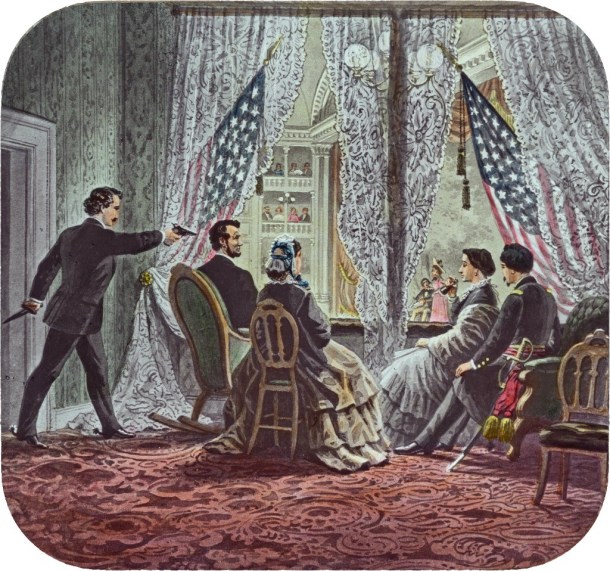
On April 14, 1865, Robert, citing exhaustion, turned down an invitation to join his parents to watch a play at Ford’s Theatre in Washington, D.C. So Robert, then 21 years old, was at the White House when he learned that his father had been shot by John Wilkes Booth. He rushed to the house near the theater where his father had been carried and was there when he died the next morning.
The assassination changed the life of Lucy Hale, who had secretly been Booth’s fiancée. Her father, John, the just-appointed U.S. ambassador to Spain, didn’t much like Booth’s brashness or the fact that he was an actor, which he considered an undignified profession. John Hale thought a more suitable match for his daughter was the president’s eldest son, Robert. She didn’t marry either man. Booth was hunted down and killed days after the assassination and Robert found a different woman to marry.
The assassination devastated Booth’s brother. Widely considered America’s greatest Shakespearean actor of his era, Edwin Booth was ashamed of the new role in which he was cast, brother of the hated assassin. Connection with the assassin killed his acting career, despite the fact that Edwin had been a strong Lincoln supporter. Through hard work, however, he eventually managed to resurrect his career.
Few people knew about other connections between the Booth and Lincoln families. A couple of years before the assassination, Robert Lincoln had been moving between moving train cars when he slipped. A man reached out and grabbed Robert’s coat, saving him from being crushed between the heavy train cars. “That was a narrow escape, Mr. Booth,” said Robert, having immediately recognized his savior, Edwin Booth.
The years following his father’s death were hard on Robert. He moved to Chicago with his mother, Mary, and brother, Tad, to study law. He became a lawyer, married and started a family. But he also saw Tad die from disease at the age of 18 and his mother slip into mental illness. Robert hired Pinkerton detectives to follow her and keep her from harm. They were also to report any odd behavior, like when she asked a waiter to show her the tallest man in the restaurant. Robert sought to have Mary committed to an asylum. When she resisted, an embarrassingly public insanity trial ensued. The court committed Mary, but she later won her release. Not surprisingly, the incident frayed their relationship beyond mending.
In 1877, President Rutherford Hayes asked Robert to be his secretary of state, but he declined. Four years later, however, Robert accepted the post of secretary of war from President James Garfield.
Four months into his term, the president walked with his two sons and Secretary of State James Blaine to the Baltimore & Potomac Railroad Station in Washington. Garfield was heading to his alma mater, Williams College in Massachusetts, to give a speech. As they walked through the station, a gunman stepped out and shot Garfield in the back. Among the witnesses was Robert Todd Lincoln, who was at the station to say farewell to his boss.
Garfield didn’t die immediately. He lingered for more than two months before dying, apparently of an infection brought on by doctors’ probing for the bullet with bare, and not particularly clean, hands.
“How many hours of sorrow I have passed in this town,” Robert lamented to a reporter in the aftermath of the Garfield shooting.

But Robert chose to stay in Washington, serving as secretary of war under Garfield’s successor, Chester Arthur, the Vermont-born (or, according to political rivals, the Canadian-born) politician.
During his tenure as secretary of war, Robert got blood on his own hands, Vowell asserts, having been ultimate responsibility for a botched expedition to the North Pole. Under the auspices of the Department of War, a 25-man scientific research team had started for the pole the same week Garfield was shot. The men established a base at the pole and waited in vain for resupply or rescue. Some historians blame Robert’s lack of interest in the expedition for its inadequate provisioning. The starving men eventually tried to head south. Only six of them survived the journey, which they did by eating some of those who did not. Robert Lincoln and others tried to cover up the cannibalism by claiming that the bodies of the dead had been cut up for bait.
Robert later served as U.S. ambassador to the United Kingdom and then as president of the Pullman Palace Car Company. In that capacity, Robert accepted the invitation of President William McKinley to join him at the Pan-American Exposition in Buffalo on Sept. 6, 1901. Robert’s train was reportedly late that day, pulling into the station just when he was supposed to be at a reception with the president at the Temple of Music.
If Robert had been there, he would have witnessed an anarchist walk up to McKinley and shoot the president twice. (Some versions of the story claim Robert was close enough to the Temple of Music to hear the gunfire.) Vice President Theodore Roosevelt learned of the shooting while at a Vermont Republican Party gathering in Isle La Motte. McKinley died eight days later, making Roosevelt president.
Roosevelt would himself be the victim of an assassination attempt. In 1912, as he was about to give a speech during a campaign event in Milwaukee, Roosevelt was shot in the chest. In true Teddy fashion, Roosevelt insisted on delivering the speech before letting doctors treat him.
Fortunately for Roosevelt, the bullet had passed through a sturdy eyeglass case and a folded copy of the speech. The fact that Roosevelt wore glasses, had written a 50-page-long speech, and hadn’t invited Robert Todd Lincoln to hear it, might have saved his life.
