

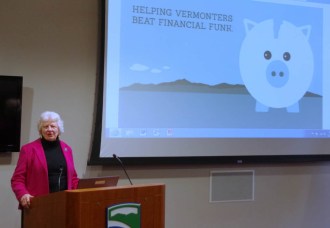
A group of state leaders wants to create a financial literacy commission that would make policy recommendations on issues related to Vermonters’ fiscal well-being.
Several witnesses testified Wednesday before the House Committee on Government Operations in favor of H.393, which would create a statewide financial literacy commission.
The commission would bring together one representative, one senator, an appointee by the governor’s office, an appointee by the treasurer’s office and several members involved in K-12 and higher education.
The group would have limited powers, meet regularly and produce a report for the Legislature every two years. The advantage of having the separate group is that it would be forced to take policy positions, according to John Pelletier, a financial literacy counselor at Champlain College.
Pelletier presented the Vermont Financial Literacy Action Plan to House Government Operations. The plan recommends that the state form a financial literacy commission to find methods to help low-income Vermonters increase savings accounts and other assets, among other things.
“We’re not looking for funding,” Pelletier said. “We’re just looking for a forum to keep this front and center in our mind.”
Pelletier said some high schools and technical schools offer personal finance classes, but the commission could work with the Agency of Education to build financial literacy components into math and social studies curricula.
“Fundamentally, you might say, ‘isn’t this the parents’ job?’” Pelletier said. “The data shows that the parents aren’t any more comfortable with these topics than their kids.”
Parents are as uncomfortable talking to their teenagers about money as talking to them about sex, he said.
State Treasurer Beth Pearce said her office wants to encourage policies that allow adults to have healthy retirement savings and teach adults to increase those savings themselves.
“You’re shooting yourself in the foot when you turn around and don’t have adequate retirement funds,” Pearce said. “[Legislators] should see [retirement] as an economic generator. Those are people who are buying services in their communities, buying goods.”
Lisa Helme, financial literacy and communications coordinator in the treasurer’s office, said forming a commission would help people move past the fear of talking about money.
“Personal finance is not rocket science at any level, but it’s a lot of getting over this idea that ‘Oh, I’m bad at math,’” Helme said.
Chris Delia, president of the Vermont Bankers’ Association, said another goal of financial literacy should be to help young people understand the “unconscionable” interest rates they pay to take out student loans through the federal government.
“As the father of four girls who have all finished college, I can attest to the student loan debt issue, and I can attest to my own debt,” Delia said. “While it’s a tremendous burden to our students, the parent debt is also something that’s growing at a dramatic rate throughout the country.”
Delia asked the committee to add language to the bill to put a banker on the financial literacy commission. Pearce also suggested minor language changes, including a statistical change to the “findings” section.
The financial literacy bill, H.393, did not meet this session’s crossover deadline. Pelletier said advocates planned to work on the bill through the summer and try to pass it in the beginning of 2017 session.
Delia suggested the House tie the language into the House economic development bill, H.124.
