

Editor’s note: Mark Bushnell is a historian and writer who lives in Middlesex.
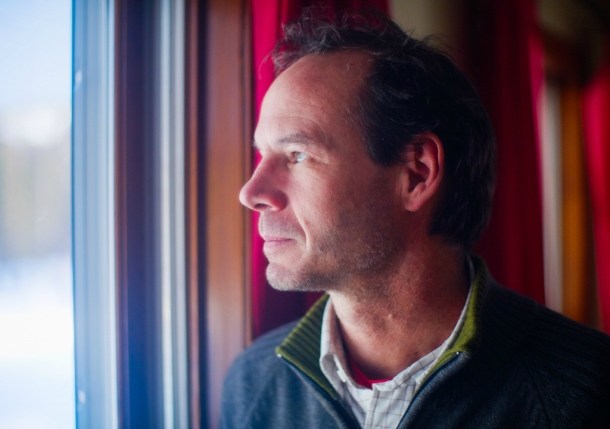
[H]istorian Paul Searls has lately been hearing echoes from the past that still resonate loudly. It happens whenever he hears news that the Vermont Legislature is considering eliminating local school boards and consolidating schools. That’s because the school issue is splitting Vermonters along a social divide that has existed since the state’s founding, he says.
Searls, a professor at Lyndon State College, calls the two sides of the divide “Uphillers” and “Downhillers,” terms he borrowed from historian Robert Shalhope. Searls ran into them years ago while writing his dissertation and found they neatly described the opposing factions he was seeing in his research. He had considered using “city” and “country,” but those designations weren’t as appropriate.
As the terms suggest, Uphillers and Downhillers were originally divided geographically. At their core, however, their differences were not simply based on geography, or education or economics. They were based on values.
The Uphillers arrived in Vermont first and settled hillside farms to be safe from valley floods. After the Revolution, another wave of settlers arrived in the state. These newer arrivals, the Downhillers, tended to be from the professional class — lawyers, merchants, craftspeople and the like — and they settled in the valleys.
The differences between Uphillers and Downhillers were clear from the beginning. In the 1790s, Vermont Congressman Matthew Lyon, a staunch defender of Uphill interests, bemoaned the fact that Downhillers were trying to change how Vermonters governed themselves. Lyon criticized this “new set of gentry who are interested in keeping the government at a distance from, and out of the sight of the people who support it.” Indeed, that is one of the main characteristics that Searls ascribes to Downhillers.
Searls described the differences between Uphillers and Downhillers in his book “Two Vermonts: Geography and Identity, 1865-1910.” Uphillers, he wrote, preferred “localized, informal, (and) cooperative communities,” whereas Downhillers were inclined toward “competitiveness, formality, contractual relationships, and comfort with the concentration of power in increasingly large institutions.”
Because of these natural inclinations, Downhillers prospered as the state shifted from a subsistence economy to a capitalist one.
Downhillers sought to bring to the state what they saw as the benefits of modernity, including industrialization, in order to overcome what they saw as Vermont’s stagnation. Uphillers, however, viewed the status quo in a positive light. They saw it as stability, not stagnation. For this reason, and because they sensed threats to their community values, they resisted Downhillers’ push for change.
The Downhillers’ reform efforts were well intentioned. The problem, Searls notes, is that “when Downhillers don’t know what they want to do, they do something anyway.”
And Downhillers’ actions often involve shifting decisions away from local communities. “The consolidation and centralization of power in Montpelier is as Downhill as it gets,” Searls says.
In the 1840s, Downhillers, acting through the state government, created a three-tiered hierarchy to administer schools, including local overseers, county superintendents and, at the top, a state superintendent. The public balked at the cost of county superintendents, as well as the state superintendent, and argued that education decisions should be made locally. Within a few years, the Legislature eliminated the positions of both the county superintendents and the state superintendent.
During the late 1800s, the state pushed through a consolidation of schools. Before the advent of modern transportation, numerous school districts operated with individual towns. An 1892 law eliminated the small districts and gave towns the responsibility for creating and monitoring educational policy for local schools.
“Downhillers want the state to look like Uphill, but they want Vermonters to be Downhill,” Searls explains.
Vermont saw another wave of school consolidations during the 1960s with the creation of union high schools.
Interestingly, the education commissioners who led the two major consolidation efforts both later questioned the wisdom of those changes. Mason Stone, who had promoted consolidation in the 1890s, went on to lead the successful fight to roll back some of the centralizing reforms. The other, John Holden, who helped create union high schools, sounded like an Uphiller when he later said, “Sometimes I wonder if they brought us what we wanted. … When a school or any other institution gets big, it tends to get impersonal, even sometimes inhumane.”
Differences between Uphillers and Downhillers went far beyond school policy, however. Downhillers managed to push through a statewide ban on the production or sale of alcohol in 1853. The ban stood for nearly 50 years. Uphillers initially opposed the ban, seeing it as a threat to their autonomy. They also worried that a ban made it harder for communities to remain egalitarian, a strong Uphill impulse, because alcohol was a part of events, like military musters and county fairs, which drew a diverse cross-section of the community.
Eventually, Uphillers and Downhillers switched their views. Uphillers came to believe that abstaining from alcohol was a sign of good moral character, while Downhillers pushed to end statewide prohibition in favor of local option, which gave towns the right to decide whether to legalize alcohol within their borders. The Downhillers’ reasons were purely practical: they believed that by lifting the alcohol ban a community could attract tourists and, in keeping with a stereotype of the day, Irish laborers.
Downhillers were also at the heart of other reforms of the 19th and early 20th centuries, Searls says. They pushed for state regulation of hunting and fishing, as well as timber and water use, all of which Uphillers strongly opposed.
The two factions also disagreed over economic matters. Downhillers looked at the condition of Uphill communities and decided the state was suffering through a period of malaise. Their remedy was to promote the state as a tourist destination, starting in the late 1800s. But Downhillers recognized that the state’s charm was its very backwardness, Searls says, so they advertised Vermont as a pre-modern society, while simultaneously attempting to modernize it. Searls sees those contradictory impulses still at work today. “Downhillers want the state to look like Uphill, but they want Vermonters to be Downhill,” he explains.
Downhillers’ efforts to change Uphill society continued in the 20th century. In the 1930s, the governor, commissioner of agriculture and several major newspapers supported a federal government effort to move 13,000 Vermonters off farmland it deemed “submarginal.” Supporters of the plan argued that these farms would inevitably be abandoned anyway. Speaker of the House George Aiken, who was supportive of Uphill interests, responded that the federal government should put that effort into rejuvenating those communities, rather than dismantling them. The state Legislature, which was then dominated by lawmakers from small towns, defeated the plan.
Downhillers also organized the Vermont Commission on Country Life, a private group that aimed to improve the condition of Vermont’s purportedly declining rural communities. Among the commission’s recommendations were improvements in education, promotion of tourism, and preservation of the state’s natural beauty. Though it was billed as a way to help rural communities, the commission offered little economic help to farmers.
The commission grew out of the Eugenics Survey, which produced the most extreme example of Downhill overreach. The Eugenics Survey, which was directed by Henry Perkins, a University of Vermont zoology professor, aimed to use the “science of human breeding” to alleviate the supposed problem of “degeneracy” in the state. The committee wrote that it was the “patriotic duty of every normal couple” to have enough children to maintain the quality of the “‘good old Vermont stock.’” Survey organizers identified groups of Vermonters that they labeled as “degenerate,” a trait he identified in many French-Canadians and Abenaki families — in other words, groups that didn’t fit the Yankee mold of Vermont’s leading settler families.
The state Legislature, at Perkins’ urging, approved a law making it legal to sterilize the handicapped and “feeble-minded.” The law drew the backing of the state education commissioner, the state public welfare commissioner, and the president of UVM. It wasn’t repealed until 1981.
Another Downhill initiative began in the late 1950s, when state agriculture officials and dairy cooperative creamery executives pushed farmers to use bulk tanks to cool their milk. The idea was to ensure that milk remained healthy, and to improve its marketability. Eventually, creameries refused to take milk from farmers who didn’t own bulk tanks. The bulk tank requirement changed rural communities across Vermont by forcing many small farmers, who couldn’t afford the sizable investment, out of business.
“Uphillers have every reason to be suspicious of any innovation that comes from Downhillers,” Searls says, “because they have been burned so many times.”
Yet he says it’s important not to caricature either side: “It’s not that all Downhillers want to remove decision making from people and Uphillers want to live like their grandfathers.”
Ultimately, he hopes the state will find a way forward that is in keeping with Vermont’s motto. Since its founding, the state has sought to balance “Freedom and Unity.”
In everyday life, those words embody people’s twin urges: “You want to be free, but you want to be in a community of people who take care of each other,” Searls says.
“Life is about showing that this isn’t a zero-sum game. We can have both. We can have tradition and progress, preservation and development, city and country.”
And Uphill and Downhill.
