

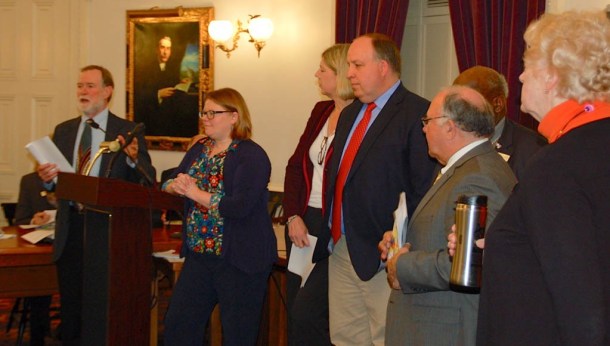
[T]he architects of education governance reform legislation met with Democratic and Republican caucuses Tuesday on the eve of a House floor vote on one of the session’s major bills.
The House Education Committee fielded questions about provisions in the bill, including the spending cap, restriction on state education dollars going out of state and how small towns with high taxes will fare under the law.
H.361 seeks to reduce the nearly 300 school districts in Vermont into fewer, larger school systems in an effort to find cost efficiencies and improve educational opportunities for the state’s public school students.
The Legislature made reform a priority this session because of growing voter discontent with rising education costs, increased property taxes and a continued decline in student enrollment.
“This bill is not about closing small schools,” it is designed to help small schools become part of larger systems, said Rep. Emily Long, D-Newfane, a member of the House Education Committee and the president of the Vermont School Boards Association’s board.
Long said the bill creates more supports for small schools that join larger systems. It also makes exceptions for small schools that have adequate student to staff ratios, meet quality standards or qualify for geographic reasons.
Vermont has lost more than 21,000 students since 1997, but staffing levels have shrunk only slightly, while education spending and property taxes continue to rise.
H.361 includes carrots and sticks that lawmakers believe will push school districts into much larger pre-K-12 systems of 1,100 pupils. School districts that do not move forward with merger agreements will need permission from the State Board of Education.
Rep. Cynthia Browning, D-Arlington, objects to that provision. She appeared before the House Education Committee on Tuesday morning to discuss two amendments to H.361 she will present from the floor Wednesday.
One of Browning’s amendments relates to making the merger step voluntary.
“If you reject this amendment, you are saying that Montpelier knows best,” Browning said.
Spending cap draws questions
Rep. Sarah Buxton, D-Tunbridge, said the bill’s controversial per pupil spending cap is designed to hold down school spending.
An amendment to the bill’s initial 2 percent cap will offer a variable component that would allow school districts to apply the cap to either the prior year’s budget or equalized per pupil spending.
The formula rewards districts that spend below the statewide average. Districts that spend more than average will face a lower budget cap under the proposal, Buxton said.
School districts can also increase student to staff ratios as a means of meeting the cap.
Rep. David Sharpe, D-Bristol, said Vermont has the nation’s lowest staff-to-student ratio, 4.67 to 1. “It’s incredibly low,” he said. “That is where the money is.”
Members of the House Education Committee have characterized the spending cap as a temporary measure that would no longer be required once districts form larger school systems by 2020.
Rep. Laura Sibilia, I-West Dover, advised the committee on Tuesday that she plans to introduce an amendment to strike the caps.
Statewide view
“What this committee is asking you to do is think about all the students of this state and what is best for those students, and not be as parochial as we would like to be,” Sharpe told the caucuses.
He predicted that if lawmakers don’t act, “genuine tax revolt of our citizens” could result, and that small schools would be forced to close out of “sheer economics.”
“It’s not a perfect bill, but we ask for your support,” Sharpe said at the end of the Democratic caucus.
