

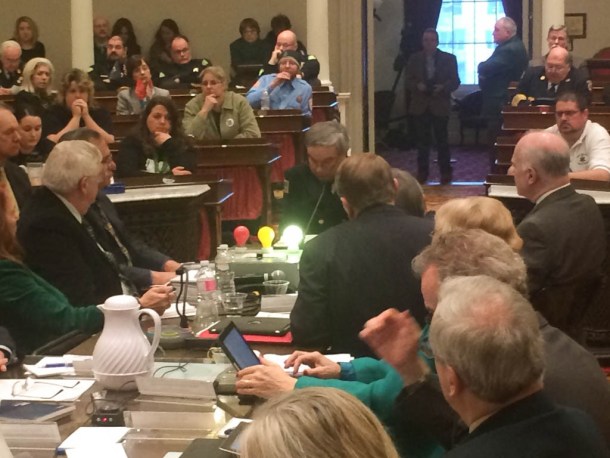
About 100 opponents of the Shumlin administration’s plan to close state police call centers in two rural areas voiced their displeasure at a public hearing Tuesday evening in Montpelier.
The group, which included many Public Safety Answering Point (PSAP) workers, told a joint hearing by the House and Senate Government Operations committees that the plan compromises public safety.
The Vermont Department of Public Safety intends to consolidate two PSAPs in Derby and Rutland Town into operations in Williston and Rockingham, respectively, as part of Gov. Peter Shumlin’s budget proposal.
The move would cut the number of full-time PSAP employees statewide from 71 to 57. The workers handle the majority of emergency 911 calls in the state, paid for in part through a universal service fee on phone bills. The centers also field regular business calls for the Vermont State Police.
The other four PSAPs in Vermont handling 911 calls are quasi-private: the Lamoille County Sheriff’s Department, the St. Albans Police Department, the Hartford Police Department and the Shelburne Police Department.
Witnesses who spoke Tuesday said the plan would add to the workload at the other centers and likely increase the amount of overtime paid.
Joe Colangelo, the town manager in Shelburne, testified Tuesday that the consolidation plan would increase rollover calls to the Shelburne Police Department’s local PSAP.
Colangelo said the local PSAP serves callers from Brighton when the Derby PSAP is overloaded, and the department “must rely on the knowledge of local dispatchers.”
“We strongly believe the state has an obligation to increase its compensation to us should the consolidation go through,” Colangelo said.
In an interview Monday, Public Safety Commissioner Keith Flynn stuck by the plan that he says would save $1.7 million through more efficient scheduling and operations. Flynn defends closing the two centers as a difficult decision that will “get the maximum return on the dollar.”
“This was a business decision that I made and not a political decision,” Flynn said. “From a business perspective, as the commissioner, this is a decision that makes sense.”
Of the $1.7 million in projected savings, most of the money, $1.05 million, would come from eliminating positions, according to a presentation Flynn and the PSAP consolidation team presented in February to the House Appropriations Committee. Another $114,701 would come from overtime savings; $256,394 would come from “scheduling efficiency”; and $281,748 would be from operational costs.
Under the plan, Williston and Rockingham would have 16 hours of uncovered shifts, which could go to temporary workers who make $17 per hour, but must be offered first to union workers, often making upward of $20 per hour, because of contract stipulations.
The department is currently paying for 230 overtime hours per week, including some that are built into the schedule, according to Flynn’s presentation. There are 64 overtime hours per week in Williston, 56 in Derby, 52 in Rutland Town, and about 58 in Rockingham.
‘More dispatchers, not less’
At the Tuesday hearing, Rep. Donna Sweaney, D-Windsor, asked witnesses to advise the two committees on how to consolidate the PSAPs in the best way possible. But all of the witnesses, who included workers, were vehemently opposed to the plan.
Rutland Town dispatcher Melissa Sharkis testified against the decrease in scheduled hours. “You can’t create a schedule based on our lowest level of activity,” Sharkis said.
Sharkis added that in the past five years their open positions have barely been filled. Janeea Choiniere, another dispatcher, testified that in those five years, 17 people have started the six-month training program in Rutland Town, eight required extra time, and seven out of the whole pool of 17 ended up finishing.
Sam Trombino, a dispatcher in Williston, said the consolidation would require up to 2,000 overtime hours.
“We don’t need less dispatchers — we need more,” Trombino said.
Trombino said he estimated the number based on eight positions moving to Williston, where he said there are three open positions, and multiplied the 40-hour-per-week jobs by 4.3 weeks.
Flynn said Monday that opponents to the plan are only counting overtime hours at some PSAPs, not analyzing the overtime hours at all four in the state.
Process criticized
Rep. Loren Shaw, R-Derby, called the situation “horrible” in an interview Monday, and said the process left his constituents voiceless because the plan wasn’t brought to committees before Shumlin announced it.
“I’ve never witnessed anything like this, and I’ve been here since 2001,” Shaw said Monday. “The governor really got beat up here [in the November election], and he really got beat up in Rutland, and I just hope it’s not revenge.”
Shaw said he is having trouble getting through to Shumlin’s administration to talk about his concerns. “It appears that it’s in stone, and it’s in concrete,” Shaw said.
The governor’s spokesman, Scott Coriell, said Tuesday that insinuating that the decision to consolidate was in any way politically motivated is “insulting.”
David Tucker, executive director of the state’s Enhanced 911 board, said Monday his board was not involved in the decision, but he doesn’t expect it to hamper the ability of E911 to answer emergency calls.
“I first learned of the plan an hour before Gov. Shumlin’s budget address,” Tucker said. “Our concern with this has primarily been the lack of involvement in the decision.”
Tucker said the state is transitioning from a 911 system run by Entrado to a $11.2 million contract with FairPoint.
FairPoint spent $108,000 running fiber-optic cable from central offices to the PSAPs in Derby and Rutland Town before the consolidation was announced.
Duncan Kilmartin, a former Republican state representative from Newport, called the consolidation plan “pure political skullduggery.”
“They have the highest rate of turnover in the state,” Kilmartin said of the Williston PSAP. “Why? Because you can’t afford to make those wages and live in Chittenden County.”
Kilmartin said the best-case-scenario for workers at the Williston PSAP is for the state to move the workers to Derby. He said the cost of living in the Northeast Kingdom is half of what it costs to live in Burlington.
The political issue was a hot topic at a March 9 legislative breakfast in the Northeast Kingdom.
Derby’s shortcomings
Flynn said Tuesday that the PSAP in Derby is not large enough to accommodate new workers from Williston, and adequate technology isn’t available there.
Terry LaValley, who is on the PSAP consolidation team, said the Williston PSAP has “redundant technology” that can serve as a backup in case of an emergency. LaValley also said the location has a better phone system, while Derby has an old, analog system.
Capt. Donald Patch, who has been the project manager for the PSAP consolidation since December, estimated that the office in Derby is less than 900 square feet, and the office in Williston is closer to 1,750 square feet.
Additionally, Patch said consolidating the Rutland Town PSAP into Rockingham will make it easier to move the Rockingham office to Westminster once the state breaks ground on the new state police barracks this spring.
Shumlin said in a news conference last week that his team’s proposal for two PSAPs is an improvement an Federal Communications Commission proposal for have just one PSAP in each state.
The New Hampshire example
Bruce Cheney, director of the New Hampshire Division of Emergency Services and Communication, said the state has two PSAPs that only answer 911 calls, and about 76 local dispatch centers throughout the state.
Cheney said the workers in the two PSAPs in Laconia and Concord answer 911 calls and delegate dispatching to the local call centers. The two PSAPs are 40 miles apart, he said, but “electronically the same room.”
New Hampshire used to have 108 local dispatching centers, and local jurisdictions voluntarily consolidated down to 76, Cheney said.
“In my view, I would tell you that you should have two in case one goes down, and more than two is a political question,” Cheney said. “The only other state that has a single PSAP is Rhode Island.”
The Federal Communications Commission has created a task force to study the optimal number of PSAPs each state should have, given the benefits of added technology and the threat of cyberterrorism.
