

Lawmakers want to lower an already controversial cap on school spending by an additional half a percent.
H.361, the House Education Committee’s “big bill” on public school reform, would put a 2 percent limit on school district increases in equalized per pupil spending rates.
Legislators in two key House committees are now looking at a 1.5 percent cap on the per pupil rate or a 1.5 percent cap on increases in overall school spending.
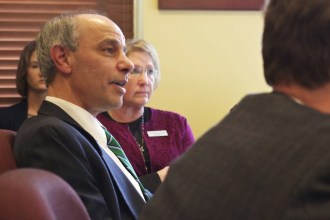
Rep. Adam Greshin, I-Warren, a member of House Ways and Means, said the two options would give school districts greater flexibility.
“The amendment to the 2 percent cap was a per pupil spending cap that worked for some districts better than it worked for others,” said Greshin. “The new cap that we devised, 1.5 percent, essentially gives districts two choices: They can use an overall 1.5 percent education spending cap, take whatever they were spending this year, increase it by 1.5 percent and that’s your cap, or they can do it as a per-pupil cap, so there’s a choice involved.”
The cap would sunset after three years.
Rep. Kurt Wright, R-Burlington, describes the lower cap as “a bridge” to help control rising education spending until larger school systems can be established in 2020. H.361 aims to consolidate the state’s 300 school districts into larger regional districts of at least 1,100 students.
Mark Perrault, senior fiscal analyst for the Joint Fiscal Office, said that under the proposal, districts would be able to choose which cap better fit local circumstances.
Legislators are considering the proposed caps on spending as a way to mitigate spiraling property tax rates.
“There’s no way to control the growth in property taxes without controlling the growth in education spending,” Greshin said. “We simply have no choice but to control the growth in education spending. This is one method of doing that.”
Student enrollments in Vermont have declined by more than 21,000 since 1997, but costs for education spending and property tax increases to pay for schools have continued to rise.
Lawmakers said last year’s defeat of more than three dozen school budgets across the state was an indication that it was time to move forward with education governance and funding legislation.
Meeting the cap will be difficult for many schools that are faced with contract negotiated increases in labor and health insurance costs, Greshin said.
“It is challenging, we acknowledge that, but we also acknowledge that our constituents are asking for relief from the grinding, steady increases in property taxes and so we are trying to both listen to our constituents and work with the school districts,” he said.
The lower cap drew more criticism from education groups on Friday.
Darren Allen, spokesman for the Vermont-National Education Association, said spending caps undermine local control.
“We cannot be more clear,” Allen said. “A Montpelier-imposed limit on what local Vermont communities can spend on their children’s education is harmful and unacceptable. This cap proposal — which is even more draconian than the one it would replace — would basically nullify decisions made by local school boards and local voters. Hard caps on what local voters can spend on their children — even with an ‘appeals process’ (which the language contains) that rips final authority on local spending from local voters to an appointed bureaucrat — are wrong and remain a non-starter for us.”
Jeffrey Francis, executive director of the Vermont Superintendents Association, also expressed frustration. “I don’t think that these modifications do anything to negate all of the legitimate opposition to caps as a mechanism to address the cost of education,” he said. “It is like trying to put a fine point on a blunt instrument.”
Rebecca Holcombe, secretary of the Agency of Education, said nearly 150 school budgets that passed this year at town meeting would have been higher than the 2 percent cutoff.
Holcombe said unfunded state mandates, including universal pre-kindergarten programs, will make the cap very difficult for schools to meet.
Wright asked Holcombe if the state should consider postponing the universal pre-K requirement. Holcombe said the agency does not recommend stopping the rollout of the program, which is underway.
Mark Perrault, senior fiscal analyst for the Joint Fiscal Office, said a range of districts would be affected by the 1.5 percent cap.
“When I ranked the districts that would have exceeded the cap, it was a mixture of really large and really small districts,” said Perrault.
Rep. Emily Long, D-Newfane, a longtime school board member and a freshman legislator, said she was concerned the cap — which she opposes — would hurt small schools the most. She said the cap suggests that spending problems are all local, and she cited the many unfunded mandates passed on to schools.
“It can really be a huge problem for a school district when they’re capped,” said Long. “I’m still believing it’s smaller school districts that are going to feel that … (and) instead of a 2 or 3 (percent cap), now we’re down to 1.5. Every time I see this, it’s a little lower.”
Schools will likely defer maintenance and cut school programs to come under the cap, she said.
Rep. Sarah Buxton, D-Tunbridge, said the cap is a painful mechanism, but the Legislature needs to send a signal to school districts that steps must be taken to lower spending.
“Those conversations need to happen,” Buxton said.
Wright agreed, saying the hope is it will “nudge the direction.”
Rep. Bernie Juskiewicz, R-Cambridge, vice chair of the House Education Committee, suggested language that would call on schools to evaluate staff- and teacher-to-student ratios and personnel costs as they seek to meet the restrictions imposed by the cap.
The House Education Committee will take up the spending cap again this week. Once an amendment is agreed to, it will be presented by Wright on the floor of the House.
See the Joint Fiscal Office chart here.
