


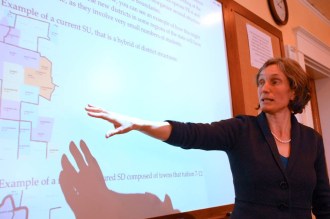
[E]ducation Secretary Rebecca Holcombe says one provision of the Legislature’s school governance reform bill gives her more authority than she wants.
H.361, which was passed by the House Education Committee, would rearrange the state’s more than 290 school districts into larger Pre-K-12 systems by 2020. If districts are unable to merge, the bill charges the secretary with finding a solution.
Holcombe suggested the State Board of Education should help districts with mergers.
“Governance is serious business,” Holcombe said. “The authority to assign schools should not be done by one person. It should be done in an open, public, transparent process where the boards have a right to appeal.”
Vermont is facing ongoing and significant losses of public school students — more than 21,000 pupils since 1997 — at a time when education spending and property taxes to support schools continue to rise.
The Legislature this session is working on school reforms that address rising costs and unequal educational opportunities for the state’s public schools.
Districts would be required under H.361 to enter into studies with neighboring districts to form larger school systems, which will need to be made up of a minimum of 1,100 pupils.
Only 15 districts in Vermont have more than 1,000 pupils, Holcombe said in testimony on H.361.
Holcombe acknowledged that reaching the 1,100 student threshold would be difficult for some districts.
“While many systems could transition smoothly to a new, larger unit, a minority of districts will struggle to find like districts,” she said. “These are the districts for whom a different solution will be necessary, and the state board could play a role to facilitate good options.”
Rep. Patti Komline, R-Dorset, asked if the governor’s proposal on education change had any real cost-containment provisions.
The phase out of small school grants and phantom student subsidies, outlined in H.361, will force school districts with declining student populations to think more carefully about how spending decisions affect local taxpayers, Holcombe said.
Rep. Alison Clarkson, D-Woodstock, asked if the state is aligning costs with the declining student population.
Holcombe said as a result of declining enrollments, many districts are offering fewer programs for students at a higher cost.
“At some point, we have to decide if we’re living in too big a building,” said Holcombe. She likened the small school district problem to empty nesters who have seen children fledge, only to face a house that is too big and a mortgage.
“In terms of cost containment, our experience is that when you free up resources, there’s no question the consolidation literature is clear …,” the optimal number for a school system is around 1,500. “My question is how do we help them achieve what they want to achieve but at a lower cost impact to the state,” she said.
Savings from merged districts can be reinvested to give more educational opportunities for students, Holcombe said.
“Being part of a bigger system, you can afford to hire more depth and more breadth of teachers,” Holcombe said.
She said the changes will require people to look beyond their town boundaries to define a new sense of community.
“It’s going to be a tough lift,” said Rep. Jim Condon, D-Colchester. “People don’t want to look beyond their borders; they really don’t.”
The House Ed’s 2 percent per-pupil spending cap proposal is too restrictive, she said.
“If there was a 2 percent cap in place, only 106 of current year budgets [passed last week at Town Meeting — 246 total passed, 20 were rejected] would have made it under the cap, while 149 would have been capped,” she said.
Next year state-mandated universal pre-kindergarten programs will add to local school budgets, making that cap extremely difficult to achieve.
Rep. Janet Ancel, D-Calais, said the House Education Committee will revisit the spending cap, which has drawn criticism.
