

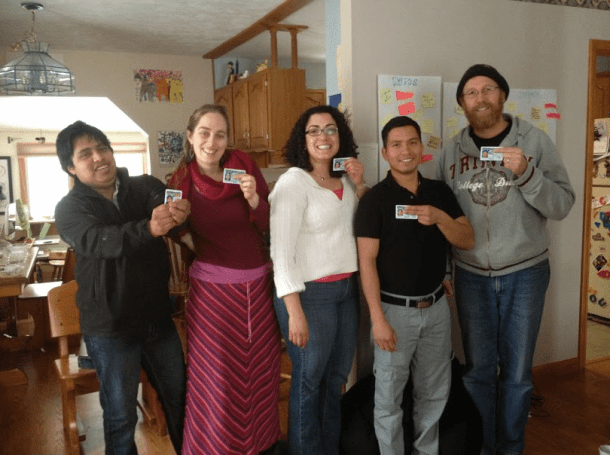
More than a year after driver’s privilege cards rolled out, the new Department of Motor Vehicles system has left many Vermonters unsure of the difference between driver’s licenses and privilege cards.
The form of identification intended to extend driving rights to migrant workers has been issued to more than 40,000 Vermonters — considerably more than state’s estimated 1,500 migrant population the cards were designed to serve.
About one in five Vermonters who have gotten or renewed driver’s licenses since January 2014 have opted for the privilege card, sometimes without understanding the difference between a privilege card and a REAL ID license.
Marked by a white star in a gold circle in the upper right corner, REAL ID came out of a recommendation by the 9/11 Commission to set nationwide regulations in an effort to improve the reliability of state-issued identification across the country.
Vermont’s REAL ID licenses were rolled out concurrently with the driver’s privilege cards at the start of 2014. One month after the new system took effect, only about 58 percent of the IDs that had been issued were REAL ID compliant.
“A lot of it was lack of people understanding what it is that we are asking for,” said Mike Smith, director of operations for the DMV.
In order to obtain a REAL ID, Vermonters need to give the DMV a specific set of documents, including a passport, a Social Security card and two documents with a Vermont address, as proof of residency. Several different types of licenses, including driver’s licenses and enhanced licenses, meet REAL ID standards.
Privilege cards require a lower threshold of identification, so if someone showed up unprepared to get a REAL ID, they could still walk out of the DMV with an ID card that would get the job done.
Eventually, Smith said, Department of Homeland Security regulations will make REAL ID a more vital form of identification. The ID will be necessary to get into federal sites, ranging from nuclear facilities to the upper floors of the federal building that houses Montpelier’s post office. At some point after 2016, DHS will require REAL ID to board an airplane.
In the year since the new license system took effect, the distribution has settled down so that about 80 percent of IDs issued by the DMV are REAL IDs.
“Do we make people (get them)? No,” Smith said. “Do we encourage them? Kind of.”
Meanwhile, the ease of getting a driver’s privilege card has raised some concerns. An investigative team that examined fraudulent applications has found 130 confirmed cases of fraud, according to Capt. Drew Bloom, chief inspector for the DMV.
Bloom stressed that each fraudulent case is handled individually. Applications could be flagged for a number of reasons, from using variations on names to providing two pieces of mail addressed in the same handwriting.
The privilege cards are meant to be accessible to people who are not in the United States legally, but applicants do need to be Vermont residents.
Most of the suspicious applications are in the southern part of the state, Bloom said, with many fraudulent applicants coming from outside Vermont.
According to Sen. Philip Baruth, D-Chittenden, a sponsor of the legislation behind the privilege cards, they were never intended to be so widespread.
Baruth set out to extend driving rights to migrant workers who don’t have legal status in the United States. With more mobility, farm workers would have better access to health care and more independence.
In the implementation, the privilege card became the fallback option when Vermonters showed up at the DMV without proper documentation for a REAL ID driver’s license.
“In a way it was, on the administration’s part, a very gentle form of a push to get REAL ID cards,” Baruth said.
The Legislature has expressed reservations about REAL ID in the past — in 2007, the House passed a resolution objecting to the system. From Baruth’s perspective, the statistics are not significant for showing how many Vermonters have not signed up for REAL ID.
“It’s, ‘look how small that percentage is considering that originally so many people in so many states were opposed to the concept of what they thought of as national ID,’” Baruth said.
According to Sue Minter, secretary of the Agency of Transportation, the administration did not intend to link the privilege cards with the REAL IDs, but the timing of the rollout made privilege cards the de facto option for people who do not want a REAL ID compliant card.
Although it was not intended, the rollout does help Vermonters to be better prepared when federal identification regulations change.
“There may well be a time when we are required and our citizens are required to be REAL ID compliant,” Minter said.
Allen Gilbert of the American Civil Liberties Union said his office often fields calls from Vermonters confused about the difference between the forms of identification.
“A lot of Vermonters remain concerned about the REAL ID license and that’s why many people are ending up not with the REAL ID but with the driver’s privilege card,” Gilbert said.
Many Vermonters, he said, are not aware that they have a choice between the two DMV documents. Gilbert raised concerns about the security of the various ID information needed to obtain a REAL ID card. It’s part of why he plans to get a driver’s privilege card.
“I’m not particularly interested in having all my identifying documents housed with a department where all they’re supposed to do is give me a license saying I’m capable of driving,” Gilbert said.
Migrant Justice, a Burlington-based organization that works with Vermont’s farm workers, was very active in campaigning for the driver’s privilege cards. Brendan O’Neill said that the enrollment of Vermonters outside the community they represent in the program was important to them.
“It was very important to us during this campaign that the card not be exclusive, just for migrant workers,” O’Neill said.
