


Jon Margolis is VTDigger’s political columist.
[M]ore than three-quarters of Vermont’s registered voters think the Legislature should pass a law ensuring that everybody who buys a gun (except from a family member) should undergo a criminal background check.
Last week a Senate committee killed a bill which would have done just that.
In a democracy, so the saying goes, the majority rules. Here the majority just got clobbered.
True, members of the Senate Judiciary Committee had not seen the results of the latest VTDigger/Castleton Polling Institute survey when they rejected the portion of S.31 that would “require that a criminal background check be conducted on the proposed purchaser before a firearm may be sold,” with just a few exceptions.
See the full poll results here.
So they didn’t know for sure that 77 percent of the poll respondents were in favor of the provision they scuttled. That’s about as big a majority as any position gets these days.
But the committee members couldn’t have been surprised. Polls had been showing similar results for years. Yet the bill couldn’t even got to the Senate floor for a vote. What kind of democracy is this anyway?
Perhaps precisely the kind it is supposed to be, at least as envisioned by the guys who created it in Philadelphia 226 years ago and their Vermont counterparts a few years later (or earlier, but that’s a detail that need not be dealt with here).
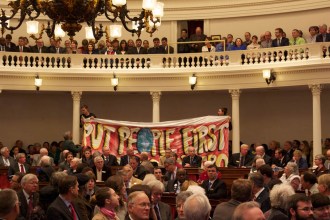
Not that the polls are useless. This one proved that the orange-clad gun owners who demonstrated against S.31 on Feb. 11 represent no more than 20 percent of the public. And the crowd that disrupted Gov. Peter Shumlin’s inauguration in January to protest his decision to abandon his single-payer health care plan don’t represent much more. Only 25 percent of the poll respondents disagreed with his decision.
On Tuesday, some Vermonters will gather to participate in one of the few remaining rituals of direct democracy, or “Real Democracy” as described by former University of Vermont political science professor Frank Bryan in the title of his book about Vermont’s town meeting.
That’s a plebiscite, in which all the people (or all who show up) adopt budgets, allocate spending and pass local laws by direct vote. It’s a Vermont tradition.
But town meeting is an anomaly in most of the country, and even in Vermont, above the town and school district level. In most places, budgets are adopted, spending is allocated and laws are passed by the elected representatives of the people, not by the people themselves. The people are the ultimate sovereign, but they do not do the day-to-day work of governing.
That’s another things polls aren’t good at, and plebiscites wouldn’t be, either. They give respondents or voters two choices – yes or no, approve or disapprove. Legislatures can choose a middle ground, or another alternative.
That’s the system, and it has given rise to a claim that the United States was designed to be a republic, not a democracy at all. As claims go, this does not rise to the level of silliness. A republic, according to the dictionary (Merriam Webster in this case), is a society “governed by elected representatives and by an elected leader.”
Or a democracy as it is sometimes known, even if not one run by perpetual plebiscites, and one with constitutional protections. So even if 77 percent of Vermonters thought folks who express certain outrageous positions should be thrown in the clink, the Legislature could not pass a bill gratifying their wish, at least not one that could survive a legal challenge.
And in addition to the horror of living in a land of perpetual plebiscites, there is a good case to be made for representative – as opposed to direct (or even “Real”) — democracy. Consider another result of the VTD/CPI poll, this one showing that 57 percent of Vermonters think the Legislature should enact “an additional tax on sugary drinks to support health care for low-income Vermonters.”
Forget for a minute whether this is good policy. Think instead of how polling works.
Out of the blue, a person is called by a pollster asking his or her position on an issue. It may be an issue the person has barely thought about. Now she’s thinking about it, but probably in isolation. In isolation, it sounds like a good idea. Who’s against better health care for low-income Vermonters? And most people don’t drink so much sugary soda that they’d notice the higher tax.
But of course the proposal does not exist in isolation. The tax would have repercussions, some desirable and some not. That’s why it’s a good idea for it to go through the legislatives process. The bill goes to a committee, whose members consult experts, take testimony, ponder the pros and cons. They would take into account whether the higher tax would hurt convenience stores near the border of states with lower taxes. They would also examine whether the evidence supports the assumption that the tax would reduce obesity (another benefit touted by supporters, though not mentioned in the poll).
The evidence seems unconvincing. The generally liberal physicians/economists at “The Incidental Economist” website are dubious, citing studies which conclude that “the effectiveness of a taxation policy to curb obesity is doubtful.”
Not because the tax would not reduce consumption of the drinks. Markets work. But the sugar-craving fellow who cuts down on colas might just scarf down more donuts. Price increases, according to this study, “may lead to a reduction in consumption of the targeted products, but the subsequent effect on caloric intake may be much smaller.”
Or take the poll result showing a 60 percent majority opposed to eliminating the small schools grant. Assuming for the moment that most respondents knew what the small schools grant is, this response, too, was without context, including the context that subsidizing all those small schools might be raising everybody’s taxes.
Studying the matter in context, the Legislature seems on the road to reducing the small schools grant, though not eliminating it. That’s another things polls aren’t good at, and plebiscites wouldn’t be, either. They give respondents or voters two choices – yes or no, approve or disapprove. Legislatures can choose a middle ground, or another alternative.
The Legislature, to be surer, is an elite, so to suggest that it sets public policy better than the folks at large is to invite the charge of elitism.
But that’s the system the Founding Fathers established. Elite white men themselves, they feared the fleeting passions of the majority. So they established a far more elitist version of democracy than Americans would now tolerate. The Founders had U.S. senators elected by state legislatures, and they really thought that this Electoral College thing they invented meant that presidents would be chosen by a handful of elite gentlemen, not the public at large. Nobody’s perfect.
Still, 77 percent is a huge majority. And this one seems no fleeting passion. A Castleton poll two years ago found comparable majorities in favor of various gun control measures (the questions were not exactly the same as this year’s). Furthermore, Vermont isn’t all that different from the rest of the country, and the last nationwide poll on the subject (by Quinnipiac University last summer) found overwhelming support for requiring background checks.
This does not prove that the Legislature ought to enact S.31. It does raise the question of whether even James Madison, father of the Constitution, leading foe of “the turbulency and weakness of unruly passions,” might think that by not even letting the measure out of committee the lawmakers were ignoring the will of the people.
