

Tropical Storm Irene and the destruction it wrought in Vermont have now been history for about three and a half years – or, roughly, about the length of time it takes to execute a well-thought-out plan to create new architecture and replace what was swept away. How fitting, therefore, that prominent in the latest Vermont architecture competition were two direct responses to the statewide flood of August 2011.
When the Vermont chapter of the American Institute of Architects (AIAvt) announced its 2014 excellence awards at the Statehouse in December, a mere apartment – and a somewhat prosaic one at that – was, surprisingly, among the honorees. But, in a way, it was the invisibility of the architecture that enabled Joseph Cincotta to claim the award on behalf of his small firm, LineSync Architecture of Wilmington.
If you want an apartment that overlooks the Deerfield River in a fine old building in that picturesque Windham County town, this two-bedroom flat is the place for you – provided that you don’t mind living in the only apartment in town that is actually below street level. When Irene was at her worst, the apartment was completely submerged. When the waters receded, the apartment was ruined.
After the flood, the owner of the building turned to Cincotta and his spouse, LineSync co-principal Julie Lineberger, and told them he wanted to have the first apartment in Wilmington to be ready for reoccupancy after the next 100-year flood. Cincotta and Lineberger appear to have hit the high water mark.

According to Cincotta, the seven windows, which ordinarily admit copious amounts of light, can be unscrewed, snapped out of their frames and carted away in a mere half hour. Notably, every other bit of material used in the project, from the ceiling to the gravel and drain system that underly the floor, is designed to withstand an Irene-magnitude deluge. The architects and their clients figure it won’t be another century before the next 100-year flood happens.
Corrugated metal, dyed concrete, closed-cell foam, and thin-set tile adhesive are prosaic materials not calculated to land the project on the cover of Architectural Record. And some might even say that the shiny corrugated metal panels, which are pretty much everywhere in the apartment, make for an oddball living environment. That aside, soft-spoken design has virtues that make this project worthy of recognition in a state that must strive to provide reasonably affordable housing in places where people actually want to live, including downtowns subject to flooding.
When the next tropical event inundates Wilmington, don’t look for the occupants of this apartment to be toting their kitchen appliances on their backs. LineSync has not figured out how to make these things portable, so the flood will claim them. But in every other respect, this project is worthy of its title – the Resilient River Apartment. Everybody talks about resilience these days – it’s the buzziest of buzzwords – but, here, Cincotta and Lineberger have truly achieved it.
Some 100 miles to the north is an entirely different sort of response to Tropical Storm Irene. High above Barre (and thus well protected from floods) is the new Vermont Psychiatric Care Hospital (VPCH), the impetus for which was Irene’s tragic ruination of the Vermont State Hospital in Waterbury.
Opened last summer and designed by two collaborating architecture firms – Black River Design in Montpelier and architecture+, a firm based in Troy, New York, with special expertise in hospital design – the hospital can plausibly be described as a series of minor architectural miracles.
First miracle: This is a $23 million project that was completed within its budget, a memorable feat for any building commissioned by an instrumentality of government. The entire process, from the day the architects started drawing to the day the first patient arrived, took just two years. The mission was an urgent one, given that Irene had claimed the previous facility and inpatient mental health care is a vital commodity.
It is true that the architects and their client – the Vermont Department of Mental Health – had something of a headstart. Black River Design and architecture+ had already teamed up to design a larger facility that the Douglas administration had planned for the old Vermont State Hospital, which the Shumlin administration scrapped. The design team stayed put and got to work.
Another miracle? The windows work. All of them can be opened. This was no simple achievement for a building that is, alas, much like a prison. Among those living at the 25-bed facility are plenty of people who, but for their psychiatric diagnosis, would be doing time. Others, though guilty of no crime, have been adjudged a danger to themselves or others.
The operable windows were a must-have for the Department of Mental Health, which wanted the new facility to be, in every respect, a place of recovery and comfort. Acquiring suitably safe fenestration in these circumstances required the use of a manufacturer in the U.K.
Miracle No. 3 becomes obvious just by driving down Fisher Road in Barre to take a look at the place. The Vermont Psychiatric Care Hospital is right there, plain as day and visible from the street – partially clad in brick, partially in board and batten, configured in a pleasantly contemporary style that one typically associates with elementary schools. In other words, the place is not hidden in the woods, or ensconced behind some big fence, or otherwise situated so that the outside world never need consider what Vermont does with some of its most vulnerable and troubled citizens. Architects and clients even opted to put the sally port – the ultra-secure portal via which patients arrive, often in restraints – front and center in the building, to make the point visually that obtaining care at the state’s psychiatric hospital is not a shameful act.
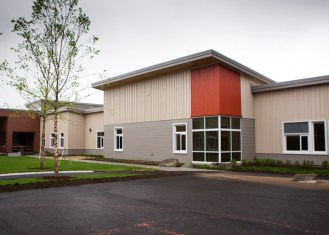
Architect Jim Drummond, the Black River Design principal who led his firm’s work on the project, is especially proud of the building’s plan. “You could think of it almost like a monastery,” he says – referring to the fact that the communal elements of the facility – offices, admissions facilities, meeting rooms, are all organized around a courtyard that is ringed by a pleasant hallway. Drummond and his fellow designers imagined patients, or at least those patients in sufficiently good health to have freedom of movement, strolling around this circuit, looking at and even visiting a well-landscaped outdoor space that even includes a labyrinth etched into the ground.
It has not worked out that way, at least not yet, confesses hospital CEO Jeff Rothenberg, explaining that he and his staff are still working through all of the protocols and customs that govern the use of a physical facility rife with rules and security concerns. Another aspect of the design that, although intriguing, has not worked out exactly as planned is the combination chapel and courtroom.
Conceptually, it’s mixed use at an ingenious micro scale. Judicial proceedings are a fact of life for many VPCH patients; on-site hearings make sense. Anguish and sorrow are also ubiquitous, thus making a space for quiet contemplation and prayer a source of solace. There is little overlap but the scale of the space they require is similar. So the architects came up with a series of opaque plastic panels that slide into place to transform the rectangular courtroom into an ovoid sanctuary.
However, for good or ill, hospital officials report that the judges also prefer the sanctuary configuration for court proceedings. Either way, the room is in keeping with the overall architectural spirit of the place – kind, soothing and pleasant.
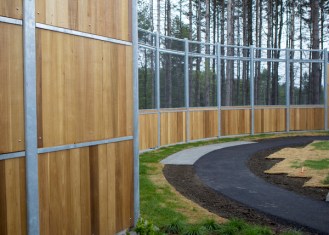
Extending in two wings from the monastic core are the four patient wards, each with private patient rooms and each patient room with alcove beds in the Scandinavian fashion. Communal spaces with comfortable built-in benches also abound. The wings embrace a recreation yard, the fourth wall of which is a 14-foot fence made of a warm cedar to mute the obviousness of its confining purpose.
A modern psychiatric hospital is a place of humanizing euphemisms – “elopement” for escape; “ligature” for the devices suicidal patients occasionally seek to improvise – and the architecture here is to similar effect. The fundamental intention, which appears to have been achieved, is to make people who being confined, often against their will, have some notion that they are in a haven if not a home.
This is not the sort of design achievement calculated to win the Pritzker Prize, the architectural equivalent of Nobel honors. In every possible sense, the VPCH is a long way from Frank Gehry’s latest bedazzling creation, a business school in Sydney, Australia that is clad in undulating brick so that it resembles a slightly crumpled paper bag. Rather, as with LineSync’s Resilient River Apartment, the VPCH embodies something architecture can do, but is so seldom allowed to do everywhere: solve real problems by combining beauty and ingenuity. And when you add the poignancy of these projects as astonishingly rapid responses to Irene-induced devastation, the excellence of these two projects set the walls of the Statehouse cafeteria ablaze when photos and descriptions of the dozens of competing designs were on display the night of the AIA Vermont awards ceremony in December.
What, then, accounts for the fact that the psychiatric hospital got no recognition and the apartment received an honorable mention, the lowest of the nine awards that were given? What could have been better than these fine efforts – and why?
One answer surely likes in the mechanics of the award process. State AIA chapters typically turn to a counterpart elsewhere in the country to empanel a jury of disinterested but still expert architects. In this instance, four architects from the AIA chapter in Wyoming made the awards, presumably with relatively little knowledge of actual conditions in Vermont and without any opportunity to visit the projects under discussion.
Another possible answer could be characterized as the Mockbee effect. Samuel Mockbee, who died in 2001, was an architect who founded and led Auburn University’s Rural Studio, which sends teams of architecture students into impoverished and rural sections of Alabama to create all sorts of buildings for little or no money. Recycled materials and a combining vernacular building forms with contemporary design principles comprised Mockbee’s signature, which gained popularity in the profession because it so effectively combined art and virtue.
One sees echoes of that in the top AIAvt award given by the Wyoming jurors, which went to McLeod Kredel Architects of Middlebury. They received it for the latest edition of their Bear Island Design Assembly project, which brings architecture students to a coastal Maine island in summertime to build stuff for the locals. In this instance, the locals were of the egg-laying variety. Said the jury, “elevating the typical chicken coop to a work of multi-functional art –nicely composed, sculptural forms—is compelling.”
It is not necessarily absurd for AIA Vermont to pass over buildings that help people in the Green Mountain state recover from devastation in favor of admittedly groovy looking chicken coops in Maine. Architecture as a profession is striving for relevance in a troubled economy that sees most buildings designed in notably expedient and mediocre fashion by non-architects. Free services are always relevant in challenging times.
Nevertheless, even useful pro bono projects do not provide the ultimate formula for ongoing relevance. This explains the recent bankruptcy filing by the nonprofit group Architecture for Humanity after 15 years of Mockbee-esque endeavors under the motto “design like you give a damn.”
Which begs the question of who will give a damn about architecture in Vermont when six of the other seven AIAvt award-winners were (a) two private houses created for clients with the means to commission custom-designed homes, (b) a pergola that an architect designed for his wife, (c) the district heat plant in Montpelier (which the jury hailed as Vermont’s answer to the Pompidou Center but which project architect Gregg Gossens of Gossens Bachman Architects unabashedly attributed to engineering rather than architecture), (c) a bunch of squash courts for a college in Addison County with a billion-dollar endowment, and (d) a retrofitted Airstream trailer the AIA chapter itself commissioned, to haul around the state for promotional purposes.
The only building honored this time around by AIAvt that serves the public and was not pro bono is the new headquarters of Capstone Community Action in Barre, another Gossens Bachman project.
Maybe the answer is that architects should not give awards to other architects. Perhaps the jury should have to visit any projects they are considering as finalists.
Maybe a trade association is not the best arbiter of quality in their trade, just as Major League Baseball does not decide who gets into the Hall of Fame.
Or maybe it suffices simply to take note of how nobly so many Vermonters have rebuilt so much of Vermont since Tropical Storm Irene swept through in August 2011.
