

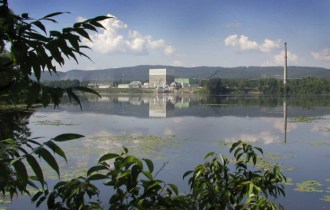
[S]trontium-90, a cancer-causing radioactive contaminant, was found in test wells at the Vermont Yankee nuclear power plant at levels considered safe by the federal government, state health officials said Monday.
Sr-90, a fission byproduct found in nuclear reactors, was detected in samples collected from 21 monitoring wells on the plant compound last August, officials said. The water is not available for human consumption, and the concentration levels are below federal safe drinking water thresholds.
Health Commissioner Harry Chen said he does not believe this is a new leak. Instead, he said the state has changed to laboratory contractors that use more sensitive detection equipment.
“There is no risk to the public health,” Chen said.
Entergy, a Louisiana-based company that owns four nuclear reactors in the Northeast, officially shut down the 42-year old plant in Vernon for economic reasons on Dec. 29. State officials say the radioisotope leaked from structures, systems and components at the plant.
“Although the specific source of the Sr-90 is unclear, it is likely that Sr-90 in groundwater and soils at Entergy Vermont Yankee are the result of past leaks and fallout from air releases at the station during its years of operation,” a state news release said.
The highest concentrations reached 3.5 picocuries per liter, or pCi/L, which is below the a safe drinking water limit set by the Environmental Protection Agency of 8 pCi/L. On Jan. 29, 2015, Nuclear Regulatory Commission and Oak Ridge National Laboratory verified the Health Department’s findings.
Ingesting the radioisotope can cause bone cancer, cancer of soft tissue near the bone, and leukemia. Sr-90 has been detected in fish’s bones in the Connecticut River, according to the health department. The radioisotope has a 29-year half-life — the time it takes to decay to one-half its original concentration.
Spills and leaks and other plant activities at Vermont Yankee have released radiological contaminants from the plant’s boundaries in the past, according to a 2014 report. In 2009, Entergy detected tritium coming from underground pipes near the Advanced Off Gas, or AOG, building leaking into the Connecticut River, and also detected the radioactive material in a drinking water supply well on the plant compound
Arnie Gundersen, a Burlington-based nuclear engineer, said there is likely more Sr-90 that will be released from the plant. He said the leak will continue to move for years.
“Just because they got this number, that doesn’t mean that there is not more behind it,” Gundersen said. “That’s not the worst there is, that’s the best there is. That’s what you measured.”
He said the owners of Connecticut Yankee, another nuclear power plant, discovered strontium entering the water table at the plant site after it closed in 1996. He said the cleanup increased the cost of decommissioning by $1 billion. Connecticut Yankee was a utility, so the costs were recovered from ratepayers over 10 years, he said. Vermont Yankee is a limited liability company.
Gundersen said Strontium-90 is a heavier radioisotope that takes longer to travel into the groundwater. He said the radioisotope likely came from the AOG building, where the tritium leak was found. He suggests that the company decommission this part of the plant first to avoided larger costs.
“If the strontium is moving, you’ve got more cubic feet that you have to pay for,” he said.
The strontium-90 levels were below minimum detectable limits established in Vermont Yankee’s federal license, which comply with standards set the the EPA and the NRC, according to Martin Cohn, a spokesperson for Vermont Yankee.
Cohn said that tests of the water wells in August and November did not register any Strontium-90 concentrations above 3.5 picocuries per liter, the lab’s detection limit. He said the state likely rounded up.
He said wells are tested either monthly or quarterly. He said the ground wells will be tested again in late February or March.
Cohn said there were four wells where the state disagreed with Entergy’s concentration measurements. He could not say where these wells were located. He said it remains to be seen whether the radioisotopes even came from the plant.
“All we can say with any certainty that the groundwater wells, which meet all NRC and EPA standards, have a small detectable limit of Strontium-90,” he said.
