A long-held practice of allowing public tuition dollars to follow students who attend out-of-state schools — if they live in a community that offers school choice — may come to a halt if two state legislators get their way.
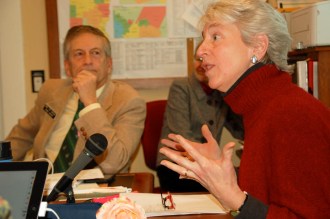
Reps. Alison Clarkson, D-Woodstock, and Jim Condon, D-Colchester, this week filed a bill that would end the practice of public school districts paying tuition for a resident student to attend an out-of-state public or independent school.
The goal of H.38 , is to “to try to keep Vermont taxpayer dollars in the state,” Clarkson said.
“If we believe that we offer fabulous education in our schools, let’s put our money where our mouths are,” Clarkson said.
In Fiscal Year 2013, $4.7 million was paid for Vermont students to a attend school in another state or another country, Clarkson said.
Of that figure, about $1.1 million went for 110 students who attend designated high schools in New York and about 19 elementary students attending New Hampshire public schools.
The bulk of the remaining $3.6 million in tuition dollars leaving Vermont went for 331 students attending schools in more than a dozen other states and several countries.
In a sheet that tallies tuitions going out of Vermont, $2.2 million went to public schools in Massachusetts, New Hampshire and New York; $1.4 million is flowing out of Vermont to private schools in those states and other countries.
A chart provided by Aaron Brodeur, education finance manager with the Vermont Agency of Education, shows where the money is going: in towns in northern Vermont, such as Brunswick, or Guildhall, some of those tuition dollars are going to New Hampshire or Quebec; other districts show a number of high school students attending private, out-of-state schools such as Loomis Chaffee, Kimball Union Academy, Deerfield Academy, Suffield Academy and Northfield Mount Hermon, among others.
A total of $3,587,835 in tuition to border states was paid out in 2013, including $1.44 million to Massachusetts and $1.34 million to New Hampshire. Meanwhile, $326,763 went to tuition to schools in states across the country, including Arizona, California and Utah.
Nearly $110,000 went to students attending school in Argentina, Canada and Sweden.
Another $265,267 went for 19 elementary students who attended public schools in New Hampshire, and about 110 students were tuitioned to designated high schools in New York at a cost of $860,020.
According to School Choice Vermont, 90 towns in Vermont offer school choice for at least one grade.
Clarkson said some abutting districts would be excluded because of existing reciprocal agreements; students with special needs, such as a visually impaired student whose needs cannot be met in Vermont, would be excluded so they can receive the program that best meets their needs, she said.
“This bill really is designed to keep our hard-earned taxpayer dollars in Vermont, supporting Vermont institutions, whether they be public schools or independent schools,” Clarkson said.
She was asked about a possible concern if other states were to retaliate and not allow their tuition dollars to come to Vermont, such as in the case for St. Johnsbury Academy.
Rep. Scott Beck, R-St. Johnsbury, a teacher at St. Johnsbury Academy, said if that were to happen it could hurt the independent high school.
“That isn’t our issue,” Clarkson said. “We can set as a value to support our own Vermont institutions. I know St. J has a lot of money coming in.”
Disallowing tuition dollars to go out of state or country would also “prevent people from gaming the system,” Clarkson said, like a second home owner “getting an opportunity they could afford anyway,” she said of the residency requirement for obtaining tuition dollars from a community in a choice town.
Rep. Ann Manwaring, D-Wilmington, said she was not surprised to see that neither of the bill’s sponsors are from border towns.
Rep. Sarah Buxton, D-Tunbridge, However, said it’s not just a border issue. In her district, she said one town is a sending town and one is not, so, “the way that these disparities impact communities isn’t just about the cross-border issues.”
The town of Hartland, the committee discussed, “pays full freight” for high school choice.
Rep. Alice Miller, D-Shaftsbury, said she thought other states would “be offended by the very suggestion of doing this.”
Clarkson said she has been called a hypocrite because she sent her sons to private high school, but she said her family paid for that.
“Every student that returns to Vermont means a reduction in the local property tax,” she said. “We have a declining enrollment problem and we’re fueling it. We are paying to decline our own population.”
Beck, the St. Johnsbury Academy teacher, was asked about enrollments by students from other states whose towns pay their tuition, and he estimated it would be 75 to 80 students in that situation. If those states retaliated, “it would hurt,” he said.
Asked who might be against the bill, Clarkson said, “Some tuitioning towns are not fond of it because one of the attractions for living in those towns is that their kids can go wherever they want.”