

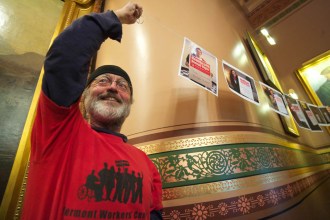
Members of the grassroots group joined Sen. Anthony Pollina, D/P/W-Washington, for a news conference at the Statehouse on Thursday.
“Today we’re here to push forward on equitable public financing for a universal health care system,” said Anna Gebhardt, a Workers Center volunteer.
Middle- and low-income Vermonters pay too much for inadequate insurance, while wealthy residents pay a relatively small portion of their income to meet all their health care needs, they say. At the same time, insurance companies, large hospitals and businesses continue to profit from the current market-based health care system, the group said.
“You’re going to hear many ideas for piecemeal approaches for reform. These are Band-Aids and do not address the root causes of the ongoing crisis,” said Jessica Fuller, another volunteer.
Both were among the demonstrators who participated in a sit-in on the House floor organized by the Worker’s Center after the governor’s inaugural ceremony this month.
Pollina said the governor took his public financing proposal off the table, but that doesn’t mean the debate over how to achieve universal health care should stop.

The former gubernatorial candidate said he’s not aware of any support for public financing among leadership in either chamber, but he believes there is support from some members of the Senate and House health care committees.
The Workers Center is developing its own proposal for equitably financed public health care, and suggest the data released in Gov. Peter Shumlin’s single-payer financing report shows a program is viable.
The group would remove the cap on income tax for people making more than $290,000, while flattening the sliding scale income tax for people earning less than $90,000. It would also exempt the smallest businesses in the state, while placing a payroll tax on a sliding scale that increases for larger businesses. They would also link the payroll tax to the ratio of low- to high-wage earners within a company so that firms with a greater disparity would pay more.
The Workers Center will release a detailed version of that plan and hopes to find a lawmaker to introduce it in the coming weeks. Organizers haven’t found a sponsor yet, which creates a tight timeline for introducing their plan this session. Typically for a bill to pass during the current session it must clear one of the chambers before the crossover date, which is in early March.
To help vet their proposal, the Workers Center demanded access to MIT economist Jonathan Gruber’s proprietary microsimulation model. Releasing the modeling Gruber did for the state and their own work on public financing is insufficient, they said.
“It’s the administration’s responsibility to make all relevant tools available and hold private contractors accountable,” Fuller said.
The Shumlin administration paid Gruber $160,000 of a $400,000 contract for the work he did modeling different scenarios for public financing. Gruber agreed to the discount after impolitic remarks he made on video surfaced and created a national controversy.
“We understand that there has been a contract signed that does not in this moment allow us to have access to that model. We just found out about this, and we think that’s inappropriate,” said Matt McGrath, campaign coordinator for the Workers Center.
Lawmakers and the public need to act with “due diligence” to develop alternatives for achieving the goals set out in Act 48, the state’s health reform law, McGrath said.
The Workers Center also asked that the administration and the Legislature make health reform a more participatory and open process by hosting evening hearings and meetings in communities outside Montpelier.
