

Vermont’s largest hospital network and its largest health insurer both say they are on board with Gov. Peter Shumlin’s health reform proposal, which will rely on their support.
Shumlin wants to levy a 0.7 percent payroll tax to raise $92 million to pay for the package, which — along with a slew of related initiatives — would increase Medicaid payments. The program for low-income Vermonters doesn’t cover costs incurred by providers, causing them to make up their losses by negotiating higher payments from private insurance.
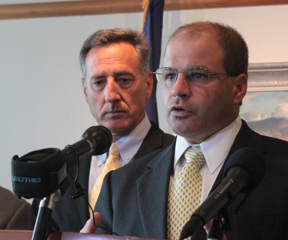
Lawrence Miller, chief of Health Care Reform, told lawmakers Tuesday the increased payments could reduce premiums by 5 percent from what they would otherwise be in 2016. Rep. Tim Briglin, D-Thetford Center, a newcomer to the House Health Care Committee, said that would leave the state in the position of proving a negative when Vermonters see how much their premiums will increase next year.
John Brumsted, CEO of the University of Vermont Health Network, told VTDigger in a statement that his organization will work to reduce the growth in premiums.

“I and a number of my colleagues have committed to engage in a process with the Green Mountain Care Board to see that a Medicaid increase would be reflected in rate reductions paid by those who purchase commercial insurance,” Brumsted said.
The University of Vermont Health Network includes the University of Vermont Medical Center and Central Vermont Medical Center, which account for more than 43 percent of hospital spending in the state. The network also has two hospitals in New York.
Brumsted’s statement did not address whether he supports a payroll tax to fund the Medicaid increase. UVM Medical Center has a payroll of $550 million and would pay $3.8 million under the proposed tax.
Blue Cross Blue Shield also supports the governor’s plan. The nonprofit company provides coverage to roughly 200,000 people or roughly a third of the state.
Cory Gustafson, director of government and public relations for Blue Cross Blue Shield of Vermont, said the company “has long identified the negative impact that the cost shift has had on its customers and members.”
“BCBCVT is committed to working with the Green Mountain Care Board and health care providers to ensure that Medicaid reimbursement increases translate into premium relief for its members,” he said.
The other central player in ensuring Shumlin can deliver on lower premiums — or lower than they would otherwise be — is the Green Mountain Care Board.

Susan Barrett, the board’s executive director, said Tuesday she was not prepared to comment on whether the board has the tools it would need to follow through on the governor’s pledge. The board is still working through the proposal, she said.
Shumlin’s plan would increase the board’s budget by more than $1 million and expand its authority, but that can’t happen immediately. Insurers are to submit their rate requests in April.
The Green Mountain Care Board regulates hospital budgets and insurance rates, except for entities that self-insure, such as large employers. Miller acknowledged that leaves part of Vermont’s health care industry outside those regulatory processes.
Sixty-three percent of what Vermont spends on health care goes to non-hospital providers and services, and 30 percent of the private insurance market is in self-insured health plans, according to figures collected by the board.
“It’s not purely efficient. You can’t assume a one-to-one [ratio of dollars invested in Medicaid to dollars in reduced premiums] — that would be a little ambitious,” Miller said.
That’s why the governor’s proposal allocates a greater amount of money toward increasing Medicaid payments than is collected through the payroll tax, he said. Vermont would be able to do that because state Medicaid spending draws down a federal match of more than a dollar for each dollar spent.
“Individual businesses would have different experiences based on what they choose to cover now, and of course businesses that don’t provide any health insurance today would see an additional increase and no offsetting reduction in premiums,” Miller said.
Vermont Businesses for Social Responsibility, a nonprofit trade group whose members employ 14 percent of Vermont’s workforce, said they are cautiously optimistic about Shumlin’s plan to increase Medicaid payments.
“If a payroll tax can leverage additional funds, reduce the cost shift and ultimately reduce premiums by more than the tax, that makes good business sense,” said Andrea Cohen, the group’s executive director.
But before the group endorses Shumlin’s proposal, Cohen said they want greater assurances that will happen.
Correction: An earlier version of this story misstated the deadline for insurers to submit their rate requests.
