

Testifying before the House Education Committee on Friday, state officials painted a none-too-rosy picture on key issues of the legislative session.
Enrollment is still declining. Taxes are still rising.
Hours before Vermont Education Secretary Rebecca Holcombe addressed the House, committee members heard testimony from two state experts who outlined the difficult job ahead.

William Talbott, deputy commissioner of the Agency of Education, broke down the numbers on enrollment.
Public school enrollment has declined from 79,524 last year to about 78,402 this year, Talbott told the committee.
Trends continue to show declining student populations, as well as fewer people in the workforce as the Baby Boomers’ retirement waves hit the Vermont workforce.
Talbott reviewed numbers from the 2010 census and population projections for 2020 and 2030, and noted that the downward trend is not a new concern.
Projections show a continued decline in student population and wage earners, Talbott said. The bottom line, he said, is that, “More are leaving than are coming in.”
“The kindergarten population is down 300 this year,” he said. “We don’t have as many kids in the state; we’re not bleeding them off to homeschooling, and independent or private schools. It’s actually fewer kids.”
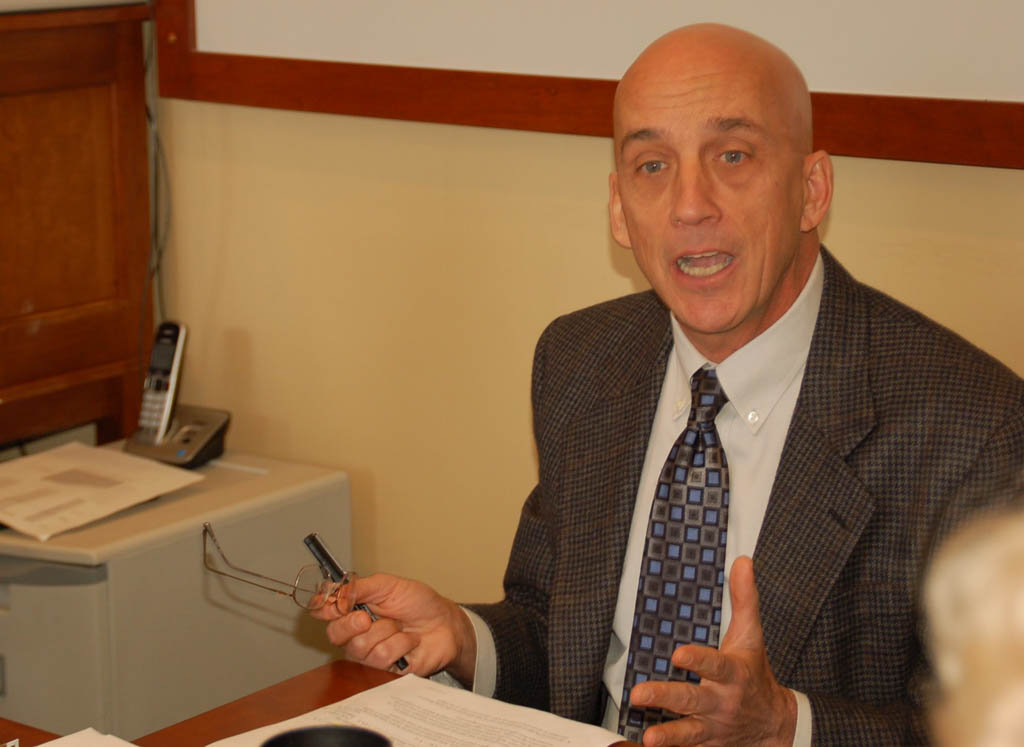
Mark Perrault, fiscal analyst from the Joint Fiscal Office, reviewed the finer points of Acts 60 and 68 with committee members.
The homestead rate and the non-residential property rate are expected to increase 2 cents this year, Perrault said, but school districts across the state won’t have their budget numbers in until next month.
Perrault, starting his 18th session with the Legislature, offered committee members the context of public education funding going back into the late 1700s, when there was “very little state involvement,” to 1890, when the state instituted an education property tax, “so the statewide tax is not something new,” he said.
Perrault then walked the committee through the decades to the present, and how Act 60 and Act 68 brought the education funding formula to where it is today.
Rep. Tim Jerman, D-Essex Junction, said, “I still hear people talk about, ‘Well, we’re a gold town,’ but there are no more gold towns, we are all just taxpayers paying in.”
Committee members discussed how the low teacher-to-student ratio is driving much of the cost for Vermont’s schools. However, Perrault said of mandating student-to-teacher ratios, “It’s really complicated.”

There are more than 100 proposals that have come to the Speaker of the House for education reform, Chairman Rep. David Sharpe, D-Bristol said.
“It’s a big responsibility for this committee,” Sharpe said. “That’s why the speaker established such an all-star committee … we have a big task ahead of us.”
Education is shaping up to be among the most lively arenas in the coming legislative session.
Thursday, Sharpe echoed his fellow members’ concerns about the committee’s focus, saying the discussion should begin with, “What problem are we trying to solve?”
