

A new report recommends spending more money to boost Vermonters out of poverty, but looming state budget cuts may render the report moot. The chair of a key legislative committee said Friday that human services won’t be spared from the budget axe, no matter how good the recommendations are.
Last December, Governor Shumlin organized the Pathways From Poverty Council (originally called Pathways Out of Poverty). On Nov. 13, the group sent its final report to the fifth floor.
The 19-page document includes specific recommendations, such as offering free lunch to all public school students, as well as broader ideas, like removing barriers to communication among various agencies that help the same people.
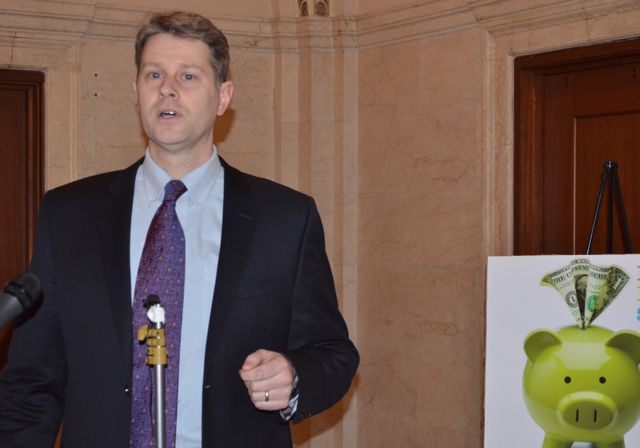
Co-chariman Christopher Curtis said the group tried to create a menu of options for the Legislature and administration to consider.
“There’s no one thing that’s going to solve poverty in Vermont,” he said.
Recommendations include improvements in job training, transportation, child care, tax policy for the poor, housing, cash benefits, food security and medical and addiction treatment programs. The Council also called for legislation on paid sick days and expansion of the Earned Income Tax Credit.
It suggests creating a matched savings program to help people save money as well as creating financial coaching programs and a “restricted license” program at the DMV for drivers whose licenses were suspended due to driving an uninspected, unregistered or uninsured car to work, school or the doctor.
The report also advocates for more affordable housing programs to cut reliance on motels for emergency housing, including increasing the rental subsidy program and making sure departments that fund housing ensure that 10 percent of the units are affordable to low-income Vermonters.
It also recommends increasing Reach Up and food stamp benefits and increasing funding to the child care subsidy program and expand eligibility.
It suggests increasing or eliminating the “asset test,” which would allow consumers to retain large tax refunds. The Reach Up program requires people who get a large tax refund to liquidate it or face loss of benefits. At the same time, Reach Up often helps people pay for car repairs even though the person may have been able to afford repairs if he or she had been able to keep a tax refund, according to the report.
The report recommends establishing a “culture of kindness” within AHS and the Department for Children and Families that would encourage staff to treat clients with respect. In addition, the group wants the state to study transportation issues that impact low-income Vermonters.
The report also calls for an independent office of child advocate to serve as an ombudsman for child services in the state.
‘There can’t be any sacred cows’
Meanwhile, this year’s state budget faces likely rescissions that will hit hard at AHS. The state faces a $100 million gap between revenues and spending.
The recommendations in the report involves many programs administered by the Agency of Human Services, whose budget makes up 40 percent of the state budget.
Ann Pugh, D-South Burlington, chair of the House Human Services Committee, said no program, department or service should expect to escape cuts this year.

“If we’re really going to do our work, there can’t be any sacred cows,” she said.
If anything, child protection and family services should withstand cuts, said Pugh, who also serves on a legislative committee investigating the state’s child protection system.
The report’s recommendations may help lawmakers decide where to cut, she said.
“(The report) keeps our eyes on what is important and it will, when we have to make some hard decisions, help us in terms of either how to move forward or if we need to begin to make hard decisions,” she said.
As budget cuts loom, a new chief is set to take over the Agency of Human Services. Gov. Peter Shumlin Thursday appointed Hal Cohen, director of Capstone Community Action, to replace interim secretary Harry Chen.
Cohen Friday said employees at Community Action still see a need for basic services like fuel assistance and food.
“You can’t talk to people about moving out of poverty if they don’t have a roof over their head and if they are hungry and if they’re cold,” Cohen said.
Curtis said spending money in certain areas can alleviate the need to spend in other areas. The state should not spend money on things like last year’s $5 million “enterprise fund” to help private companies while it cuts programs that help the poor.
“There may be other examples of funds or tax incentives that could be delayed or eliminated before considering cuts that would harm vulnerable Vermonters,” Curtis said.
