

Gov. Peter Shumlin will release his single-payer financing plan before the end of the year, and will reveal the program’s health care benefits in the next two weeks, he said Wednesday.
Those two items will address questions that have been unanswered for nearly three years: What will single payer cover, and how will Vermont pay for it?

The governor also released a short video spotlighting an inequity in current health coverage, as the first step in a campaign to drum up public support for reform.
It remains to be seen whether Democrats in Legislature will make single-payer a priority this session, as education financing looms large and lawmakers may face a $100 million budget shortfall.
Shumlin would not say Wednesday whether he will ask lawmakers to approve a financing plan in 2015. His proposal will include a series of “benchmarks” for how the program can be implemented, he said.
His administration is still figuring out “what legislative action” it will take to get there, and when those steps need to be taken, Shumlin told reporters.
A mixed reception
House Speaker Shap Smith, D-Morristown, said he is pleased that the governor will make his proposal before the session begins.
Smith promised a rigorous examination of the plan, but remained neutral on the possibility of a vote in 2015.
“Until the plan is put before us, and until we have a concrete proposal to analyze, it’s too early to say whether the administration’s health care proposal will be brought to a vote,” Smith wrote in an email.
At least one Democrat has said any proposal will be “dead on arrival” in the Legislature. Rep. Jim Condon, D-Colchester, made that remark on WDEV’s The Mark Johnson Show this week.
Condon, who sits on the purse-string-holding House Ways and Means Committee, is no friend of the governor’s health reform agenda. He was one of three House Democrats who in 2011 voted against Act 48, the law placing Vermont on its current path toward a publicly financed health care program.
Condon said he was not aware of any Democrats who supported single-payer and are now changing their tune, but he expects that many will do so when the session begins in January.
“This is an exceptionally difficult year to propose a $2 billion tax plan in Vermont,” Condon told VTDigger on Wednesday.
Shumlin’s proposal is expected to detail what taxes will be levied, and at what rates, to finance the program. The governor and supporters argue the $2 billion necessary to fund the program will replace roughly the same amount in premiums and out-of-pocket costs currently paid by Vermonters toward health care.
“Whatever plan comes forth, it’s not likely to get a lot of support, in my opinion,” Condon added.
Even with a palatable financing plan and benefits package, there are still uncertainties for single payer that are unlikely to be resolved in the coming year, which could give some lawmakers pause when they consider what to prioritize in the coming session, Condon said.
The entire program is predicated on obtaining a federal waiver to the Affordable Care Act, he said, and it’s still unclear how the state will treat self-insured companies that might sue under the federal Employee Retirement and Income Security Act (ERISA) if they’re forced into, or taxed as part of, single payer.
ERISA sets minimum standards for employee benefit plans and allows employees to sue for them, but it also protects companies that offer benefits in multiple states from a patchwork of state regulations. (For more background click here.)
The Affordable Care Act isn’t working either, Condon asserted, and creating a standalone single payer program in Vermont isn’t viable. A federal or regional public option for health care would be more likely to succeed, he said.
“We just don’t have the ability in this state to run some giant new program efficiently,” he said.
An online ad campaign
The Shumlin administration also began its public outreach campaign by releasing the first in a series of videos that will be circulated on social media.
The videos are intended to spotlight the inequalities and barriers to health care that many say are created by the current employer-based insurance system.
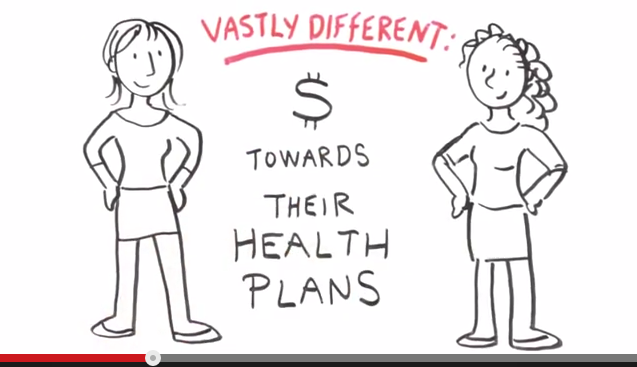
The first video, which features whiteboard drawings, tells the story of Julie and Jen, two Vermonters who have the same position at different companies and earn the same salary.
Julie and Jen both have gold level health plans purchased through the Vermont Health Connect exchange. But because Julie’s plan is sponsored by her employer and Jen’s is not, Jen pays five times more for the same coverage.
About 34,000 Vermonters have employer-sponsored coverage through Vermont Health Connect. Another 32,000 have that same insurance through individual plans bought via the exchange.
But only about 11,000 are in the same position as Jen, paying full freight for their insurance. The rest receive government subsidies that reduce the cost of that insurance.
The 11,000 are not the only ones facing that inequality, according to Robin Lunge, director of Health Care Reform. There is wide variation among employer contributions to health insurance for people who perform the same or similar work and earn roughly the same pay, she said.
In addition to the video series, Lunge said, the administration will also hold a number of informational sessions for lawmakers and a series of public forums hosted in conjunction with the Green Mountain Care Board to help people understand the program’s proposed benefit package.

