


The new owner of Burlington’s downtown mall wants to triple the size of the facility with new housing, hotel, retail, office and events space, Mayor Miro Weinberger announced Thursday. It would be the biggest development in Burlington since the mall opened in 1976, Weinberger said in an interview.
The proposed comprehensive redevelopment of Burlington Town Center, along with the northern portion of Church Street Marketplace, would take three to five years and cost around $200 million. The project is spearheaded by Don Sinex, managing partner of the New York-based real estate investment firm Devonwood Investors LLC. Devonwood purchased the site with a partner in December 2013 and later became the mall’s sole owner.
At a news conference Thursday with Gov. Peter Shumlin, Sinex and a cheering squad of local business and community leaders, Weinberger said the plans will be developed through a “transparent, public process.”
The mayor wants that process to go quickly.
At its Dec. 1 meeting, the City Council will consider a resolution authorizing Weinberger’s administration and Sinex to reach a development agreement. The Council is expected to vote on the resolution two weeks later.
The city and Sinex immediately will begin to solicit, review and incorporate public input into their negotiations for parking, public amenities and infrastructure, the project’s scale and other key elements of what’s described as a “public-private partnership.”
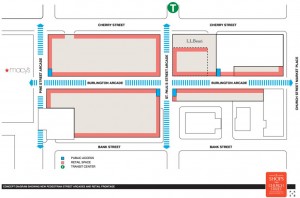
Sinex’s vision for the block includes 250 apartment units, a 250-room hotel and an events hall for up to 5,000 people. Retail space would nearly double, from 125,000 to 225,000 square feet. Office space would more than quadruple, from 35,000 to 150,000 square feet. An underground garage would add 375 parking spaces, for a total of 950. A public, north-south pedestrian and bike thruway would be added.
To make room, part of the city’s existing parking garage may be eliminated, and the mall could be built both up and down, adding stories to the top — where a 1.5-acre rooftop garden would grow — and underground.
“I am counting on the public to offer impactful input and ideas that will help us achieve our goal of turning the mall inside out,” Sinex said in a press release. “(O)f transforming one, often hidden space into a multitude of outward-facing shops, restaurants, entertainment venues, parks, and other open spaces.” Sinex could not be reached for further comment by press time.
Former Weinberger staffer Carina Driscoll said there’s a lot to like about the proposal, but its scale gives her pause. Driscoll, cofounder and owner of the Vermont Woodworking School, is a former school board member, Burlington City Councilor and state representative. She assisted Weinberger with open government, transparency and mayoral initiatives.
“Transparency is very important and I hope that that is the true intention,” Driscoll said. “I’d be concerned that a project of this scale and scope would be on the fast track.”
Driscoll said she supports Weinberger’s efforts to stabilize the city’s finances, and she’s not necessarily opposed to the proposed redesign of the downtown mall.
But Driscoll has concerns about the impact of a newer, much bigger Burlington Town Center on the successful Church Street Marketplace. While the city’s Downtown and Waterfront master plan calls for downtown density and increased housing, there’s no call for additional retail or hotel space, she said.
“Investment downtown is certainly a good thing. Housing is good. Mixed use is good. Connectivity is good. However, this looks at this point to be doubling retail space downtown. And that is not necessarily a good thing,” Driscoll said.
“Whether this is an investment that will work out for Burlington is not a question for the developer. It’s a question for the community,” she continued. “The citizens of Burlington need to decide what kind of downtown and what kind of retail do we want.”
Her reservations are not shared by Church Street Marketplace executive director Ron Redmond.
“I think we underestimate the potential of Burlington,” Redmond said.
“The trick is to have enough of a balance between local and national stores,” he said. National brands can serve as a magnet that benefits local shops with smaller advertising budgets, but both residents and tourists want the authenticity and unique local brands, he said.
Weinberger said although the district’s master plan does not suggest the need for substantial growth in all the areas Sinex is pursuing, it’s not the city’s place to say how the space should be used.
“The city certainly will not be in the position of making predictions of how much retail space will be filled or not,” Weinberger said. He added that low vacancy rates on Church Street may indicate pent-up market demand.
“Don has talked about this being rolled out in stages, and it may take some time before there’s demand for a hotel,” Weinberger said.
Whatever Sinex wants to build, the city will be ready to discuss public investments to help make it happen. Weinberger said none of the details are yet finalized, but the main tool the city would have for supporting the development would be Tax Increment Financing, or tax credits.
Weinberger’s office said the development would create about 300 construction jobs and between 1,000 to 1,600 permanent positions.
The economic benefit is estimated at $6 million per year in new real estate tax revenue and $9.25 million in sales tax revenue during construction. That would be followed by annual collections of $7.2 million in ongoing sales tax, $2.4 million per year in hotel occupancy tax and $450 million per year in related economic activity from a “multiplier effect” from the additional downtown commerce.
