


The Vermont Veterans’ Home remains underutilized and overstaffed, lawmakers learned Wednesday. The facility is licensed for 171 patients, staffed to handle 150, but averages only 125 to 135 patients, state officials told the Legislature’s Joint Fiscal Committee.
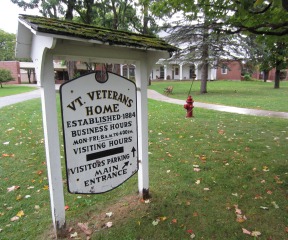
The Civil War-era estate in Bennington has served Vermont veterans for 130 years, and it was originally funded through a $10,000 state appropriation. The Vermont Veterans’ Home was financially self-sufficient until a few years ago when the state filled a gap in the facility’s operational funds. The state gave the home $2 million in support from the General Fund in each of the last fiscal years, according to Veterans’ Home administrator Melissa Jackson.
Jim Reardon, commissioner of the Department of Finance and Management, estimates that the home would need about $1 million next year if its current staff-to-patient ratio is maintained.
That trend can’t continue, lawmakers told administration officials.
Overstaffing is a hard sell especially when the state is looking at an estimated $100 million budget gap for fiscal year 2016. Gov. Peter Shumlin acknowledged on the same day that Vermont is struggling with a structural budget deficit.
Reardon, joined by Secretary of Administration Jeb Spaulding, presented the Joint Fiscal Committee with an overview of the home’s long-term financing picture and previewed a related report, due Monday.
Their focus is marked by a change of direction in a conversation that’s continued for more than a year.
Previously, efforts were geared toward increasing the number of veterans, veterans’ spouses and veterans’ parents at the home. (All are eligible for residency at the home, which is not open to the general population.) A marketing director was hired in October 2013 to help raise the facility’s profile and drive up the patient count. Jackson said his efforts have paid off.
“Our census could be substantially worse than it is now,” Jackson said, considering that 52 patients have passed away since January of this year.
Most of their efforts are shoe-leather, she said: staying in touch with hospitals, keeping brochures stocked, and hosting on-site events to get the community more involved and aware of what’s there.
The Veterans’ Home board of trustees pitched in $40,000 to pay for development of a comprehensive marketing plan; the plan suggests a total expenditure of $250,000 on marketing efforts.
Spaulding said Wednesday that he’s not convinced it’s worth that much money. “I have some questions,” he told the Joint Fiscal Committee.
Jackson said that the plan is made up of discrete parts that can be carried out separately. That work will continue as the Home’s budget allows, she said, and the plan may never be completely implemented.
A changing clientele
Conversation turned instead toward aligning Veterans’ Home staffing levels to realistic census counts, and making good use of whatever space is left over. The empty beds don’t necessarily reflect a diminished need for care among veterans, Reardon said, but a change in how care is delivered.

Reardon said that, historically, veterans coming to Bennington were younger than a typical nursing home residents. But that dynamic is shifting toward use as an end-of-life alternative, Reardon said, partly because of the state’s efforts to promote more cost-effective home- and community-based care options.
“That’s working, and that’s having an effect on the Veterans’ Home.”
Spaulding suggested that, marketing or no, demand for beds might not go up. “We’re hoping to reduce the requirement of state support by having a right-sized nursing home,” he said.
There’s been some talk of finding alternative revenue sources to keep current staffing levels funded. Several committee members scoffed when Spaulding said some veterans’ groups have suggested creating a “veteran-centric lottery game,” or direct proceeds from break-open ticket sales to the Veterans’ Home.
“None of (the options) are very palatable,” Spaulding said. “On the other hand, people in this building (the Statehouse) … have some severe heavy-lifting to do, and there are going to be no popular options.”
Reardon, who used to serve on the Veterans’ Home board of trustees, said previous administrations had considered closing the non-nursing home portion of the facility, where about 10 people now live who don’t require intense medical care.
“I pushed back hard on that, because that specific population are … people that otherwise would fall through the cracks and more than likely be homeless,” Reardon said. “So I wouldn’t in any form or fashion advocate… that we would preclude them from receiving those services.”
The option of recruiting veterans from Massachusetts to Bennington was not well received south of the border, Spaulding and Reardon said. And an idea to recruit retired veterans back to Vermont from places like Florida is a non-starter because it would increase enrollments in the state’s Medicaid program, which faces funding problems of its own. The potential to find efficiencies by working with The Shires, a nonprofit housing development for low-income residents in Bennington, also is complicated by the different populations served by the two facilities.
Local concerns
Sen. Dick Sears, D-Bennington, suggested the possibility of moving Bennington’s VA clinic, now downtown, back to the Veterans’ Home.
But the main option that emerged Wednesday is the one Sears resisted most vehemently: staffing cuts.
“Those are 218 jobs in Bennington County that are hugely important to our local economy,” Sears said. He said if staffing changes are considered, he does not want to see the facility slip back to a time when the home struggled with callouts, sick days and paying people who are not working.
“Neither do I,” Reardon said. But that issue might be better discussed in terms of what’s appropriate for union contracts at the Veterans’ Home compared to a place like the Department of Children and Families, he said.
“I don’t want to lose jobs neither (sic). But at the same time, I have a responsibility to the taxpayers of VT, which is if there’s not the work, I shouldn’t be subsidizing the home with jobs that aren’t necessary.”
The committee also discussed the option of downsizing the facility’s licensed capacity, then converting empty beds to private suites for use by the general population.
Jackson declined to comment on the long-term business plan proposal before it’s made public Monday, but she emphasized the importance of keeping the Veterans’ Home viable.
“We take care of veterans, which makes us special,” Jackson said. “That being said, if we cannot run this like a business, we will not be here down the road.”
