

With two weeks before the Vermont Health Connect web portal is due to go back online, state officials insist users will enjoy a smooth open enrollment period.
But internal documents provided to VTDigger show that while new registrants — who are expected to number about 8,000 — may have an improved experience, the exchange is far from resolving issues for its existing customers. And just getting through open enrollment will cost as much as $20 million, the documents show. The state has already spent $100 million on Vermont Health Connect.
In order to relieve stress on the incomplete website, previously insured users are being asked to avoid it and, unless they have a problem, the call center, too. Snail mail is the recommended option.

“Don’t go on the website, don’t call. Fill (an application out) send it in. Nobody should have to spend time on hold for a straightforward renewal,” said Lawrence Miller, chief of health care reform, and the man responsible for the exchange’s performance.
“The limitations of the system have been causing people a lot of frustration, so we’re trying to approach things in a different way so people aren’t exposed to the same customer service frustration,” he added.
Those frustrations are all too familiar for the 32,000 existing customers who were forced to buy health insurance on the exchange, or go uninsured and pay a federal penalty. That doesn’t include the nearly 100,000 others who were added to Medicaid through the exchange.
As it prepares for new customers, VHC has left itself a mountain of old problems that its top official now admits won’t be settled before the Nov. 15 start of open enrollment.
There are 15,000 change requests — updates to personal information or coverage — that remain unresolved. Without enough time to finish making those changes before open enrollment, the exchange is relying on a technical workaround to keep old cases active.
Despite all that, Miller says he’s pleased with the performance of the exchange’s new contractor, Optum. But if Optum doesn’t have a new contract by Monday, the company won’t continue to work on open enrollment and “Vermonters will not be renewed and will lose coverage,” according to a document obtained by VTDigger.
Miller says a new contract will be signed in time, but nothing was in place as of Friday afternoon.
State officials say they have not paid Optum a dime of its existing $29.4 million contract and Miller says he expects the portion of the work covered by the agreement to come in under budget.
Miller and other state officials had no estimate of what the new contract would be worth or how much money they would need to pay Optum to handle the open enrollment period.
Costs could deepen state’s budget gap
The state has spent upward of $100 million on the exchange. Documents show Optum will need another multimillion-dollar contract just to get through open enrollment. The project has a “current shortfall” of $11 million in requested federal grants and could need as much as $8.5 million beyond that, according to the internal memos.
“Current quotes and contractual obligations may be higher than supplemental budget requests. The (state of Vermont) will need to find alternate funding to fill these shortfalls,” according to the internal report.
It appears the feds may be reluctant to provide more grant money for Vermont’s torpid exchange. The state is obligated to note such risks in internal reports, but Miller said federal money will not be an issue.
The state budgeted roughly $11 million for VHC in all of fiscal year 2015, and has repeatedly assured lawmakers and the media that the exchange won’t dip further into state coffers.
Meanwhile, Vermont is already facing an estimated $90 million to $120 million budget gap in the next fiscal year.
There’s no guarantee that VHC won’t cost the state additional, unbudgeted money, but Miller said Friday that he’s confident that it won’t.
“Until we’re through it, I’m not going to assert that there’s no chance; there is a risk. Anytime you’re working on something like this, it’s always a risk, that’s why it’s in here,” he said indicating the internal report.
Meanwhile, 44 percent of existing customers, 14,000 people, have not had their income verified. Any of those 14,000 who are among roughly 21,000 receiving subsidies, could discover that they owe the government money at tax time.
Employee concerns
There are also more than 10,000 people whose Social Security numbers, immigration status and citizenship have not been verified, though those numbers are spread across the Medicaid population.
Vermont hasn’t verified thousands of Medicaid beneficiaries’ incomes in a year, and in a few hundred cases, it hasn’t verified people’s income in two years — a growing concern of the feds that is reflected in the internal documents.
There is no way for the state to recoup money it spent on Medicaid services for ineligible people whose income it did not verify, Miller confirmed, meaning the state could be on the hook for those payments.
A VHC worker, who asked not to be named, also described internal dynamics that are likely contributing to the exchange’s poor performance.
Optum workers processing changes are not well-trained and in many cases create new issues for accounts they’re working, the person said.
There is also a lack of ownership on the part of mid- to lower-level state employees, who have adopted the attitude that if the exchange struggles this winter it will be Optum falling on the sword, the person said.
 As evidence of the casual atmosphere, the worker gave VTDigger emails showing employees planning a Friday Halloween party in which people are encouraged to dress up as bugs.
The email contains a list of “VHC historical Data Integrity issues, defects errors – altogether making up bugs(!) – for your costume enhancement, if you so desire,” followed by a list of 20 technical glitches, some of which have the potential to cause significant trouble for customers.
Cultural differences between contractors and state employees
Optum is in need of a new “task order” not covered by the current contract in order to perform 2015 renewal work, which must be in place by Nov. 3 or renewals won’t happen Nov. 15.
Another major contractor on the VHC project, Exeter, is working without a contract. It’s impossible to know how much federal money has gone to Exeter, as they were initially a CGI subcontractor and have yet to ink their own deal with the state.
Vermont paid CGI $67 million of an original $84 million contract before terminating the deal. CGI continues to provide hosting services for VHC, but has otherwise closed out its work on the project.
Exeter’s retroactive billing won’t create a situation where the state overpays, Miller said.
It’s unclear if the state has the contract management resources to make sure companies aren’t milking the state for extra money, but Miller said he’s confident that’s not happening. The state is aware of that potential, and is actively working to prevent that from happening, he said.
Optum and other contractors have financial motivation to protract their term of employment with the state to generate profit, as noted by a top VHC official in an email to staff.
In a missive dated Oct. 15, Bob Skowronski, the newly hired incident commander — the man who replaced Lindsey Tucker at the top of the VHC organizational chart — wrote that Optum and other vendors enter government contracts with “fundamentally different” goals and priorities.
As a publicly funded customer service organization, VHC has to use tax dollars effectively, while contractors are obligated to “generate revenue to support returns to investors,” Skowronski wrote.
“I suggest that success will be difficult to achieve unless we can reconcile those two differences,” and find a path forward that gives contractors “a fair return on their work” and offers “Vermonters what they need at a price that is justifiable.”
The workaround
An Oct. 23 internal report shows VHC workers believed Optum would need as much as a week to load the 2015 plans, and that the system could only hold one year of plan data.
The exchange will instead rely on a workaround to allow the system to contain 2014 and 2015 plan year data at the same time, and thereby continue to process existing changes during the upcoming open enrollment period.
The employees charged with making those changes were unaware of the workaround as of Thursday night, according to the exchange worker.
VHC will load the 2014 plans as 2015 plans and create false zip codes to be attached to existing accounts to allow workers to keep processing change requests from 2014.
Miller says that having the 2014 plan year data in the system during open enrollment won’t create problems for VHC.
Of the 15,000 change requests 3,300 are counted as “backlog” — meaning they are untouched and have not begun to be processed.
If the backlog isn’t eliminated it could leave those consumers with “coverage, claim and financial reporting issues,” according to the report, which Miller says is outdated because it does not reflect the workaround.
Temps and contractors
Vermont Health Connect staffers are relegated to checking Optum’s work, a task complicated by the contracted workers’ lack of familiarity with the system, the VHC employee said.
Miller said he is disappointed with the “operations support” provided by Optum, which he said has left something to be desired, but the technical and security work that Optum has done is top-notch and, overall, he said he is pleased with the new contractor.
Many of the state employees working alongside contractors are temporary workers. A few have been working on Vermont Health Connect or related projects for more than a year, far longer than is allowed for temporary staff without a waiver. State officials did not say if the exchange had such a waiver.
Temps are paid roughly $17.50 to $25 an hour and don’t receive benefits. That means no sick time, personal time, health insurance or contribution to retirement, despite many being required to work mandatory overtime during some of the exchange’s darkest hours. Temps also have no collective bargaining rights or union protections.
“(The state) has lost a lot of good people because they kept them as temps,” the VHC worker said.
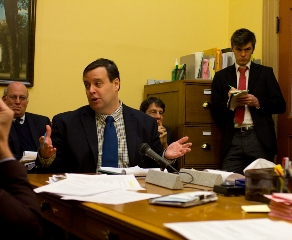
The classification of people as temps who are working full-time for long periods is an “injustice,” Vermont State Employees Association executive director Steve Howard said. Those workers deserve the benefits and protections afforded their colleagues, he said.
But Howard said that under a pilot program launched this year by the state, close to 50 former temps working in the Health Access Eligibility Unit (HAEU), which works with VHC on Medicaid and premium subsidy eligibility determinations, is a step in the right direction.
The number of hours a temp can work before being replaced was reduced from 1,520, roughly six months of full-time work, to 1,280, and Howard said VSEA will be watching closely which agencies and departments seek exemptions from that new threshold.
State officials were not able to provide figures on how many temps work for the exchange or HAEU, or how many had worked there past the temporary worker threshold.
Optum’s workers in Vermont cycle through on one- to two-month stints and have to be trained when they arrive, according to the Vermont Health Connect worker. State officials were not able to say how many Optum workers are on the ground in Vermont.
Miller said new Optum workers continue to arrive, but to his knowledge they are not being cycled between VHC and other Optum projects.
But some of Optum’s workers are flown to and from Vermont weekly or semi-weekly at the state’s expense, Miller confirmed.
Past mistakes could come back to haunt customers
The VHC source also warns that workers are not tax specialists and applications were approved qualifying people for subsidies that could cause them to lose, or gain, money at tax time.
There are roughly 21,000 customers receiving premium tax credit subsidies. And while there are limits on what they could find themselves paying back, thousands of exchange customers could be in for an unwelcome surprise next April.
A federal report this year by the Health and Human Services Inspector General included Vermont among several state exchanges that were unable to properly verify income and citizenship information. That is clearly still the case for VHC.
There are 6,700 open cases in which Social Security numbers couldn’t be verified; 4,900 in which citizenship is not verified; and 2,200 in which immigration status is not verified.
If there is a greater than 10 percent difference between self-reported income and the last tax return filed with the IRS, a verification process is triggered at the state level, Miller said.
There is no way to know how many of the 14,000 people with unverified income are among the 21,000 Vermonters receiving premium assistance through tax credits, or if the incomes of others were verified properly.
In other cases during the past year, people were hastily added to the state’s Medicaid rolls in order to close out their cases and get them off the hands of overworked employees, the VHC worker said.
States typically check people’s Medicaid eligibility annually, but Vermont suspended such efforts in August 2013, at first to focus on the extended open enrollment and later because many long-time beneficiaries were directed to the Web portal, causing confusion.
Medicaid beneficiaries who self-report income changes are being processed as they are received, Miller said, but the state won’t resume its own verifications until mid-2015.
