

 Editor’s note: Jon Margolis is VTDigger’s political columnist.
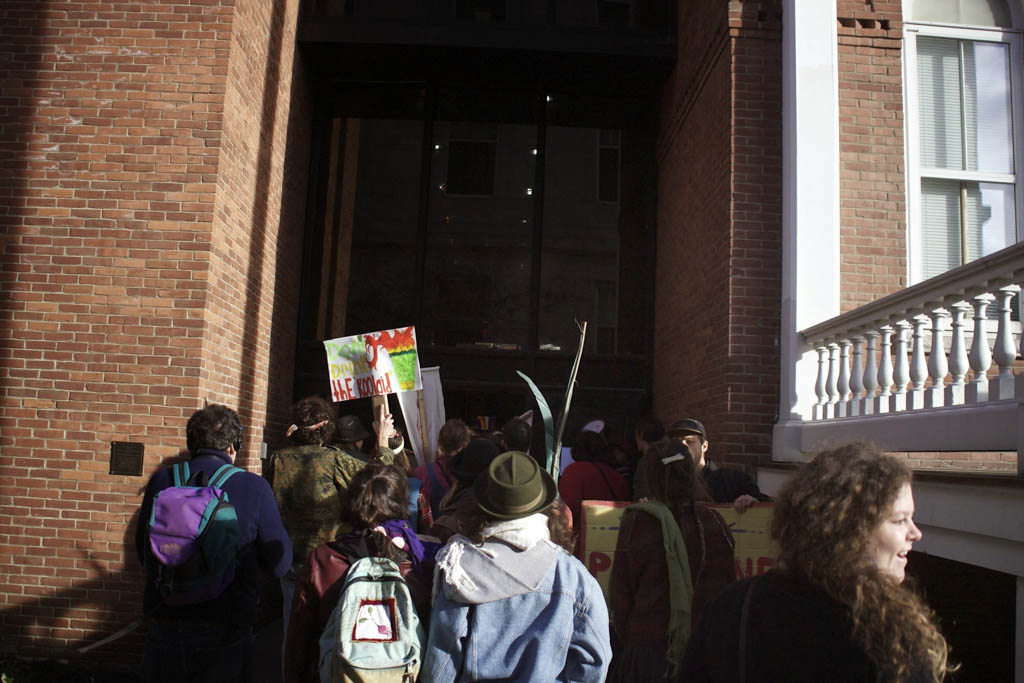
[T]hat was a very Vermontish act of civil disobedience in Montpelier on Monday night. The protesters promised to keep things orderly, and even courteous. Top officials of Gov. Peter Shumlin’s administration – the target of the protest – not only allowed the civil disobeyers to remain in a state office building after its official 5 p.m. closing, but even ordered up pizza and salad for the protesters so they would have more than merely their ardor for sustenance.
Vermontish? If this event had been any more peaceful and polite, it would have seemed downright Canadian.
Yes, 64 of those who refused to leave the building at closing time were issued citations for trespassing. Not a big surprise; on the face of it, they do seem to have broken the law, even if they broke nothing else in the Pavilion Building except its silence, and that more by singing than by shouting.
But any penalties imposed on them are likely to be mild. After all, the extent of the law-breaking and the manner of the arrests had been amicably agreed upon by the police and the demonstrators. No harm, little foul.
Global warming may be one of those issues. Perhaps so is hydraulic fracturing (fracking) by which some (though not all) of the gas slated to go through this pipeline will be produced. The pipeline is not.
But several questions, starting with this one:
How do you suppose the protesters – not just the 80 or so who entered the building, but the roughly 500 who gathered in front of the Statehouse a block away – got there?
Hmmm. No one seems to have seen scads of bicycles parked nearby, and Montpelier doesn’t have much in the way of a public transportation system.
Odds are, then, that almost all the protesters got there by car, burning gasoline – a fossil fuel – all the way.
So they could voice their opposition to burning fossil fuel.
Well, political advocacy has never been equated with – or particularly troubled by – absolute consistency.
If it were, protests against burning fossil fuel would not be directed at a governor who rarely misses an opportunity to voice his opposition to … burning fossil fuel. Few American politicians outdo Peter Shumlin as a (self-proclaimed, to be sure) warrior against climate change and champion of renewable energy.
In fact, that’s why Shumlin – along with most officials in Vermont and a majority of the Legislature – favors extension of a natural gas pipeline from Colchester to Middlebury, and eventually south to Rutland. Those officials say that natural gas – which, at least as it burns, produces less greenhouse gas than heating oil – is the perfect “bridge” fuel between the dirtier fossil fuels of coal and oil and the (sort of) non-polluting wind and solar power of the hoped-for future.
If some 4,000 homes and businesses in the area of the first phase of the pipeline extension switch from heating oil to natural gas, said Vermont Gas Systems spokesman Steve Wark, those customers will save $195 million over 20 years, and their furnaces will spew 300,000 fewer tons of greenhouse gases into the air.
Not so, say the protesters and the organizations that mobilized them, 350.org and Rising Tide Vermont. They argue that Vermont Gas and the rest of the industry ignore the methane leaks. Methane is a potent greenhouse gas, and some academic research has concluded that so much of it leaks as natural gas is produced and transported that the net result is production of more greenhouse gas than would spew from all those oil furnaces.
There are such studies. But the one most frequently cited by pipeline opponents, a paper by R.W. Howarth of Cornell and two associates, has come under strong criticism, not all of it by scholars with ties to the natural gas industry.
A study by another Cornell scholar, Laurence M. Cathles III, found that the Howarth paper was “seriously flawed” because it over-estimated how much leakage would occur.
As with so many controversies, this one pitting equally credentialed experts asserting conflicting conclusions can be confusing to the general public. Who can one believe?
Perhaps the Public Service Board? It took expert testimony from both sides, with each given the opportunity to cross-examine the other, and concluded that the pipeline would save consumers money and lead to a net reduction in greenhouse gas emissions.
The PSB could be wrong, but there is no reason to believe it is not doing what it thinks is right, or that it is not doing essentially what the Legislature (its boss) wants it to do.
To some extent, Vermont Gas has been its own worst enemy in this controversy. Its response to its opponents has been high-handed to say the least. And when it acknowledged that it had underestimated the cost of the pipeline construction by almost 40 percent, it inevitably created the suspicion that it had deliberately low-balled the price estimate at the beginning.
Not to mention giving opponents ammunition for doubting all of its projections.
Even if using natural gas reduces emissions for a while, opponents say, the pipeline is bad policy because it will lock in fossil fuel use for decades. The pipeline could last 50 years or more, and the millions that Vermont Gas invests in it would create a disincentive to switch to renewable energy.
Maybe. But this is America. The system is democratic capitalism, in which new technologies, the market and government policies regularly displace old ideas, old infrastructures, old businesses. Tomorrow, or next year, a new invention or process could render natural gas obsolete.
The protesters might also take time to ponder what this demonstration does to the future efficacy of demonstrations. Invading (however peacefully) the building that houses the governor’s office may be an effective tactic where the dispute is essentially moral, where one side is unmistakably right, the other misguided if not downright evil: racial segregation, unnecessary war, suppression of human rights.
This is not one of those disputes. It’s a legitimate policy argument, one in which decent and thoughtful people can reasonably disagree. Threatening (if only implicitly) to occupy the governor’s office over this kind of dispute diffuses and dilutes the potential power of demonstrations. The next time there is a real moral issue, the public is more likely to ignore the civil disobedience that would – and should – take place.
Global warming may be one of those issues. Perhaps so is hydraulic fracturing (fracking) by which some (though not all) of the gas slated to go through this pipeline will be produced. The pipeline is not. There is a tendency these days to invest some issues of limited impact with far more significance than they deserve.
Something the protesters might think about as they drive home, burning fossil fuel along the way.
