


BARRE TOWN — Brandy Ofciarcik-Perez pointed from her lawn to a sharp bend in the road as a flatbed truck carrying granite slabs overshot the center line in its trajectory down the hill toward her home.
“People fly through here,” the 40-year-old dance instructor said, holding one of her three children by the hand. “I used to actually put up barriers.”
Traffic is just one of the concerns raised by residents of Graniteville Road about an asphalt plant operating at the Rock of Ages quarry. More than two dozen neighborhood residents also say the plant is noisy and pollutes the air.
Many landowners in the self-proclaimed Granite Center of the World have posted signs in their yards saying “stop the asphalt plant.”
The back story
Northeast Materials Group, the plant’s owner, started operating a rock crusher at the Rock of Ages facility in 2009. The Washington-based company mines granite at the quarry for landscaping and infrastructure use.
Neighbors near the site attempted to block the rock crusher, arguing the company needed a new Act 250 permit. An appeal in that case is pending before the state Supreme Court.
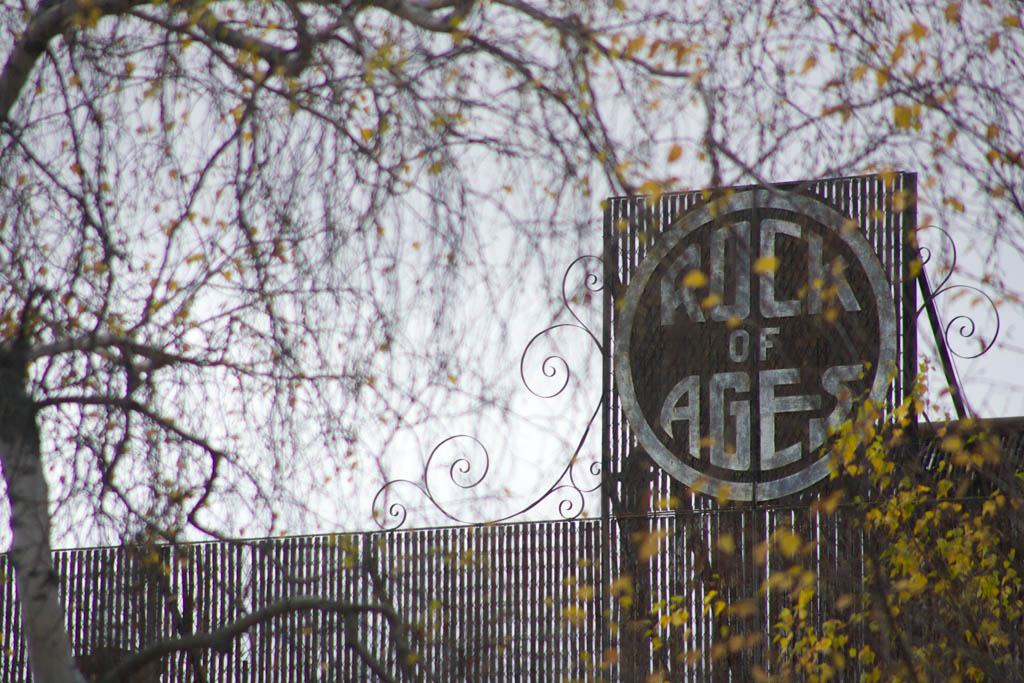
In January 2013, Northeast Materials received an Act 250 land-use permit to operate a hot-mix asphalt plant.
Now residents are appealing the Act 250 permit in Environmental Court, specifically alleging that the company’s air quality permit is flawed. The next hearing is scheduled in the spring, attorneys say.
An attorney representing the plant claims that no one has provided medical evidence of physical harm caused by the plant. And so far, state investigators have found no evidence of permit violations.
But Perez said she can smell diesel, asphalt and dust wafting down the hill. She said her husband has been using an inhaler more often to treat his asthma since the plant began operating in 2013.
“When I first moved up here, it almost seemed idyllic,” Perez said. “I can see that it’s changing. And it doesn’t seem to be changing for the better.”
Since the asphalt plant began operating, the state has received 30 odor complaints from eight neighbors. None were filed previously, according to John Wakefield, chief of the state’s air quality permit compliance division.
He said the state has tried to confirm nearly all of the complaints, but often arrives after any odors may have passed. He said the state put three staffers in Graniteville for two days during the plant’s largest production days, and found only a few instances of an asphalt smell lasting about 15 seconds. (Wakefield said Northeast Materials Group was not informed that the state was inspecting for off-site air emissions.)
Wakefield says the plant is relatively small, and it produces as much asphalt in an entire year as other plants make in a day. He said at this production rate, there is little chance of carcinogens affecting nearby property owners. Enforcement action is not imminent.
“Because of their limited production, we don’t have much to go on,” Wakefield said. “Without some sort of state witness, there is a good chance we may not win that case.”
In preparation for the appeal, some residents have been documenting instances in which they smell the asphalt, according to Doug Ruley, an attorney with the Vermont Law School who is representing the landowners.
Lower Graniteville resident Suzanne Smith and her husband, Padraic, are among the residents keeping a record of odors. The couple are concerned the state is not enforcing the permit.
“I know numerous calls have been made and people have come up, but a lot of times it has to be in the moment,” Padraic said of the asphalt smells. “You have to be there when they happen.”
Asphalt dangers
The asphalt plant emits several hazardous air pollutants, including formaldehyde, a probable cancer-causing agent, according to the Environmental Protection Agency. Its permit requires that the plant not produce any odors that cause “injury, detriment, nuisance or annoyance to any considerable number of people or to the public.”
Plant opponents are seeking to point out what they say is a flaw the Air Quality Permit granted by the Agency of Natural Resources, according to Ed Stanak, a retired Act 250 district environmental commissioner who is consulting with the landowners.
Hazardous air pollutants from the asphalt plant include benzene, formaldehyde, arsenic, cadmium and nickel, according to the 2012 permit.
Rather than placing specific emission limits for each pollutant, the state required that the plant operate efficiently to prevent benzene and formaldehyde emissions, and imposed particulate emission limits for arsenic, cadmium and nickel, according to the permit.
Stanak said there is nothing in the agency’s air pollution regulations that allows them to to this.
The citizens’ group will send a letter to the Vermont Natural Resources Board, which oversees Act 250 applications, detailing their concerns.
A representative from the the state’s Air Quality and Climate Division, which issued the permit, was not available for comment Wednesday. Wakefield, of the division’s enforcement section, said the company has not been operating the plant at full capacity.
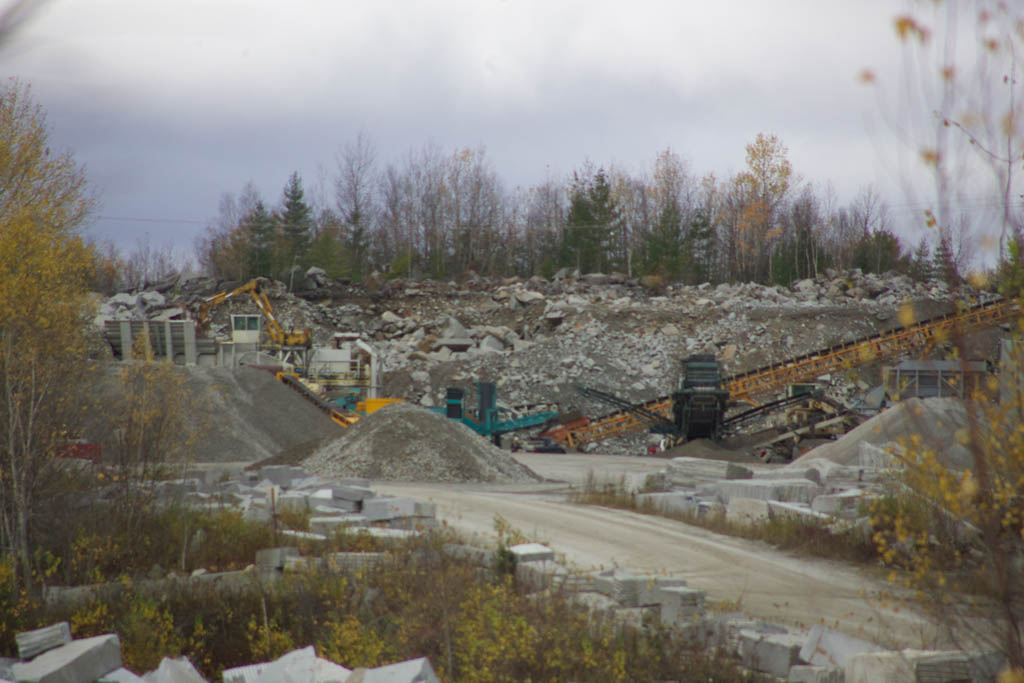
Neighbors are also concerned about dust emissions from the plant’s rock crusher. Acceptable pollution levels for the crusher were grandfathered under Rock of Ages’ previous permit. Rock of Ages has been using the site to crush granite since the the 1940s, according to the Natural Resources Board.
Suzanne Bennett, 76, has lived above the Rock of Ages quarry for 54 years. She no longer sits outside her home when the plant is running due to the noise, asphalt smell and dust, she said.
“The dust is extreme. My sister came over and helped me wash the window. And three weeks after you could write your name on it,” she said.
Legacy of a company town
Matters then got worse for Bennett, her daughter, Lori Bernier, and her husband, Marc Bernier, who live within a mile of the plant. Just weeks before an Act 250 appeal hearing last year, Rock of Ages filed suit against the family, alleging they violated a condition in their deed that prevents them from speaking out against the company.
The “vast majority” of the homes surrounding the quarry were once owned by Rock of Ages, who asked subsequent buyers to sign a deed agreement attesting that the company’s operations were not a nuisance, according to an attorney representing the company.
Lori Bernier, 50, was diagnosed with multiple sclerosis and and later Lyme disease, forcing her to be bedridden for five days a week at times. She and others formed a citizens’ group opposing the plant, Neighbors for Healthy Communities.
After the lawsuit was filed, she did not testify in a hearing out of fear of possible liability. She was hesitant to share information with VTDigger.
“I feel it has really taken away our rights. It has taken away our freedom of speech,” she said. “We still believe we’re not in violation in anything that is expressed in that covenant.”
Daniel Richardson, an attorney in Montpelier representing the Berniers, said Rock of Ages’ lawsuit could set a dangerous precedent.
“It’s a clear message: ‘Don’t oppose us,’” he said.
He said there has never been a case where a private deed covenant cuts off a person’s constitutional rights, including the right to participate in an Act 250 process. He said it’s possible the company may have placed similar provisions in other deeds, and could use them if others speak out.
“It creates this liability for people that participate by right,” he said. “It’s a scary frontier for public participation in Vermont.”
Jim Goss, a Rutland attorney representing Rock of Ages and Northeast Materials Group, said the plant in its present location has satisfied every single regulatory standard.
He said the plant is required to test for emissions, and monitors regularly for an excess level of pollutants. To reduce dust, he said the company regularly sweeps an access road and sprays water to hold down dust within the plant.
“We have had complaints about both the crusher and hot-mix plant on days and weeks when those facilities were not operating,” Goss said. “I think those folks are complaining about operations that have been going on for a long time.”
Northeast Materials is required under its Air Quality Permit to test its stack for emissions, but due to the low production levels, the state waived the first year’s testing results. It does expect an emissions report this year, a state official said.
As for the noise, Goss said the Rock of Ages plant has been operating for more than a century. He said the asphalt plant is operating within the existing quarry, and it is difficult to parse out which operation is causing dust and noise.
“This has less to do about the environment and more to do with fear of change,” he said.
Some landowners want the plant to be relocated on the more than 1,000 acres of property owned by Rock of Ages. Others want the plant removed entirely.
Russell Austin, 55, said he has lived in Graniteville for 33 years. He said he is fascinated by the mountains of granite that leave a lasting mark of village’s history. He understands it is an industrial area, but now he has trouble finding peace during the day.
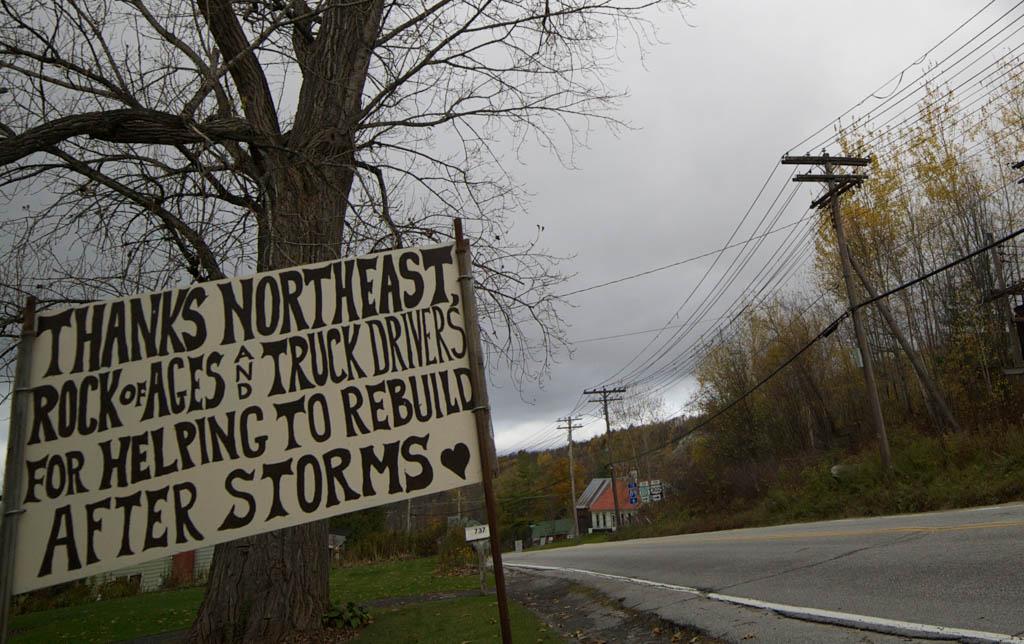
On Austin’s lawn, there is a sign protesting the asphalt plant; on another lawn up Graniteville Road, there is a sign in support of the asphalt plant and the quarry operation.
“At one time, the people that lived here in the community, they built this community. They had to live here. It was close to work,” he said. “We have always been in close ties with our neighbors. And this is kind of tearing us apart.”
“At one time, the people that lived here in the community, they built this community. They had to live here. It was close to work,” Austin said. “We have always been in close ties with our neighbors. And this is kind of tearing us apart.”
