

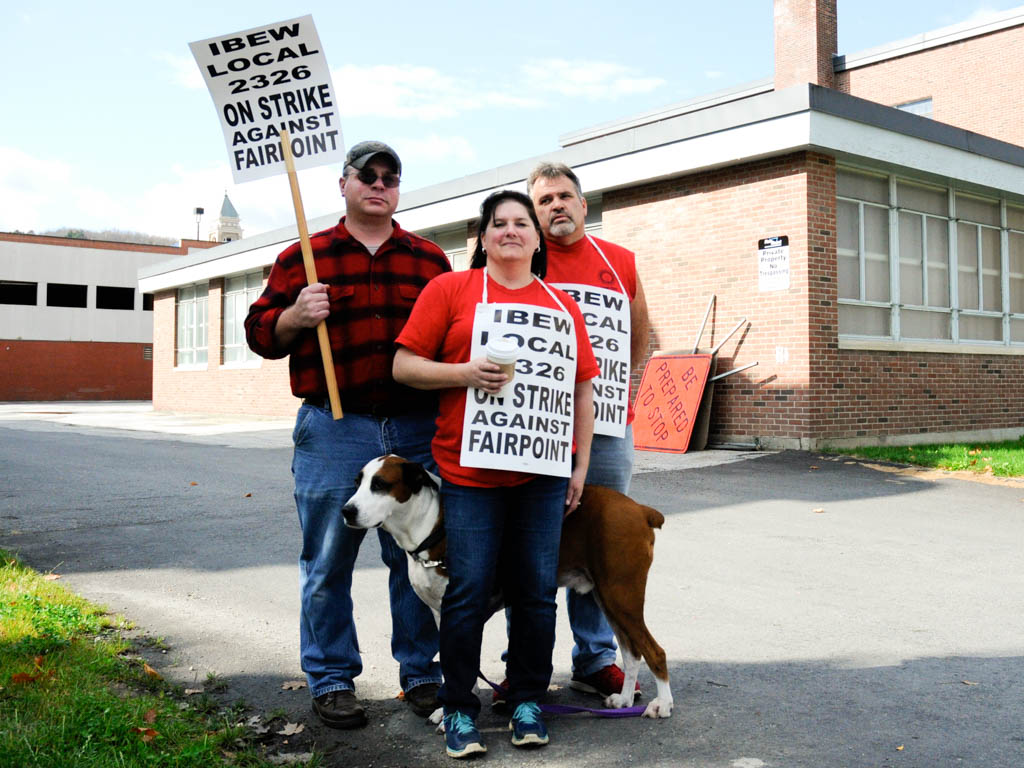
Striking FairPoint Communications workers formed picket lines around Northern New England on Friday.
The strike began just after midnight, but there weren’t many workers on the clock at that hour, according to picketers at the company’s Montpelier office. FairPoint’s White River Junction dispatch center is the only facility staffed 24 hours a day, and personnel there have been reduced to two or three people.
Pension and health care changes are at the core of the dispute between the publicly traded company and the International Brotherhood of Electrical Workers and the Communications Workers of America. The unions represent about 1,700 of FairPoint’s approximately 2,550 employees in Vermont, New Hampshire and Maine.
Gov. Peter Shumlin has been monitoring the news regarding the labor negotiations, according to his spokeswoman, Sue Allen. Shumlin “is disappointed to see that no compromise has been reached that would avoid a strike,” she said.
“The Governor hopes the parties come back to table soon to work this out. Meanwhile, he expects FairPoint to fulfill its commitments to maintain service and respond to its customers, and has asked his Department of Public Service to monitor that situation closely,” she said in a statement.
Allen said customers who experience a service problem, after reaching out to the company, also can call the Department of Public Service’s Consumer Affairs hotline at 800-622-4496 to report any concerns.
In a statement released Friday morning, FairPoint spokeswoman Angelynne Beaudry said customers should experience no interruption of service. For customer assistance, she advised residential subscribers to call 866-984-2001 and business subscribers to call 866-984-3001.
“We value every customer and it is important for them to know that we have comprehensive contingency plans in place to ensure the service they, and the economy and communities of northern New England, rely on continues without interruption,” Beaudry said.
But Lisa LeFebvre-Barr, Montpelier picket officer and the sole employee who would have reported to work at the city’s office Friday, said installations and repairs will suffer without staff to provide the services.
She said FairPoint employees had noticed replacement workers throughout the region since late summer, but had not seen them in the past couple of weeks.
Beaudry did not respond to an inquiry regarding the number of contingency staff currently in place throughout the region, nor the company’s capacity to respond to installation or repair requests.
BACKGROUND
The strike that commenced Friday morning is the first since FairPoint acquired Verizon’s landline business in 2007.
The action follows about six months of failed negotiations with IBEW and CWA workers, whose contracts expired Aug. 2. FairPoint declared an impasse less than four weeks later and unilaterally imposed new employment terms.
According to Beaudry, prior contracts provided a defined benefit pension plan with no employee contributions and a 401(k) plan with a company match. Health care premiums were paid 100 percent by the company, and workers received unlimited paid sick days. She said the changes the company instituted bring employment compensation into line with regional standards and benefit plans offered to other FairPoint employees, including management.
“In total, under the old agreements, the average wage and benefit costs for FairPoint’s union-represented employees in Maine, New Hampshire and Vermont were approximately $115,000 per year – not including the future costs of pension and other post-retirement benefits,” Beaudry said.
LeFebvre-Barr said workers are grateful for those packages.
“It’s not about getting more. It’s about keeping what we have,” she said.
According to a news release from the IBEW and CWA, FairPoint’s initial proposal in April would have cost workers more than $700 million. Aside from pension and health care changes, the company sought to institute a two-tier wage system that would pay new hires as little as minimum wage.
“In addition, the company sought to end job security and outsource union members’ work to out-of-state and foreign contractors,” according to the release.
Union members authorized their leaders to call a strike in July, but the trigger was not pulled until Thursday evening.
The unions say they have offered concessions that would save the company hundreds of millions of dollars, “But they absolutely refuse to compromise on any significant issue,” said Peter McLaughlin, business manager of IBEW Local 2327 in Maine.
By opting to strike as a method of fighting to keep their compensation packages, workers are giving up their pay for the duration of the strike. They receive no compensation from either the company or the unions for work missed during the strike. Their health insurance is paid through October, but will expire at the end of the month.
This is the third strike Matt Orr, now a splice service technician, has weathered. He said workers don’t want to take the step, but feel their hands have been forced.
“They want to freeze my pension, not give any health care to retirees,” Orr said. “It just seems wrong.”
He, LeFebvre-Barr and technician Dennis Barr comprised the three-person picket line in Montpelier on Friday morning, joined by LeFebvre-Barr’s mutt Spike. They said they “jump through hoops to make things work,” but FairPoint has yet to purchase or build systems that effectively integrate field work with business operations.
In Beaudry’s public statement, she expressed disappointment in the union’s decision to strike.
“While we have implemented our final proposals, we have always remained willing to negotiate and have committed to evaluate and respond to any counterproposal from the unions that meaningfully addresses the core issues of these negotiations,” Beaudry said. “So far, we have not received any such counterproposals.”
She said in the meantime, “FairPoint will focus on meeting the product and service needs of our customers.”
In addition to Vermont, New Hampshire and Maine, North Carolina-based FairPoint provides data, voice and video service residential and business customers plus wireless companies and wholesale resellers in 14 other states.
The firm bought Verizon’s Northern New England land lines in 2007. The deal was approved in 2008, but a year and half later, the company filed for bankruptcy, from which it emerged in 2011.

