


Two teenagers have attempted suicide in the past five months at the Brattleboro Retreat.
One of the patients who attempted suicide later died, and her parents say it was a “direct result” of her injuries at the hospital.
The two cases and a recent sexual assault on the same adolescent ward could jeopardize federal funding for the psychiatric hospital. The Centers for Medicare and Medicaid Services is reviewing the Retreat’s certification, and the state is scrambling to help the hospital ensure patient safety and compliance with federal rules.
The Retreat is home to the only child and adolescent inpatient psychiatric unit in Vermont and holds several contracts with the Agency of Human Services to provide substance abuse programs and mental health services for state patients.
Last year the state paid the Retreat about $7.5 million just for adult inpatient psychiatric services; about $4.2 million of that total came from the federal Medicaid program. If the Retreat is decertified, the state would have to find a way to pay more for services through the General Fund.
The suicide and assault events have also undermined lawmakers’ confidence in patient safety at the facility. Recent events have left lawmakers wondering if the Department of Mental Health is providing adequate oversight of the state’s decentralized mental health system and whether it should continue sending patients in state custody to the Retreat.
The latest problems were uncovered in August when investigators found a patient with a history of sexually assaultive behavior engaged in sexual activity with another patient who had a history of being sexually abused.
The Retreat’s most recent plan to address patient safety (also known as a plan of correction) was accepted by regulators on Sept. 2, but the facility still could lose federal funding, which would have serious consequences for the Vermont mental health care system.
A follow-up visit from state investigators, acting on behalf of the federal government, prior to Oct. 6, will determine if the hospital’s federal certification is revoked.
Retreat officials declined to be interviewed for this report. They said they needed to focus their energy on getting the hospital back in compliance with federal law.
The Retreat handles patients who have severe cases of mental illness, and tragedies occur there that are beyond the control of caregivers. The hospital was recently cleared of any liability for a teenager’s death by suicide in January at an outpatient facility it operates.
But lawmakers who are responsible for overseeing Vermont’s mental health system say the events at the Retreat that occurred in the late spring and summer are a kind of deja vu. The Retreat nearly lost its certification because of a fatal drug overdose in January 2012.
Officials did not disclose that incident to lawmakers that year even as the Legislature made crucial decisions about how to move ahead with the state’s decentralized mental health system after Tropical Storm Irene heavily damaged the Vermont State Hospital in Waterbury.
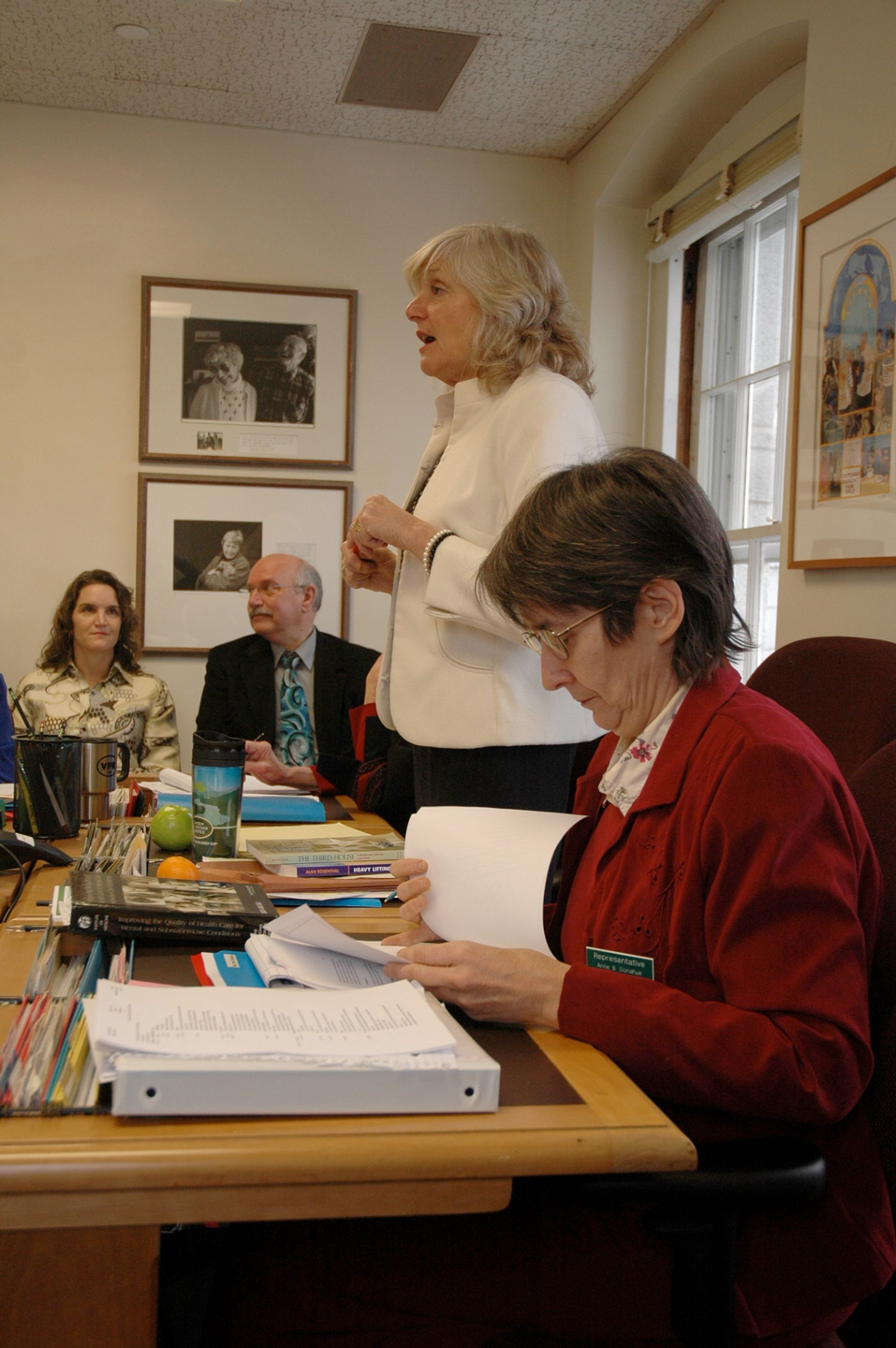
“Last year, the Department of Mental Health said that it intervened to help improve (the Retreat’s) quality assurance program, and yet, we are back again this year with another death and more ‘near miss’ events,” said Rep. Anne Donahue, R-Northfield, a member of the joint Mental Health Oversight Committee.
Sen. Claire Ayer, D-Addison, the committee’s vice chair, said the department’s efforts fits a pattern of “communication issues” replete across the Agency of Human Services.
Ayer also said she was disappointed with Retreat officials for not being more forthcoming about what had taken place on the adolescent unit when they testified before the committee earlier this summer.
Ayer said she plans to work with the committee’s chair, Rep. Ann Pugh, D-South Burlington, to see if Retreat officials can be called in to testify at its next meeting on Sept. 23. Pugh could not be reached for comment.
Suicide attempts and patient safety
On May 5 at approximately 10:30 a.m., a 15-year-old girl was found with no pulse in her room on Tyler 3, an adolescent unit at the Retreat.
She had hung herself using a pant leg behind a locked door.
Staff performed CPR and she was rushed to Brattleboro Memorial Hospital. She was later taken to Baystate Medical Center in western Massachusetts.
She died less than two months later of injuries that resulted from the suicide attempt, according to a grievance letter her parents sent to the Retreat and state and federal officials.
The Massachusetts Medical Examiner cites the girl’s cause of death as “pending,” and other records relating to her death have not been made public.
VTDigger has chosen not to identify her because she is a minor and her parents, both doctors from Massachusetts, could not be reached.
On June 12, another 15-year-old girl attempted suicide by strangulation with a piece of clothing, this time in the Tyler 3 bathroom.
When she was found her lips were blue and her face had a “pallid” color. Staff revived her and determined she did not require outside medical treatment as a result of the suicide attempt.
Emails from the Retreat furnished by the Department of Mental Health as part of a public records request, as well as a survey report from state investigators, make reference to another suicide or self-harm event between Jan. 30 and June 1, but neither document provides specifics.
The Retreat has refused to make information on the incidents public, Donahue said.
In an email to Donahue, Konstantin von Krusenstiern, a Retreat vice president, writes “the (CMS report) doesn’t reference any specifics about the incidents, (sic) dates, etc., so it is difficult to confirm which incidents they are referencing.”
Neither Retreat nor DMH officials who testified at a July 22 hearing of the Mental Health Oversight Committee made any mention of the June 12 suicide attempt, though both were aware of it. No reference was made to other self-harm events on Tyler 3.
At the hearing Linda Nagy, another Retreat vice president who also holds the title of Chief Nursing Officer, suggested that the girl who died would have an easier time taking her own life at a non-psychiatric hospital.
Asked by lawmakers if she knew the girl’s official cause of death, Nagy said she did not.
Prior to the committee hearing, Dr. Bill McMains, a DMH psychiatrist and member of the quality assurance team, expressed concern about the string of suicide and self-harm attempts on Tyler 3 in an email to Nagy.
Nagy details in a response email the steps the Retreat took in the wake of those incidents.
The suicide attempts began in March, she writes, and appeared “in some part to be a reaction to our residential incident in January.”
The “residential incident” was the suicide death of a teenager in which the Retreat was found not to be liable. Nagy explains that some of the children were back-and-forth between the outpatient facility and Tyler 3, and had known the teen who died.
“As you know, behavioral patterns can tend to become reinforced negatively in adolescent psychiatric settings,” Nagy writes, but she adds that most of the self-harming behavior “seemed of an acting-out nature.”
In response, Retreat workers increased surveillance, limited the amount of time patients could be alone in their rooms and required that doors be left open at night.
Staff stressed the “potentially lethal nature of these behaviors,” and instituted a reward system for positive behavior, including a drop box for implements that could be used to self-harm. Patients were thanked when items were turned in.
They increased the use of a peer mentoring system where “more positive patients” work with others who might be at risk of self-harming behavior.
Retreat staff also instituted a pizza night on Fridays to reward patients for making it through the week with no self-harm events. An ice cream social was added on Sunday nights if patients made it through the weekend without a self-harm incident.
“All these interventions helped,” Nagy writes.
Paul Dupre, commissioner of DMH, said McMain found that the Retreat’s response was “adequate.”

Two of the three self-harm or suicide attempts in the last eight months, including the one that was allegedly fatal, occurred behind locked doors on Tyler 3, according to a survey report. Patients are afforded five minutes twice per day to change clothing in private.
In the case of the girl who died, the significant event report states she was seen awake in her room at 10:15 a.m., but staff did not re-enter her room until 10:30 a.m.
Investigators say that in at least one instance in the past year, a staff key broke in a locked door. The facilities manager estimated that it takes 20 minutes to access a patient’s room when a key breaks in a lock. That occurs roughly once a year, they said.
The Retreat does not appear to have any intention of removing the locks on the doors. The hospital instead wants to use Halligan bars, a tool commonly used by firefighters to pry open locked or barricaded doors.
Donahue, who surveyed other hospitals in the state, said none had doors that could be used to lock out staff.
Asked if DMH would like to see the locks removed from inpatient units at the Retreat, Deputy Commissioner Frank Reed said, “We’re looking into that.”
CMS had accepted the Halligan bars as a reasonable way to ensure timely access to patient rooms, he said.
Reed said the hospital needs to maintain a balancing act between making sure patients feel they have privacy and preventing them from taking their own lives.
DMH record keeping ‘seriously remiss’
The Retreat reported the May 5 attempted suicide to the state Division of Licensing and Protection. A subsequent investigation by Licensing and Protection surveyors, acting on behalf of CMS, led to a July 8 termination letter from the feds.
The June 18 survey report found a mental health worker failed to conduct a timely reassessment of the girl’s mental state following a reported change in her behavior that included suicidal ideation.
The Retreat was also cited by regulators for not being able to gain timely access to locked patient rooms.
CMS determines whether a facility qualifies for federal Medicare and Medicaid funding based on the division’s surveys. There are separate significant event reports submitted to the Department of Mental Health as well.
The Retreat said it faxed a copy of a significant event report on the May 5 suicide attempt to DMH. The nurse manager also called two different state employees.
However, when Rep. Donahue requested a copy of the report in August, DMH said it had never received the fax, and did not have the report on file. The suicide attempt was not included in a list of significant events kept by the department.
“The most basic record-keeping at DMH is seriously remiss for purposes of quality oversight,” Donahue said in an email. “DMH was aware of the May suicide attempt of [name withheld] and her later death, and yet did not have a copy of the significant incident report from the Retreat, did not have the suicide attempt listed in the mandatory report list of significant events, and did not ask for it when it was found to be missing.”
Reed, the deputy DMH commissioner, said the department currently relies on a “manual process” for distributing significant event reports internally. The reports apparently are not sent to parties by email. Reed said the department is looking at ways distribution of reports “can be automated.”
The June 12 suicide attempt was reported as a significant event to the department but was not included in the survey report conducted by the Division of Licensing and Protection for CMS on June 18.
The CMS report made no mention of the June 12 suicide attempt made just days before the site visit. The report only included the May 5 suicide attempt and a vague reference to a previous self-harm event or suicide attempt that occurred between Jan. 31 and June 1.
DMH’s quality assurance team, which helps hospitals ensure compliance with state and federal rules, doesn’t always look at event reports from the hospitals and typically relies on survey reports from the Division of Licensing and Protection.
Fran Keeler, director of the Division of Licensing and Protection, the state survey agency, said it includes “only information that directly backs up a regulatory finding” in survey reports.
Poor record keeping and the “manual” process for sharing information within the Department of Mental Health may be impacting the state’s ability to provide adequate oversight of hospitals and other organizations that treat state patients.
Moving out of ‘crisis mode’
Vermont’s mental health system of care has been operating in “crisis mode” since flooding forced the closure of the Vermont State Hospital in 2011, according to Rep. Mary Hooper, D-Montpelier.
DMH and the Department of Buildings and General Services opened a new smaller state psychiatric hospital in Berlin this summer.

But the crisis response mentality that has pervaded the department for several years needs to shift toward a review of the decentralized system, Hooper said. The system was regionalized after the Vermont State Hospital closed and now acute care treatment will be provided at Vermont Psychiatric Care Hospital in Berlin, Rutland Regional Medical Center and the Retreat. In addition, the state refers patients with less severe psychiatric conditions to nine additional facilities. In all, the state spends about $22 million on what is referred to as the Vermont State Hospital system of care replacement.
“We have to start thinking about how the system is working, and if we have the right processes in place for proper oversight,” Hooper said.
Dupre said the opening of the Vermont Psychiatric Care Hospital hasn’t impacted his department’s oversight of psychiatric facilities dispersed around the state — if anything, he said, oversight has increased.
Asked for specific examples, Reed stepped in and said that oversight had stayed constant throughout the opening of the new state hospital.
Helping hospitals shore up deficiencies in patient care is a process that must be continuous, and there’s always room for improvement, Dupre said.
In the past year, DMH rehired Dr. Jay Batra as its medical director and promoted Susan Onderwyzer to director of mental health services.
The two have taken the lead in overseeing hospitals that accept patients in state care.
Donahue, who publishes a quarterly newspaper on Vermont’s mental health system, reported that DMH has asked that, in addition to submitting information on serious injuries or deaths, designated hospitals submit the following information:
• Admission screening for violence risk, substance use, psychological trauma history;
• Hours of physical restraint use and hours of patient seclusion;
• Patients discharged on multiple antipsychotic medications with appropriate justification;
• Post-discharge plan for continuing care, and documentation that the plan was sent to the next level of care provider (i.e. an outpatient facility or case worker).
Some of those measures are a response to CMS violations at Springfield Hospital’s Windham Center, which weren’t reported to DMH until Donahue made them aware of the violations.
Officials confident they won’t need Retreat contingency
Dupre said DMH developed a contingency plan “last time around” for what it would do if the Retreat were to lose its ability to participate in Medicare and Medicaid.
It’s not as though patients would be required to walk out the door immediately if the Retreat lost CMS certification, he said, adding that the state would continue to house its patients there while looking for appropriate venues for transfer.
For adolescent psychiatric patients that would mean transfers to out-of-state facilities, while outpatients would likely be transferred to other Vermont facilities.

The Retreat has a 14-bed unit that houses acute psychiatric patients in state custody. The unit had an average of 22 patients throughout July, and has never had a monthly average of fewer than 14 patients in the last year-and-a-half.
The state uses Medicaid to pay for psychiatric treatment and substance abuse services at the Retreat, and were it to lose CMS certification, the state would have to come up with millions of dollars from another source.
Both the Retreat and DMH officials appear confident that won’t happen.
But for lawmakers it raises a larger question of whether patients should be sent to the Retreat if systemic and lasting improvement can’t be made.
“That is what we need to determine,” said Sen. Ayer, adding that she’s hopeful lawmakers will get satisfactory answers at upcoming meetings of the Mental Health Oversight Committee.
In addition to the Sept. 23 meeting, the committee will meet once more before CMS issues its decision on whether to terminate the Retreat’s certification.
That meeting will be Oct. 3. Both meetings will be at the Statehouse in Montpelier and are open to the public.
