


A financial counterpart to the “Slow Food” movement, which emphasizes local, sustainable consumption, has begun operating in Vermont. Slow Money Vermont officially launched with a public event at the Vermont College of Fine Arts on Tuesday night.
Vermont has long led grassroots sustainable agriculture efforts, Woody Tasch, a social investment adviser, told a standing-room-only audience in Montpelier. Now, he said, the state needs a more formalized mechanism for investing in local farms.
Tasch is the founder of the national Slow Money Alliance, a network of businesses and investors geared more toward “making a living” than “making a killing,” as Slow Money’s principles articulate. The group’s name follows the lead of the international Slow Food movement, conceived as an antidote to fast food. Instead of constant growth and profits, Slow Money’s economic paradigm values personal health, public good and human relationships.
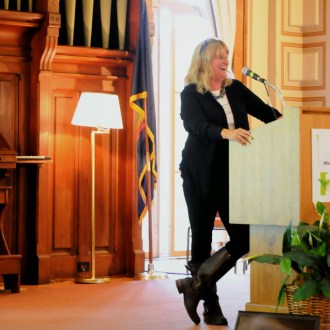
Even without a formal chapter, “slow” money already has been spent in Vermont. Following Tasch’s keynote address, Cheryl DeVos of Kimball Brook Farm told the story of transforming her family’s dairy farm to an independent creamery with the help of about 25 “slow” investors. After two and a half years in business, the creamery is now turning a profit, she said.
As the name implies, Slow Money requires patience from investors. Depending on the structure of any individual transaction, deals can involve small to nonexistent interest payments. In the Slow Money economy, enhancement of local quality of life is prioritized over currency as a return on investment.
Founders of Slow Money Vermont hope to facilitate more stories like Kimball Brook’s by coalescing existing efforts in both local agriculture and local investing, and possibly forging new ground.
“What it turns into and what it’s capable of is dependent on what we want it to be,” said Caitlin Jenness of Citizen Cider, Slow Money Vermont’s co-chair.
Jenness, fellow co-chair Mary McBryde, and others have worked for more than a year to found the chapter. At a launch event Tuesday night, they invited others to join them in determining which direction to go next.
To begin with, Slow Money Vermont will cultivate investments in Vermont farm and food enterprises, as opposed to other market sectors. The agricultural focus is consistent with Slow Money’s original vision, though Tasch said that as a decentralized network, chapters are free to apply the principles to other industries, as well.
The founders — actually a task force of the Vermont Farm to Plate Network — also know they want Slow Money Vermont to be a “network” rather than an investment club. Since Slow Money’s founding in 2010, about 13 of the 20 affiliated chapters have formed as for-profit investment clubs.
The two models differ in that investment clubs are closed groups, usually for-profit entities, to which members contribute. Investment decisions are made collectively. Members of Slow Money Vermont likely will be responsible for their own investment choices.
The Vermont founders also intend their network to remain open to more citizens, whether or not a membership model is pursued.
But the simplicity of Slow Money’s conceptual framework cannot conflict with the complexity of investment regulations. Slow Money Vermont founders say they will work with lawyers and state regulators to ensure compliance with state and federal securities law.
In this regard, Vermont may be unique among the states where Slow Money chapters have taken root. At least five state officials plus a representative of Sen. Patrick Leahy, D-Vt., were in attendance at the launch event.
Tasch said that, compared to other parts of the country, there appears to be more interest from state officials in Vermont. Farm to Plate communications director Rachel Carter attributes this to the DNA of Slow Money Vermont: It’s being created by a task force of the Farm to Plate Network — a program assigned by the Legislature to the Vermont Sustainable Jobs Fund, which itself was created by state officials in 1995. More than 13 state agencies hold seats on Farm to Plate’s steering committee and various working groups.
Eric Becker of Clean Yield Asset Management, one of the state chapter founders, said he feels supported in the slow money experiment by state securities regulators.
“They are interested in helping us, not stopping us,” Becker said.
But stepping outside traditional investment models can be a stretch — for regulators and also some investors and businesses, alike.
Marisss Mauro owns Ploughgate Creamery in Fayston, where she took over the historic Bragg Farm. After selection by the Vermont Land Trust to be the land’s new steward, she closed on the property in December. And she took a sizable bank loan to do it.
Now, Mauro may have to take on more debt to purchase equipment that’s needed to become more efficient and achieve her goal: running a small-scale, grass-based dairy farm that produces artisanal butter from her own herd of a dozen Jersey cows.
Though Mauro took a traditional route to get where she is, she said she’s intrigued by alternative forms of capital to grow.
“I never imagined there would be people who would want to invest in my farm,” Mauro said. She wants to learn more about Slow Money before deciding if it’s for her. Like many small business owners, she said, she’s better versed in her business than in the intricacies of business finance.
Introducing and explaining the idea of slow money to business owners like Mauro, as well as investors, will be a major focus of Slow Money Vermont as the group looks for ways to build a sustainable food economy in Vermont.
