

For the second quarter in a row, a majority of Vermont business leaders expressed mild optimism about the state’s business climate, according to the latest Business Conditions Survey of Vermont Business Roundtable members. Their positive outlook is tempered by concerns about health care policy and difficulty hiring, as well as cumulative tax burdens, according to VBR president Lisa Ventriss.
The quarterly opinion survey of Vermont Business Roundtable members, conducted in collaboration with the Williston-based consulting firm Economic and Policy Resources, is an indicator of the state’s economic outlook. The VBR membership — roughly 100 CEOs — are asked about demand, capital spending, hiring and their general confidence levels. Participation rate was 73 percent.
Results from the second quarter survey of 2014 show optimism about the general business climate leveling off in the second quarter. The flatter line follows a steeper uptick earlier in the year. The end of 2013 had brought a precipitous decline in forward-looking prospects. Even with increases in both quarters of 2014, confidence is not back up to 2013 levels.

Ventriss said the results reflect ongoing anxiety about major issues playing out in state policy. Chief among them is health care, she said, especially now that discussion of how to finance single-payer health insurance is picking up.

“How it’s going to be paid for, who’s paying, its effects on their employees,” Ventriss said. The lingering uncertainties add up to “a major concern,” she said.
Just over half the respondents shared negative outlooks about filling open positions, according to a press release announcing the results. Ventriss said hiring difficulties end up holding Vermont businesses back.
She cited the limited pool of businesses and the predominance of small businesses in Vermont as major obstacles to attracting out-of-state talent, in particular.
“Maybe there’s not a big enough career ladder in the firm,” Ventriss said. “Or if something goes sour, they don’t have another 12 companies to look at.”
Jim Harrison, president of the Vermont Retail and Grocers Association, said some members of his organization also cite difficulty recruiting in-state for service-sector jobs.
“I take that as a reflection of the state’s low unemployment,” Harrison said.
Vermont’s monthly unemployment rates continue to rank among the smallest in the nation. A slight increase in July only brought the rate up to 3.7 percent, compared to a 6.2 percent national average.
“It’s good for the economy, obviously,” Harrison said. “But if you’re looking to fill that cashier position for certain hours a day, you may have fewer people that may be interested in it.”

Harrison said the current hiring environment could alternately prompt some employers to pursue more efficiencies to cut down on needed personnel hours, or to improve their employment packages to be a more attractive employer.
“We don’t necessarily need a law saying you need to do XYZ,” Harrison said. Earlier in the year, he lobbied legislators to tamp down the increase in the minimum wage. “If you have a good economy, competition will encourage employers to offer the best package they possibly can to make sure they’re attracting quality employees.”
Food manufacturers currently are experiencing more of an upswing than retailers, he said. The growth for food producers, in particular, reflects a growing Vermont brand of quality speciality food. Vermont Creamery won seven awards the 2014 American Cheese Society competition this month, for example, and only California took home more awards at the Summer Fancy Food Show, one of the largest food shows in the country, Harrison said. “And they’re certainly a little bigger than Vermont,” he said.
Dimmer prospects among grocery retailers reflect national sluggishness in all retail sectors, he said.
“It’s a big pie, and some retailers are doing well, some not as well,” Harrison said. “But the pie is not growing as much as we’d like it to grow. It’s a reflection of the overall economy.”
Ventriss added that state tax policies also pose a hindrance to business growth.
“It really is sort of the whole layering effect of property taxes, income taxes and estate taxes,” Ventriss said, “Which, according to a number of our members, has just become really troublesome.”
Manufacturing across all sectors presented one bright spot in the business conditions survey. For the second quarter in a row, the sector offered the most optimistic outlook on expected demand, capital spending and employment.
Ventriss said that’s due to expansions in the global marketplace that are fueling sales and products for Vermont companies, from food to durable goods.
Associated Industries of Vermont vice president William Driscoll said any indication of positivity is good, but manufacturing still has a long way to go toward improvement in its business climate.
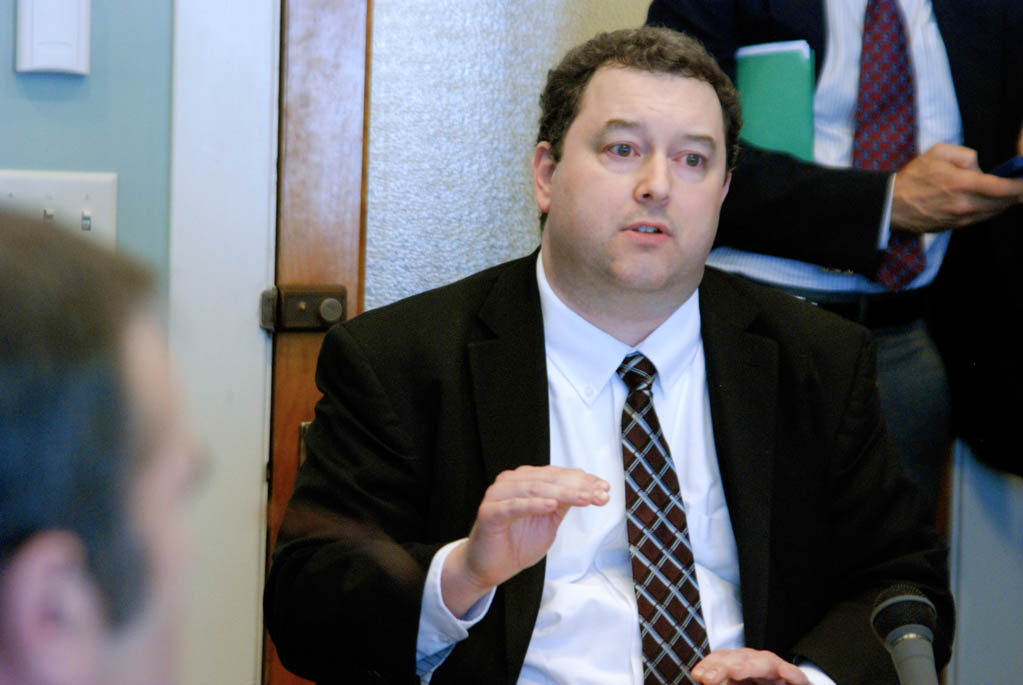
“We can’t think that we don’t need to worry about manufacturing,” Driscoll said. “We’re still the most expensive state in which to manufacture, and we’re still way down in employment from where we were not too long ago.”
Driscoll said anecdotal evidence from his organization’s members is mixed.
“Some are going gangbusters, some are struggling,” Driscoll said.
He said one challenge for reading into business data in Vermont is the small number of companies that represent each industry. Many people understandably think of IBM when they think of manufacturing in Vermont, but overall, Vermont businesses manufacture a diverse array of products, he said.
But it’s hard to talk about industry trends within manufacturing when there may only be a few companies contributing to each vein, Driscoll said.
Ventriss said VBR membership is diverse, but EPR research assistant Amanda Wassell noted that business sectors represented by the organization’s members do not necessarily match sectoral distribution within the state. For example, only a few VBR members speak for the state’s construction industry, but many represent finance and insurance businesses. EPR weighted the results to more accurately reflect proportional employment levels in the state’s economy.
Because some “best guess” approximations are involved, there’s not a specific margin of error for results, Wassell said. Raw data is not available, but the full press release and prior business conditions survey results can be found on VBR’s website.
