

After months of pressuring CGI to repair the state’s dysfunctional health care exchange website, the state of Vermont is finally cutting ties with the IT firm.
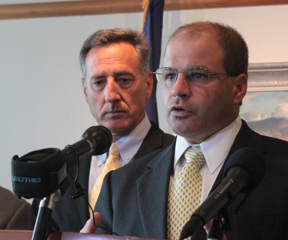
Lawrence Miller, chief of health care reform, announced Monday that the state has reached an exit agreement with the Canadian technology company and the remaining Web development work that needs to be finished will be carried out by OptumInsight, a subsidiary of UnitedHealth Group, a national insurance company.
Miller said there will be no disruption for Vermonters who are already served by the exchange as a result of the transition. He described the state’s relationship with CGI as “extremely cooperative.”
The state has paid $57 million for Vermont Health Connect, and the website, after more than a year of development work, still cannot handle insurance coverage renewals or changes to circumstances in a patient’s coverage, such as a birth, marriage, divorce or death.
Under the terms of the mutual agreement, the state will pay for services completed that Miller described as “background development.” Outstanding penalties and holdbacks will be applied to the original $83 million contract, and the state is expected to pay a total of about $67 million to the company.
Maintenance and operations will be transitioned from CGI to Optum over the next 60 days. The state is scheduled to pay CGI an additional $9.7 million on Sept. 20 for completed work. The company will continue to offer web-hosting services.
Linda Odorisio, vice president of global communications at CGI, defended the company’s work in Vermont.

“CGI is proud of the role it played in helping 85 percent of eligible Vermonters enroll in a health plan via Vermont Health Connect,” she said in a statement. “With a majority of our exchange development work complete, we look forward to providing ongoing hosting services in Vermont for one of the country’s most successful health care exchanges.”
Miller said CGI had completed much of the background work. Optum and CGI workers will begin testing the functionality of a series of features in the coming weeks. This is an appropriate time, he said, to make sure nothing was missed. The testing process “will not be quick,” he cautioned. “We’ll be running through every scenario, to find out what’s broken and fixing it.”
The state is hoping to have a “smooth renewal process in place in time for open enrollment,” which begins Nov. 15. An alternative paper process will remain in place as a back-up. Individuals who do not have insurance, Medicaid recipients and businesses with 50 or fewer workers are required under Vermont law to buy insurance through the exchange. Because of problems with the Vermont Health Connect website, these companies will be allowed to sign up employees for health exchange insurance coverage directly through insurance carriers.
Miller said allowing individuals to go directly to carriers for insurance could be problematic because many are eligible for subsidies, which are only available through Vermont Health Connect.
The terms of the agreement have been under way “for a while,” Miller said. “We were able to come to the conclusion this is the appropriate time last week.”
The state is still negotiating a contract with Optum. The company has a contract for about $5.7 million under its current agreement with the state. Miller said the total cost of the project would likely exceed $83 million.
Optum was initially hired to help the state address a backlog of more than 14,000 Vermonters who were not able to make changes to their online health care insurance profiles. In addition, Optum was asked to review CGI’s tech work.
Optum did not go through a request for proposal bidding process. Miller defended his decision to hire the company after a series of interviews with other tech firms.
“The state RFP process, even an abbreviated RFP process, takes forever,” Miller said. “The big question is, why the hell didn’t we do this months ago — because it takes months, and I’m not going to sign up for an 18-month RFP process.”
Miller said the state interviewed contractors and it came down to which one had the bandwidth and brain power to pull the project off.
“We are going to get hammered (for the no-bid process), and I don’t care, our job is to solve this with best resources we’ve got available, in the time we’ve got available,” Miller said.
In addition, Miller announced a structural change in the way personnel are managed at the Department of Vermont Health Access, which is responsible for managing Vermont Health Connect. The operations and development divisions of the department will be separated to create more efficiencies, he said.
The cost of the exchange is 97 percent federally funded. Miller said the Centers for Medicare and Medicaid Services supports the break with CGI and the transition to Optum for completion of Vermont Health Connect.
CMS has a “high interest in not paying for anything twice,” Miller said. The federal agency supported the “handoff for completion,” he said, “we’ll have to see … what will be supported for completion.”
Politicians on the right and the left weighed in after the news broke on Monday. Scott Milne, a Republican candidate for governor, said changing the vendor doesn’t “remedy the leadership and management problem of the Shumlin administration that got us here in the first place.
“This is simply another symptom of Governor Shumlin’s ailing healthcare experiment,” Milne said. “Throwing in the towel with CGI is long overdue. This band-aid fix doesn’t change the fact this administration’s failure has been a loser for Vermont families,” Milne said. “Vermonters deserve accountability before we commit to yet another no-bid contract and tens of millions of dollars trying to fix the same problem all over again.”
Dean Corren, the Progressive candidate for lieutenant governor and an advocate for a single payer health care system, said in a statement that he had been frustrated and disappointed with CGI’s work.
“I have been concerned that CGI’s failures have been undermining Vermonters’ confidence have in moving to our single payer plan,” Corren said. “It is essential to realize that these failures are closely related to the tremendous complexity from the multiple insurance systems involved in our current healthcare non-system, and under our comprehensive reforms, the systems will be much simpler to build and to use. Moving to a universal comprehensive healthcare system is essential to slowing the unsustainable cost increases, and strengthening Vermont’s economy.”
