

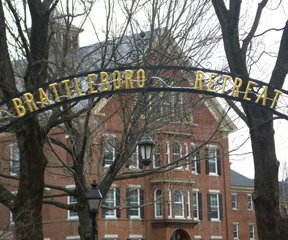
The Brattleboro Retreat, the state’s largest psychiatric hospital, is straining to ensure the safety of patients and staff after recent attempts at suicide or self-harm and a violent incident that left several workers injured on a secure adolescent ward.
The Retreat’s secure wards serve people with severe mental illness, including many who are in state custody. The Vermont Department of Mental Health has a contract with the Retreat to pay for the care of those patients.
Vermont’s mental health system relies on private psychiatric hospitals to provide inpatient treatment for some of the most difficult cases. The services are paid for with federal money and is contingent on certification of the hospital by the Centers for Medicare and Medicaid Services.
There have been three cases since 2012 in which patients took their own lives at the Retreat’s outpatient facilities.
Following a death in 2012, a federal investigation resulted in heightened scrutiny of the Retreat and jeopardized the facility’s operating license. The Retreat has since regained full status after the Centers for Medicare and Medicaid Services determined last year that the facility met federal standards.
In June, a survey of the facility by the state Division of Licensing and Protection revealed two patients had attempted suicide or self-harming behavior on Tyler 3 — a secure adolescent ward — and exposed new violations of federal regulations.
The suicide attempt in May occurred in a secure inpatient ward. Six weeks later, the teenager died, though she was no longer a patient at the Retreat.
A report was sent to the Department of Mental Health and CMS, which is responsible for certifying psychiatric facilities. CMS has not taken action based on the June report.
It’s unclear from the report if the other incident — for which it does not give a date — was for self-harm or an attempted suicide, and Retreat officials said releasing more information would harm patient confidentiality.
The latest incidents at the facility are part of an “ongoing history of problems,” said Rep. Anne Donahue, R-Northfield, a member of the Joint Committee on Mental Health Oversight, and the facility could do more to address them.
A month after the survey, on July 20, a violent altercation between several teenage patients on Tyler 3 injured eight staff members. Four were admitted to an emergency room, according to a statement from the Retreat. The statement does not indicate the severity of staff injuries, but mentions that three employees had not returned to work 10 days after the incident.
Staff injuries included head, neck and rib injuries due to kicking as well as bites to forearms. One patient was hospitalized with a dislocated shoulder.
State or CMS officials have not visited the facility as a result of the July incident, said Konstantin von Krusenstiern, vice president of strategy and development for the Retreat.
Frank Reed, deputy commissioner of the Department of Mental Health, told the Rutland Herald recently that the Department for Children and Families would review the event and investigate if necessary.
There are currently three adolescent patients at the Retreat who are in DCF custody. One of the teenagers was placed there involuntarily under DMH custody.
DMH did not respond to multiple requests for comment on the recent incidents at the Retreat.
Retreat spokesman Peter Albert originally told the Herald that no patients were injured and the employees who went to the emergency room sustained only “bruises and scratches.”
Krusenstiern said in an email that Albert reported “the information as he knew it at the time” to the Herald and subsequently told the reporter that a patient was injured in the melee.
In an internal memo to staff, Albert writes that he “called the reporter late Friday to share my concerns with the story and to correct information I had given her regarding the extent of the recent injuries to staff.”
His concerns centered on quotes attributed to him that hitting staff is part of treatment, and he adds that he has done his best to correct the information given to the Herald.
“I have never thought nor would I ever say that part of working at the Retreat includes being hit by patients,” Albert continued. “The work that all of you do is about helping people who have great difficulty expressing their emotions.”
In a statement to VTDigger, Albert said, “Many of the adolescents who come to the Retreat do so with a history of trauma and abuse, the result of which can sometimes lead them to ‘act out’ their emotions.”
Retreat staff has told lawmakers on the mental health oversight committee that the hospital has “a chronic shortage” of skilled psychiatric nurses.
But Tyler 3 was fully staffed at the time of the most recent incident, Krusenstiern said, and “turnover at the Retreat is in line with industry norms,” and “staff on all units get the same training.”
DEFICIENCIES AND A PLAN FOR CORRECTIVE ACTION
The state survey report found three violations of federal regulations at the Retreat. One was a reporting issue in which a nurse did not update a patient assessment to reflect a change in behavior. That patient later attempted suicide.
Though the altered behavior wasn’t initially reported, it was reflected in a subsequent assessment that was documented, according to a statement from the Retreat.
The Retreat has since submitted a plan of correction to the Department of Licensing and Protection, which the state has accepted, according to the statement. The plan involves better documentation and communication between staff and more diligent patient monitoring.
The survey also found safety violations at the Retreat. One was an unsecured light fixture in the elevator that surveyors thought could be pulled down and used to injure. That problem has since been fixed, and the correction plan calls for the director of facilities to be more involved in the Retreat’s quality improvement program.
The other two violations centered around safety issues on or near Tyler 3, including another unsecured light fixture that could be used for self-harm.
The other safety concern related to the unit’s locked door policy. Doors to patient rooms on Tyler 3 and several other units lock from the outside, and patients are given five minutes of privacy twice per day to change clothes out of view from others. The doors are locked for those periods and staff wait outside with a key.
The two instances since January when patients attempted suicide or self-harm were behind locked doors, and there was a third situation where a key broke off in the lock when staff tried to enter a patient’s room.
Donahue says there’s no reason for the doors on Tyler 3, or other inpatient units, to have locks.
“They’re talking about 10 minutes a day of privacy,” Donahue said, “They could afford patients that same level of privacy with closed doors and staff monitoring.”
Except for those 10 minutes, doors on the secure wards are left open to allow staff to more easily monitor patients.
The Retreat does not intend to replace the doors or remove the locks. Instead, its remediation plan is to place so-called “Hooligan bars,” an emergency tool used by firefighters to break down barricaded doors, in wards with locking doors. Staff will be trained in their use.
The Retreat will also explore the possibility of installing sensors on the doors to alert staff if an object is placed over the door, a sign that a patient may be trying to take their life.
According to its statement on the recent incidents, the state may conduct a follow-up survey to confirm the hospital is back in compliance with all federal regulations.
It’s unclear if the Department of Mental Health will do that as they didn’t respond to multiple requests to comment.
CORRECTION: The Brattleboro Retreat’s statement released on Wednesday contained factual errors. As a result, staff injuries were reported as patient injuries in the original story.

