


This article is by M. Dickey Drysdale, who is the publisher of the Herald of Randolph. In This State is a syndicated weekly column about Vermont’s innovators, people, ideas and places.
Perhaps no single mountain in Vermont dominates its surroundings so completely as does Mount Ascutney in Windsor.
Sure, Camel’s Hump has the most arresting profile, but it’s always looking over its shoulder at Mount Mansfield. Killington must share the skyline with the more shapely Pico.
Mount Ascutney, however, has no competition. Cozying up to the Connecticut River just south of Windsor, it raises its lonely head far above several small villages, gazing over at the New Hampshire side of the river as well.
Perhaps as a result, residents in the area have maintained a close relationship with “their” mountain for almost 200 years. They’ve swarmed all over it. In 1825 they built the nation’s first hiking trail up a mountain — the first of many. They quarried granite at four sites; they welcomed a state park and an auto road built by the Civilian Conservation Corps after the Great Depression, and a ski area (now discontinued).
And Ascutney may be the only mountain in Vermont to have its own fan club.
What other mountain can you climb on a fine morning in spring, for example, and find an immense smorgasbord at the top? Where else but at such a picnic can you find yourself immersed in nearly 200 years of mountain history and lore?
“We love our mountain,” says Barbara Rhoad of Windsor. She’s been a director of the Ascutney Trails Association (ATA) for 30 of her 75 years and is the organizer of ATA’s annual mountaintop picnic that this year was held on May 24.
ATA members are the trailblazers, hut builders, event organizers, maintenance workers, and keepers of the remarkable history of this mountain.
That history includes a Vermont visit by the Marquis de Lafayette in 1825, and a 1857 trail to the summit that may have been the inspiration for James P. Taylor to build the Long Trail — which in turn influenced the creation of the Appalachian Trail.
And yes, ATA members do love their mountain. Starting to climb the mountain on picnic day, this reporter first met Natalie, a Windsor resident. Natalie climbs Ascutney three or four times annually. She told how the sports teams from Windsor High School used to train by running from the school to the mountain and then up it.
On the steep Brownsville Trail were two 70-ish folks accompanied by a young girl. One of the pair had already climbed the mountain this year, and the other regaled me with a tale of climbing it in winter. That, it happens, is an extremely popular activity on Ascutney — “winter-bundling parties” were said to be popular early in the century.
Next came a young couple with their baby in a carrier. The husband, a graduate of Windsor High, mentioned he once made it to the top in an hour. (At this point I was an hour and 20 minutes on the trail and only halfway up.)
Before the ATA, the mountain’s booster organization was the AMA (Ascutney Mountain Association), which in 1903 turned its volunteers loose relocating and clearing the trails while rebuilding the 1857 Stone Hut near the summit. The AMA began the tradition of annual picnics, with attendance running as high as 500, “including, usually, a complete band,” according to the Mount Ascutney Guide.
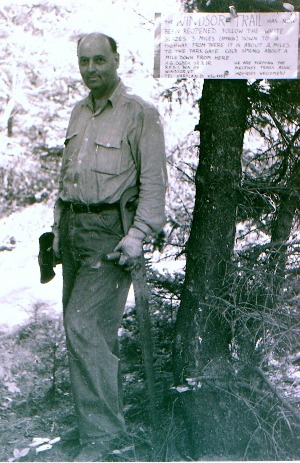
The AMA disbanded in 1917, and for a few decades, interest and trail traffic fell off. But the slowdown was reversed in 1965 by a legendary Windsor County figure, Herbert G. Ogden, a four-term state senator, book printer, newspaper publisher, and operator of a water-powered cider and grist mill.
In the summer of 1966, Ogden and his son, Herb Jr., spent untold hours rebuilding the nearly invisible Windsor Trail. At a meeting at the Ogden home the following January, the ATA was formed with Ogden as its charter director and chairman. The organization has been active in every aspect of the care of the mountain ever since.
This year’s picnic was held on a perfect hiking day on the site of the old Stone Hut, and it was a jolly event. About 70 people showed up, and laughter and stories flew back and forth. Barbara Rhoad presided cheerfully, directing visitors to the day’s sign-up sheet. The “table” was set with peanut butter and jelly sandwiches, hummus, bologna and egg salad, with lemonade and coffee to drink, and chocolate chip cookies for dessert.
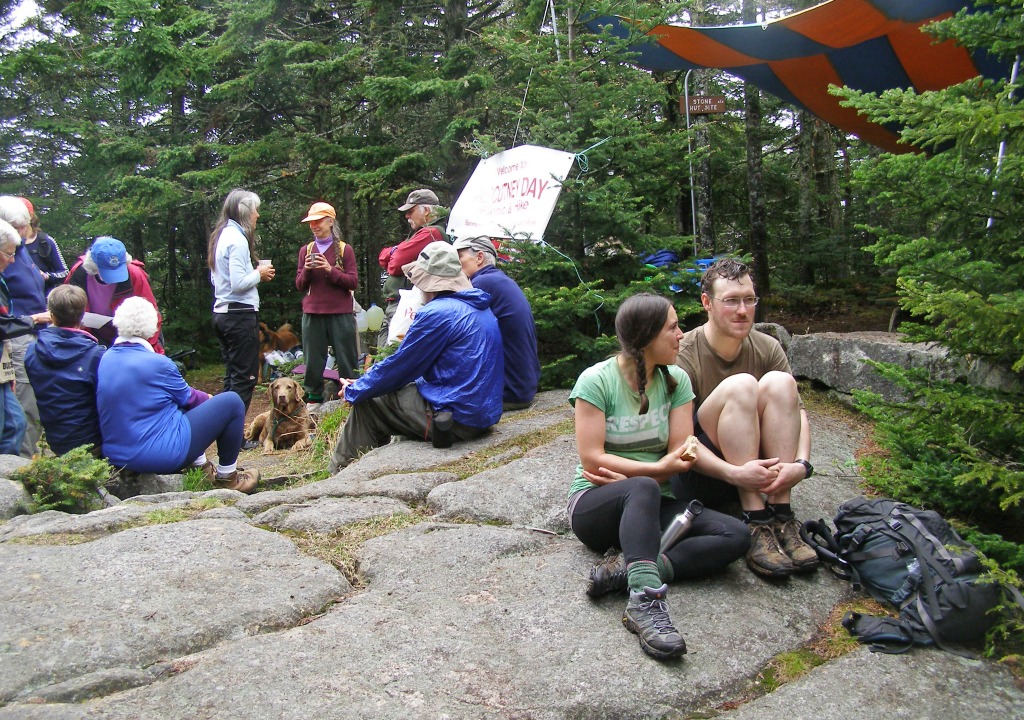
Matt Keniston of Perkinsville, an ATA director since 1981, reminisced about carrying both his own youngsters and food up the mountain for the picnic years ago. A little later, his son won the “youngest hiker” award when he walked up the Weathersfield Trail at 2 years, 9 months.

Larry French of Sunapee, New Hampshire, brought his two St. Bernards, Roscoe (184 pounds) and Holly Belle (125). They had plenty of canine company.
Oldest hiker this year was Heinz Trebits of Thetford at 83. Youngest was Kip Gaddis, 10, from Windsor. Both were awarded special ATA walking sticks.
Mount Ascutney rewards its caregivers with a spectacular outdoor playground filled with cascades, cliffs, viewpoints, and history. Four trails take the adventurer to the top — two from the north and one each from the south and east. Most people reach the 3,150-foot summit in about three miles.
Despite that modest elevation — it’s 1,000 feet lower than Camel’s Hump — climbing Ascutney is a challenge. The base of the mountain, being near the river, is barely more than 500 feet in elevation. That leaves more than 2,000 feet of elevation gain for the hiker.
All four trails lead the hiker to a summit, offering a 360-degree view of an array of peaks, ridges, and ski areas as far as 60 miles away, encompassing southern and central Vermont and a wide swath of the White Mountains in New Hampshire.
And for those less hearty souls with a car, there’s the 3.7-mile Ascutney Mountain Auto Road that was built in 1935. The road, starts at Ascutney State Park and ends just seven-tenths of a mile from the top, so there’s still a bit of a climb for those wishing to reach the summit. They, of course, have the option of stopping along the way to watch hang gliders take off from a spot known as West Peak.
The Auto Road is open from late May to the end of October and costs $3 for adults and $2 for children ages 4 to 14.
And more good news: despite its popularity, the summit is still basically a wild place to enjoy nature. And after a hike it offers comfortable accommodations, including good-sized worn rocks on which to sit or use as a picnic table.

M. Dickey Drysdale is publisher of the Herald of Randolph.
