

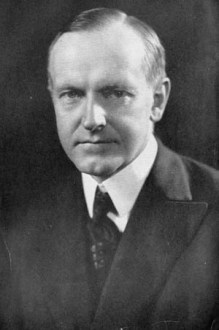
PLYMOUTH NOTCH — Silent Cal was never as quiet as his hometown is on this chilly, wet morning in late June. Only one other car is in the parking lot when I pull in front of the Coolidge Museum & Education Center at the President Calvin Coolidge State Historic Site.
Not far beyond the edge of the parking lot, the top of the Coolidge Range is shrouded in low-hanging clouds. Ozone saturates the air, and the green in the trees and fields is spectacular, suggesting a fecundity that the former farmers in this hardscrabble village must have prayed for all their long and difficult lives.
According to a letter that Mrs. Coolidge wrote in 1924, up to 1,000 people per day made a pilgrimage to this bend in the road between 1923 and 1929, when her husband served as the nation’s 30th president. Unless the president was vacationing here, all there was to see was the outside of a dozen or so plain white buildings, but still they came.
Coolidge loved Plymouth Notch precisely because of that quiet. He played up the homespun quality of his childhood and heritage during his presidency and beyond because the image was perfectly pitched to a nation reeling in excess, scandal, the racket of rapidly growing cities, and the clamor of foreign tongues. He was a foil for his times because in his virtues, his values, and his work ethic he represented a nostalgia of earlier times so many Americans remembered fondly and wished they could have back.
But as much as Coolidge loved Vermont and as often as he returned to Plymouth, he did not stay. He remembered taking a sleigh one bitter morning to his first day of high school at Black River Academy in Ludlow. “I was perfectly certain that I was travelling out of the darkness into the light,” he recalled.
When Coolidge was only six, his grandfather had deeded him and his heirs in perpetuity property in Plymouth Notch. It was his way of trying to keep his bright grandson home.
In one measure it succeeded. Although Coolidge never returned to Plymouth to live, he kept the land, played the part of farmer for the press, and passed it along to his one surviving son, John, who with his wife, presented it to the state of Vermont in 1956.
The Vermont Division for Historic Preservation was happy to acquire the presidential site. William Jenney, the administrator of the site for the state, says the state bought more buildings in the 1950s and 1960s and the Plymouth Cheese Co. barns in 1998.
“Basically, that’s everything in the village except the church, which is owned by the Calvin Coolidge Presidential Foundation,” Jenney says.

The cheese company is still in business. Coolidge’s father opened it in 1890 to convert perishable milk into a commercial product once it became clear that the railroad would never bring milk from Plymouth into the Boston milk market.
These days approximately 23,000 visitors come to see Coolidge’s birthplace, the family’s homestead, barns, the school, church, a farm shop, a school, the cheese factory, the dance hall that Coolidge used as his summer White House during the warm months of 1924, and the town cemetery where Coolidge is buried.
John and Florence Coolidge donated family artifacts, and the buildings have been restored to portray the Coolidges’ life in the 1920s. Coolidge’s father’s general store is still selling Moxie and penny candy. The post office where Coolidge’s stepmother was postmistress for a time is still open three afternoons each week although its future is uncertain. And, of course, the dim parlor is here where Coolidge’s father, a notary, administered the presidential oath of office to his son in the early hours of Aug. 3, 1923, after President Harding’s death.
So, too, is Coolidge’s mother’s Bible, upon which the new president steadied his hand.
Jenney and his staff have organized two first-rate exhibits in the Coolidge Museum and Education Center. The permanent one, “More Than Two Words: The Life and Legacy of Calvin Coolidge” traces Coolidge’s path from
Plymouth Notch to the White House, via Massachusetts, and also takes every opportunity to dispel the myth that Coolidge was taciturn almost to the point of muteness. Handsets located throughout the multimedia exhibit allow visitors to listen to fragments of Coolidge’s speeches and learn firsthand his views on debt, thrift, small government, morality, character, Prohibition, and a dozen other topics.

Looking at a life-size statue of Coolidge and photographs of his awkward encounters with everyone from Charles Lindbergh to the Chief of the Sioux, visitors will appreciate that he was not a president made for television, but his training in debating and oratory prepared him well for the new medium of radio. Invisible behind his microphone, this popular president — often mocked for his brevity — introduced presidential radio chats and staged twice-weekly news conferences.
Pining for a president who would put the country on a stable path, Americans overlooked what Jenney calls Coolidge’s “thin, reedy voice” and projected onto him the mantle of a righteous leader.
The other exhibit, “The Coolidges and the Civil War,” is a temporary exhibit.
On the Fourth of July, the historic site will celebrate Coolidge’s birthday (July 4,1872) with a flurry of activities and honor the sesquicentennial of the Battle of Gettysburg. None of Coolidge’s nuclear family served on behalf of the Union, but the exhibit, illustrated with local artifacts and photographs, brings the conflict home. Plymouth lost 31 young men during the war, almost an entire generation. A selection of books from Coolidge’s extensive Civil War library demonstrates his lifelong interest in the war.

The Calvin Coolidge Presidential Foundation, which shares the site, seeks other ways to bring the ex-president’s legacy to a bigger audience.
Matthew Denhart, executive director of the foundation, said Calvin Coolidge is sometimes “a forgotten president.”
“We think Coolidge is a great president,” Denhart said. “Through his leadership, he led the country out of the big debt and high taxes that followed World War I.”
The foundation sponsors lectures in Vermont and other states throughout the year and sponsors the Coolidge Award in Journalism, which comes with a $20,000 prize, and the $1,500 Calvin Prize for Youth for the best essay on the former president.
Its big initiative, however, is Debate Camp. This summer, for the third year in a row, approximately 200 high school students will converge on the site over three weekends to learn about Coolidge’s legacy, to be mentored in the fine points of debating, and finally, to engage in a public debate competition.

Denhart said studies have shown that students’ grades improve the more they debate, and “strategically, it’s a good way to learn about Coolidge.”
Coolidge would be delighted. By participating in debating and oratory contests in high school and college, the shy young man from Plymouth first made a name for himself and acquired the confidence to step out into the bright light of the world where his true ambitions lay.
