


Editor’s note: Dirk Van Susteren, of Calais, is a freelance reporter and editor. In This State is a syndicated weekly column about Vermont’s innovators, people, ideas and places.
Dance distinguishes the Capital City Grange. It’s what saved it.
Polka, waltz, foxtrot, jitterbug, square dance, you name it. They did it all at Montpelier’s Grange.
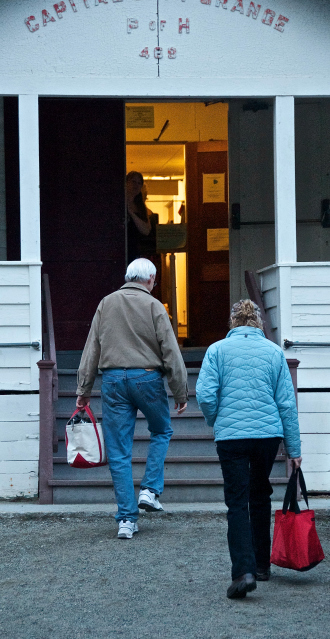
Square dance, Western style, was especially big back in ‘53, the year the Grangers constructed their hall, a white clapboard structure with a hardwood floor.
Grangers then stepped to the music of Don Fields and the Pony Boys, who wound up being celebrities on Waterbury radio station WDEV.
“The men came in western shirts and bolos, and the women in petticoats and frilly skirts,” says Al Monty of Barre, who was once a Pony Boys musician. “But everyone put on dancing shoes.”
The tradition endures. Except these days at the hall, just off Route 12 a little south of Montpelier, there’s Mali dance on Tuesdays and Afro-Caribbean dance on Thursdays, both involving steps and gyrations to loud, rhythmic drumbeats.
And contra dance? Well, that’s the biggie. That really keeps the place going. Contra dance draws the crowds on the first, third and any fifth Saturday night of every month.
That’s when you’ll see license plates from not only Vermont but New Hampshire, Massachusetts, New York, even Quebec.
“Is this a Grange hall or a dance hall?” Les Skinner, the former “worthy master” of the Montpelier Grange, is asked. Nine years ago, with the blessing of the state Grange, he welcomed dozens of contra dancers as new Grange members. “Well, it makes you wonder sometimes,” he answers, and laughs.
It’s a warm Saturday night, and this hall, this structural and organizational vestige of America’s agrarian past, is jammed, joyously so, with upwards of 160 people, estimates Tim Swartz, who sits at a table at the entrance collecting $9 admission. (“Please, No Food Or Drink On The Floor!” says a hallway sign). At the doorway, ignoring foot traffic and looking blissful is someone’s aging retriever mix, who gets one pat after another.
“We felt (saving the building) was important for the community as a whole,” says Swartz, one of the contra dancers who joined the Grange in 2005 and who is the Grange’s incumbent “worthy master,” a title customarily used by members when he’s addressed at meetings.
Under schoolhouse lights in the expansive room are the lines of dancers, who are “balancing-their-partners,” “circling-to-the-left,” and “do-si-doing” in lively fashion while following all kinds of other directions delivered melodiously by caller Bill Olson of Maine.
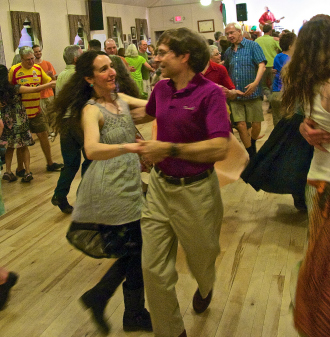
His band “Ti’ Acadie,” with fiddle, guitar, bass and accordion, plays French-Canadian, Celtic, Cajun and Appalachian-style music, with roots – as does contra dance itself – in Britain and France. Contra started as a form of country music in those countries in the 17th century, and moved across the ocean to Colonial America.
Contra dancing was a part of rural social life in Vermont, and it got a boost from some of the young urban émigrés who came to the state in the ‘70s. Various contra-dance venues cropped up, among them Montpelier Grange Hall.
By the early 2000s, though, Capital City Grange was in trouble. Local Granges throughout the state had been losing buildings and membership for years – 16,000 members a century ago to 1,600; 112 Grange halls to fewer than half that – and it seemed the Montpelier Grange Hall’s time had come.
“The older Grangers were dying off, and there weren’t enough young ones to replace them,” explained one longtime member.
With the building in desperate need of paint and repair, with property taxes climbing, with heating and snow-plowing bills rising, there was talk of selling the place, maybe, with all the parking space, as a potential restaurant.
But the contra dancers stepped in. Among them was Gail England of Calais, who with others broached the idea of the dance enthusiasts becoming Grangers en masse. And Skinner, as worthy master, presented the suggestion to the state Grange, and in January 2005, he was able to welcome 71 new members.
For what was considered his recruitment triumph, “I got a sweater that said ‘super-hero’ from the state Grange,” says Skinner, a Grange member since 1943.
“Most of the 71 didn’t intend to attend meetings – they just wanted to support the Grange,” confesses England. “But others assumed (significant) roles, and it’s just been so much fun, such a hoot …
“It’s like stepping back in time with such a lovely cross-grouping of people,” she says.
The contra dancers offered something besides new members to the Grange: some critical new fund-raising energy.
Swartz, as worthy master, dutifully honors Grange tradition and rituals going back decades, if not to the Grange’s beginning in 1867, when it first formed as a farmers’ self-help organization to deal with the dislocations wrought by the Civil War.

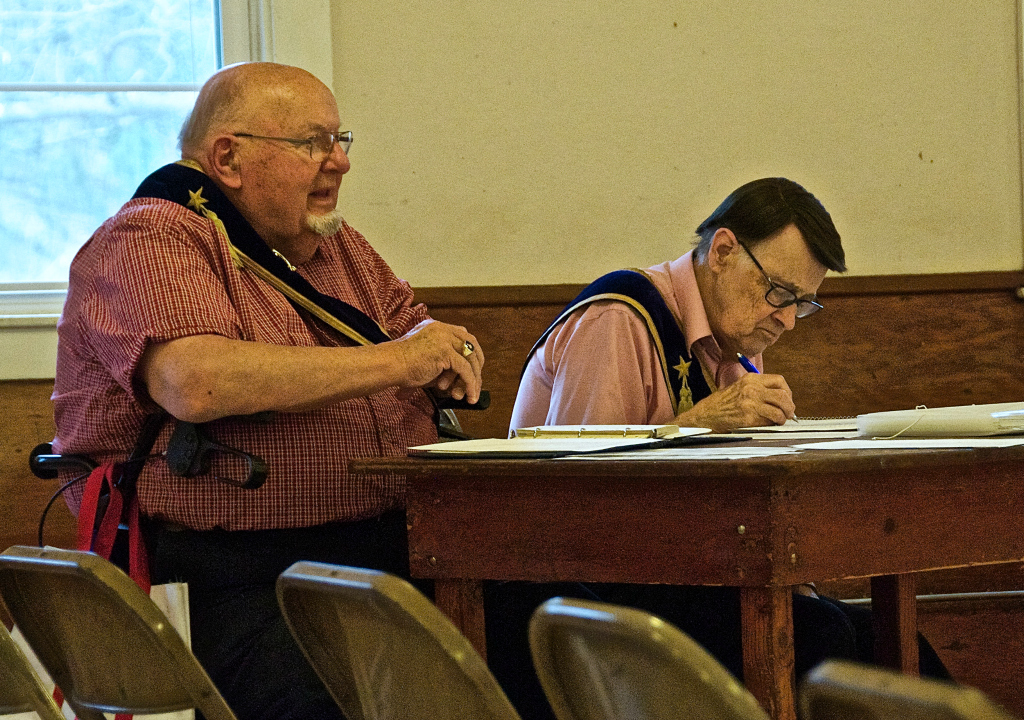
With a Bible resting on a velvet-covered pedestal in the center of the hall, a recent meeting began after the “Pledge of Allegiance” and the singing of the “Star Spangled Banner.”
Next came the health report from Phyllis Skinner, wife of Les, who discussed nutrition and warned of high levels of fat in Pillsbury muffins and of salt in Campbell’s chicken noodle soup; and then a legislative report from Marj Power, who, while knitting, gave updates on proposals to consolidate school districts and fund a single-payer health-care system.
There was no need to use a password to enter this meeting; this local Grange dropped that requirement about six years ago in part to become more inclusive. (Passwords were first used in the late 1800s, when Grangers in the Midwest were fighting railroad monopolies and their gouging transportation fees. Passwords were used to keep any railroad spies from Grange meetings.)
But there was music at this meeting: a group-sing of folk songs followed by a potluck dinner, preceding the evening contra dance.
The Grangers seem proud of their community service, mentioning: the granting scholarships; donating $500 to “Pete’s Greens” after the CSA in Craftsbury lost its big barn to fire; sponsoring forums on public issues; and holding workshops, such as the one a while back on canning that attracted 150 people.
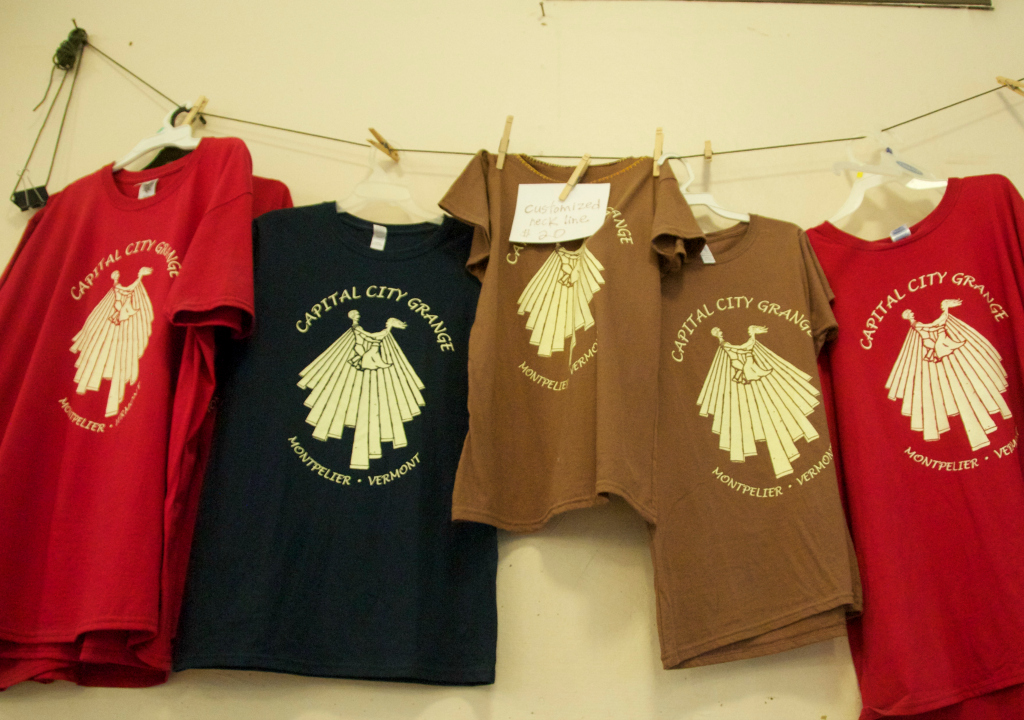
A major part of their service is providing a hall “at an affordable price” for private and community groups, says Swartz, from weddings to annual meetings.
The Grange still has needs of its own: “Little by little we are fixing the place up, trying to make it handicapped accessible, putting in more lighting,” says England. Swartz at the meeting mentioned the need for a costly furnace upgrade.
Two years ago, the Grange installed a new dance floor, because the original one had become so worn that “nail heads were showing,” says Swartz. The new floor, assembled two years ago, uses maple boards milled a tad thick for longer wear, he explains.
Some of the old floorboards were turned into cutting boards, picture frames, “and one fellow even used the old wood to make a mandolin,” says the worthy master.
The Grangers report they are still just scraping by financially with their rental income and donations and grants, but can at least claim they may have the best dance hall in Vermont if not all of New England.
“They aren’t lying,” says Bill Olson, who has called contra dances up and down the East Coast and in the far West.
“The Capital City Grange is about the best dance hall I have ever played in,” he said.
Dirk Van Susteren, of Calais, is a freelance reporter and editor.
