

Editor’s note: This article is by Maggie Cassidy of the Valley News, in which it was first published May 24, 2014.
WHITE RIVER JUNCTION — Imagine the construction of two new bridges carrying Interstate 91 over U.S. 5 near the Veterans Affairs Medical Center, with only one weekend of interstate detours on the northbound side and a separate weekend of interstate detours on the southbound side, with U.S. 5 never closed.
Wishful thinking, you say?
Reality, officials respond.
Workers will use a relatively new construction process, never before employed in the Twin States, to replace the aging structures next summer.
“The way we’re building this project is unique to Vermont,” Kristin Higgins, of the Vermont Agency of Transportation, said during a public meeting about the project at the Bugbee Senior Center last week. “We’re very excited about it.
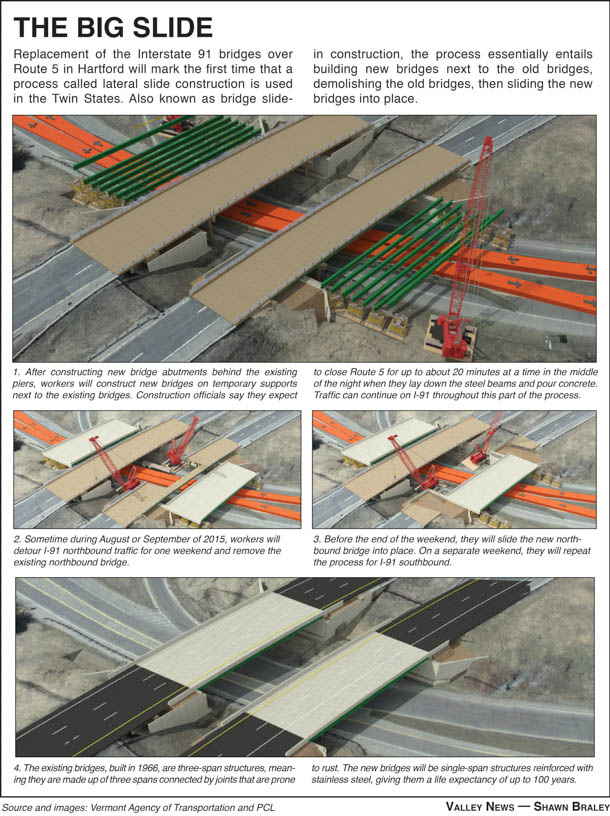
Lateral slide construction, as it’s known, entails four major steps: building new bridge supports under the old bridges, building new bridges next to the old bridges, demolishing the old bridges, then sliding the new bridges onto the new supports.
Advocates say the benefits are plenty: In addition to minimizing the impact on commuters and travelers, lateral slide construction is significantly safer than conventional bridge replacement, they say, because it moves the bulk of construction away from traffic and reduces the risk of vehicles crashing into work sites.
Indeed, Higgins said, the I-91 bridges were chosen as Vermont’s first foray into lateral slide construction largely for two reasons: First, there was enough room around the bridges for the construction to take place, which often isn’t the case, Higgins said.
And second, there’s “a lot of things going on in one area” with the interchange connecting I-91 and I-89, underscoring the need for a safety-centered construction approach.
“The safety is the big one, and the interchange … sometimes it’s really hard,” said Higgins, the structures project manager for the agency’s Accelerated Bridge Program, in an interview after last week’s presentation. “So now you throw in a traffic pattern change and cones and barrels, and next thing you know you’ve got a truck ramming through the medians because they don’t know.”
The advantages, though, come with a significant cost: Higgins said current estimates for the project are around $3 million per bridge, or $6 million total.
Higgins said it is difficult to calculate how much a similar project would have cost were it to be built conventionally, but estimated the lateral slide construction could cost 10 percent to 20 percent more. Lateral slide construction is generally more costly in the design and construction phase than conventional bridge replacement, but the state will be saving on construction set-up costs by keeping the project within one summer instead of two and by avoiding crossover lanes, which would reroute northbound traffic onto a southbound lane and vice versa.
“People get killed in crossover medians,” Higgins said, “so if you can eliminate it, you pay for it. … But it just makes it safer.”
Utah became a front-runner in lateral slide construction, also known as slide-in bridge construction, when it made infrastructure upgrades ahead of the 2002 Olympics. It has since been employed in states from Colorado to Maine.
New Hampshire previously considered lateral slide construction for work on an I-93 exit ramp in Concord, said Mark Richardson, administrator of the New Hampshire Department of Transportation’s Bridge Design Bureau.
Ultimately, though, the agency decided the process “wasn’t feasible or economical” for that project, Richardson said in an email.
“There is (of course) additional cost to construct in this manner,” he wrote, “but it is weighed against the ‘cost’ of long-term closure of the roadway to allow more typical construction methods. If the additional cost is worth it, we would/will consider it for future projects.”
Cost was not discussed during Tuesday’s presentation, and the few attendees spoke largely in favor of lateral slide construction, raising several questions but few concerns.
Chris Andreasson, director of transportation at Advance Transit, the free local bus service for the Upper Valley, said he was pleased that the technology would minimize traffic disruptions.
U.S. 5 will have a reduced number of lanes open and could experience some delays, but officials said those delays are expected to occur in the middle of the night and should last minutes, not hours. If all goes according to plan, the road will never be considered “closed,” they said.
“As a professional driver for 35 years … this really makes sense, what you showed us here,” Andreasson said. “I know it’s going to be two rough weekends, but I’ve really got to hand it to you guys. I really think this is a good way of doing a project like this. It could be a lot worse.”
Florida-based PCL Construction is doing the construction work, and 90 percent of the cost will be paid for with federal dollars. PCL is also helping with the design.
The state’s request for proposals had sought contractors with experience in heavy lifting and accelerated bridge construction, and specified the lateral slide construction approach, Higgins said. PCL has worked on a half-dozen lateral slide projects in the past, she said.
The process is something of an engineering feat.
The new bridges, weighing 725 tons each, will be built only slightly higher than the new abutments onto which they will be moved. Once workers are ready, they will take each new structure and, using hydraulic jacks, slide it — quite literally — across steel beams onto bearings on the new abutments.
“They get it all greased up, and it makes a horrible ‘eeeeeeeee’ as it’s going,” Higgins said, mimicking the sound.
“Then they lower it down on bearings. … Then it’s just gravity that really holds the (bridge deck) there, and the abutments are wide enough that it spreads the load out.”
Once workers put a new layer of pavement over the top, the process is complete.
Some of U.S. 5 will be torn up during the construction process and repaved afterward, and the state is trying to accommodate the town’s long-term plans in that area, as well, Higgins said.
For example, Richard Menge, Hartford’s director of public works, who was also in attendance at the Bugbee Senior Center, spoke to the town’s desire to install a sidewalk and 6-foot bike lanes on the road.
Higgins said the scope of what can be included in the project is limited and that she essentially has to return U.S. 5 to the way it was before the project started.
However, she said, she was able to include certain elements — such as removing the traffic islands in the area — that will help with Hartford’s plans.
Even more significantly, she was able to include the removal of the “slip lane” from U.S. 5 south on to I-91 south because workers will use that area during construction to set up vehicles and machines.
The slip lane will be replaced by a right-hand turn lane so that U.S. 5 southbound drivers will use the same I-91 ramp entrance that is used by U.S. 5 northbound drivers. During construction, that intersection will be regulated by a traffic light, which will be removed once the project is completed.
“There’s no question, that’s not something that, frankly, we would be able to do,” Menge told Higgins during the meeting. “It’s your interstate, it’s yours and the feds’ interstate, and it’s your U.S. 5, so anything that we’re doing there is with a lot of coordination and assistance from you, and frankly I don’t see the town having the money to do, for example, the (ramp closure), so that’s awesome.”
Planners scheduled construction to begin as early as March and expect interstate detours during August or September 2015. The detours are prohibited from happening during Labor Day weekend.
Each detour is expected to begin around 6 p.m. on Fridays and be lifted by 6 a.m. the following Monday, and will include uniformed traffic control along U.S. 5.
For the northbound detour, drivers will briefly exit Interstate 91 onto U.S. 5 at White River Junction’s Exit 11 off-ramp, before hopping back on the highway at the Exit 11 on-ramp a stone’s throw away.
The southbound detour will be more complicated: Drivers headed for I-89 will be detoured off of I-91 at Wilder’s Exit 12 onto U.S. 5. The official detour will bring them from U.S. 5 to Vermont 4, which they will take to get on to I-89 northbound or southbound in Quechee.
Drivers looking to continue on I-91 southbound will be detoured off at White River Junction’s Exit 11, where they will take U.S. 5 some 10 miles to the Hartland exit.
Based on traffic studies, weekend traffic on Interstate 91 averages 8,200 cars per day northbound and 13,000 southbound.
Higgins estimated that 4,000 of those cars get off on I-89 and 9,000 continue on I-91.
During the meeting, Hartland Fire Chief John Sanders noted that the town plans to revamp the intersection of routes 5 and 12 during the summer of 2015, raising concerns about sending 9,000 drivers through a construction zone.
Menge suggested that planners should consult the Upper Valley Aquatic Center about any meets that may be happening there and keep in mind that the U.S. 5 Maxfield playing fields could be open by 2015.
Both of the I-91 bridges in Hartford were built in 1966, the same year that the interstate was finished in the area. A combination of age, weather and use have “taken a toll” on the structures’ concrete decks, beams and abutments, according to a fact sheet from the Agency of Transportation.
Higgins said the triple-span bridges — which consist of three separate parts connected by joints — have required near-constant maintenance in recent years. In March, for example, workers had to remove crumbling concrete chunks that were in danger of falling onto U.S. 5.
The new bridges will be single-span structures reinforced with stainless steel, eliminating joint problems and making them far less prone to rust.
Officials said they expect to hold another public informational meeting closer to the construction period. The state has also reserved a URL, www.i91wrj.vtransprojects.vermont.gov, to post updates on the project online, although the site is not yet live.
The project falls under Vermont’s Accelerated Bridge Program, launched in 2012. The fast-track program is designed for bridge work to be completed in half the time of conventional projects — often in only one construction season — thereby saving money on design, utility impacts and road closings while minimizing route disruption.
Twelve bridges in the state have been rebuilt under the program since 2012, with 13 planned for this construction season.
Higgins said most of projects last year were for final restorations from Tropical Storm Irene damage, and that the state has been increasing its “short-duration” closed-road projects.
Maggie Cassidy can be reached at mcassidy@vnews.com or 603-727-3220.
