

Scarce housing in Burlington is a crisis not just for low-income residents, according to a new report commissioned by the city. Burlington’s dearth of market-rate — or unsubsidized — housing options is driving up prices for everyone, the report finds.
“As a result, Burlington is now at an inflection point,” according to the recently released Downtown Housing Strategy Report, written by HR&A Associates.
The city can either develop as a vibrant but expensive college town, or choose to integrate more housing in a wider spectrum of price points into broader economic development strategies and become more walkable.
Burlington’s population overall is growing, but more from students and empty nesters, while the number of young and middle-aged residents is down, the report says. And despite the growth in demand, the city’s housing stock has remained static. As a result, prices have only risen with competition.
The city has a 1 percent vacancy rate. Renters must work 1.6 full-time jobs to afford a two-bedroom apartment at fair market rent, according to estimates from HR&A. A downtown studio rents for more than a two-bedroom unit elsewhere in the city, the report finds.
The irony is that, according to HR&A’s Candace Damon, an affordable housing policy has indirectly contributed to higher costs by stalling housing developments in the jurisdiction.
The main reason rents are high in Burlington is the limited supply, Damon underscored. But additional factors also push housing prices up or bring them down: the length of time to bring a unit to market, available subsidies and guaranteed tenancy, to name a few.
In the report, Damon suggests revisiting one factor in particular that can drive prices and discourage building: inclusionary zoning. The policy requires a certain percentage of housing units in a given development to be “affordable.” To make these projects worth their cost, developers raise rents on other units to recover their investments.
“It is a perfectly reasonable way of trying to create affordable housing, particularly for low- and moderate-income people,” Damon said.
But Burlington is a relatively small community to experiment with inclusionary zoning, Damon said. She suggested exploring inclusionary zoning as a more regional strategy, so one city isn’t left to absorb all of an area’s low- and moderate-income housing needs.
As it stands, despite Burlington’s affordability crisis, “Current market rents are not high enough to support to get anybody to build market rate housing,” Damon said. And that’s part of the reason very little housing stock has been added in recent years.
The neighboring city of South Burlington is considering its own version of inclusionary zoning, which will go before the city council this week, according to Paul Conner, South Burlington’s director of planning and zoning.
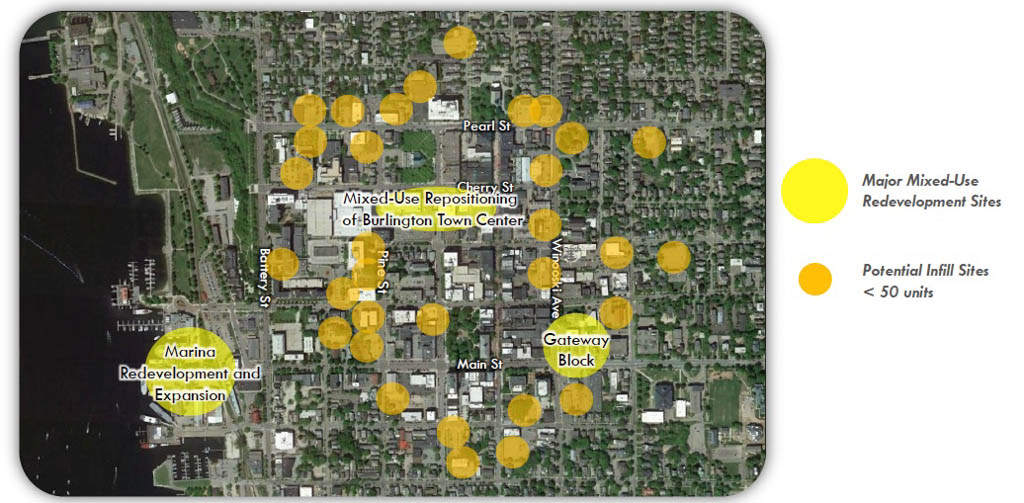
In addition to inclusionary zoning policies, Burlington’s latest housing report recommends downtown infill, development along the Pine Street corridor to the south of downtown, more on-campus student housing to relieve pressure on the private market, and incentivizing multi-family housing developments deemed affordable for a wide spectrum of households.
Burlington Mayor Miro Weinberger and city planners will hold the first of two public hearings on housing at 7 p.m., Thursday, June 12, in City Hall’s Contois Auditorium to solicit opinions on the study and its recommendations. They plan to develop a strategic action plan by fall.
While Burlington continues to contemplate its future, the city’s workers are residing in neighboring cities. Essex, South Burlington and Winooski all have outpaced Burlington in their development of market-rate housing in the past decade, according to the report.
Now, less than half of Burlington’s workers in the well-paid professional, technical, education and health care sectors actually live in the city. Many of the rest choose commutes over costly rents.
