


In This State is a syndicated weekly column about Vermont’s innovators, people, ideas and places. Tom Slayton is a Montpelier freelance writer. He is editor emeritus of Vermont Life magazine.
Walking through the woods, botanist Liz Thompson doesn’t miss anything.
Recently, scouting a route for a springtime wildflower walk on Mount Equinox, she hiked through a forest that had just emerged from winter sleep. The trees were bare and the mountainside was carpeted in brown leaves; a casual observer might think nothing much was going on. Yet within an hour, Thompson had found large patches of wild leeks, pointed out more than two dozen newly sprouting plant species, and discovered plenty of wildflowers, several just opening their buds.
Thompson, 56, who is director of conservation science for the Vermont Land Trust (VLT), is a field botanist, one of the most knowledgeable and well-known in Vermont. She has been studying the forests, fields, wetlands and mountaintops of this state for more than 25 years and is an extremely thorough, professional scientist. But none of that keeps her from enjoying the beauty of the natural world she analyzes, documents and protects.
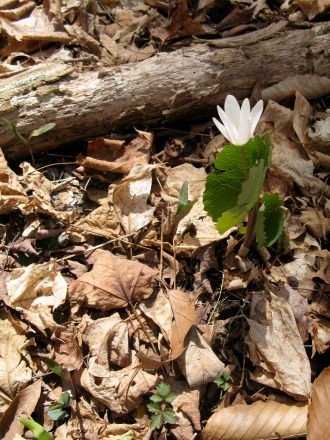
As she walked along the Mount Equinox trails, she was focused, quietly intense – until she found a patch of blossoming hepaticas. Then, it was just as though she had met an old friend.
“Oh, look at them!” she exclaimed. “Aren’t they just great?”
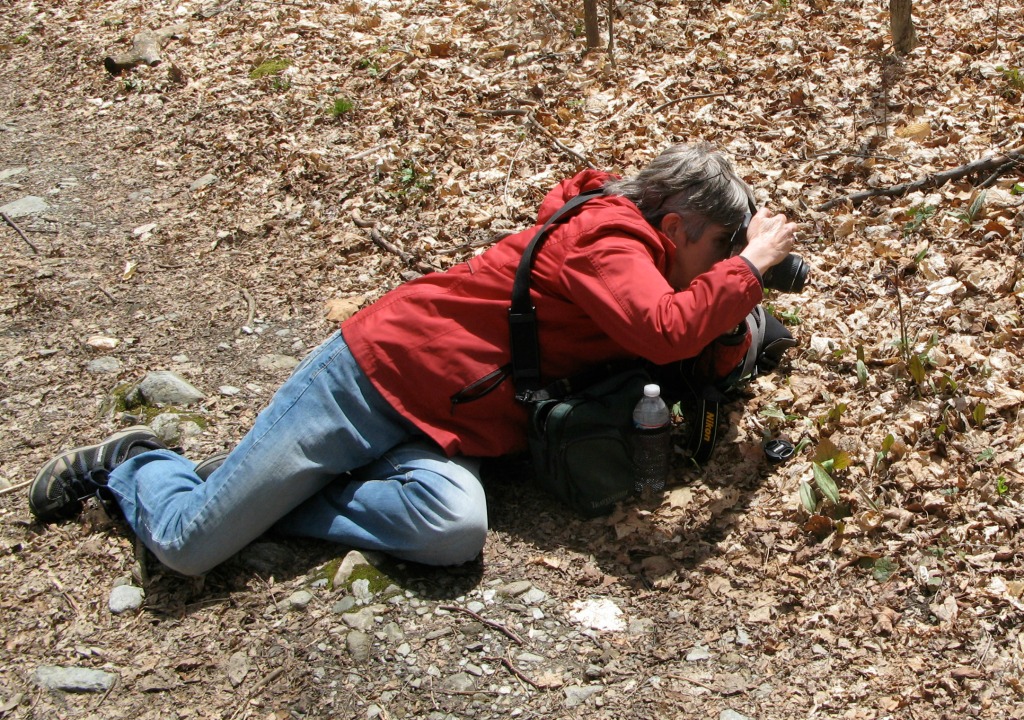
And without more ado, she flopped down on the leaf-covered forest floor beside the tiny wildflowers, camera in hand, and took their picture. Before her three-hour walk was over, there would be many more enthusiastic greetings, and numerous close-up photographs taken.
Her wildflower scouting walk took her to one of her favorite places, the steep eastern face of Mount Equinox, which towers more than 3,000 feet above Manchester, giving the village one of the most spectacular natural settings in Vermont. Most of the mountain’s face is now permanently conserved by the Equinox Preservation Trust and the Vermont Land Trust, thanks largely to work done by Thompson in 1991.
The plant community on the eastern slopes of Mount Equinox is known to botanists as a rich northern hardwood forest – a type of forest that grows only on sweet, lime-rich, calcareous soil. The bedrock underlying Mount Equinox, like much of the Taconic Range, is metamorphosed limestone – marble. That means the soil above it is rich in lime and magnesium – minerals that foster vigorous plant growth.
As a result, many unusual plants and trees grow there. It is probably the best example of a rich northern hardwood forest community in New England. Scientists have studied it since the late 1800s.
When Thompson was hired to inventory the property in 1991, she found dozens of interesting plants and other natural phenomena, and strongly recommended that the owner of the land – the Equinox Preservation Trust (EPT) — safeguard the property by declaring it forever wild. And so, 900 acres on the face of the mountain has been preserved.
However, Thompson pointed out that effective conservation involves more than just saving a single tract of beautiful forestland. One of her major contributions to the understanding of Vermont’s ecology is her work with natural communities – naturally occurring groups of trees, wildflowers, mosses, fungi, and other forms of life within a single environment. The book she co-authored with Eric Sorenson, “Wetland, Woodland, Wildland: A Guide to the Natural Communities of Vermont,” is regarded as one of the most important botany resources published in recent years.
When Thompson was awarded the prestigious Franklin Fairbanks Award in 2012 by St. Johnsbury’s Fairbanks Museum, the announcement of the award described her as “a defining voice of Vermont’s Natural Communities,” and noted that since 2003, she has led a partnership between the Vermont Land Trust and the state chapter of The Nature Conservancy to identify and protect key ecological areas throughout Vermont. As director of conservation science for VLT, she evaluates all Land Trust properties for important natural areas and recommends protections and management plans for those areas and the communities of plants that live in them.
Thompson studied botany at the University of Maine and completed her master’s degree at the University of Vermont in 1986.
“I knew from the beginning that I wanted to work on natural communities,” she says.
While finishing up her degree at UVM, she was hired by the Vermont Nature Conservancy to do just that. She worked with the Nature Conservancy for several years to identify important natural areas in the state. Over the period she developed a database of natural community types that was a precursor to “Wetland, Woodland and Wildland.” Throughout her career, she has consistently focused on preserving as wide a range of Vermont’s natural communities as possible.
As she walked through the Mount Equinox forest, she explained that having a variety of natural communities fosters a wide range of different plants, animals, fungi and other creatures, and thereby protects ecological stability. Vermont is unusual because, though small, the state has a large variety of natural communities.
“If you can protect examples of each natural community type scattered throughout the landscape, you will, in the process, protect a lot of biodiversity,” she explained, “including many species you may not know anything about.” Such species might include even underground fungi and bacteria that are likely invisible, but are nonetheless vital to the health of the botanical community.
And so a large tract of an unusual natural community, such as the rich northern hardwood forest on the side of Mount Equinox, is especially important to protect. “It’s a great example of this natural community in a spectacular natural setting,” Thompson said.
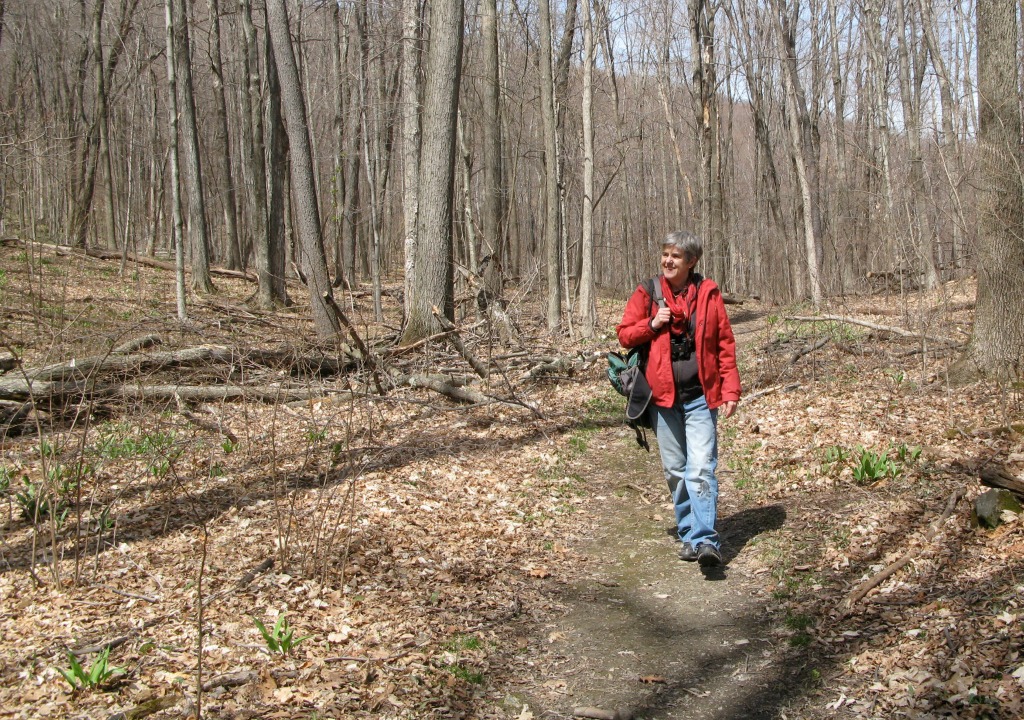
The trail she was following led up, out of a steep gully washed by a splashing spring-fed brook, toward a small plateau on the mountainside. The little plateau was carpeted with luxurious stands of leeks, ferns, various wildflowers and other plants, including one of her favorites. Spotting the slightly crinkled spear like leaves of a plantain-leaved sedge and its spindly, starburst-like flower stalk, Thompson again dropped to the forest floor and took out her camera.
“It’s an indicator species, “ she said. “It always grows in rich woods. … And I love it.”
Why the profusion of plants right on the small mountainside plateau?
It’s because of the lay of the land, according to Thompson. Nutrients from the soil and underlying rock tend to pile up at the bottom of a slope, she said, “like a big compost pile.”
Everything plays an important part in the natural community, she said. Gently pushing the leaves away from the dark red flower of a wild ginger plant, she noted that the seeds of the wild ginger have a sweet, fleshy attachment that ants like – and so ants are important in dispersing those seeds to new locations. Where ants are scarce, there is less biodiversity.
Nearby, on a rock outcropping where rare sedges grow, she found another indicator species – one that could crawl.
“It’s a land snail, “ she said, holding up a small snail which quickly retracted into its whorled gray shell. “They need calcium to make their shells – and so you only find them in limestone-marble areas.”
She placed the snail back on the stone outcropping, clambered down off the ledge, and continued her walk through the sunlit forest, quietly attentive, uncovering new springtime wonders and mysteries at every turn in the path.
Tom Slayton is a Montpelier freelance writer. He is editor emeritus of Vermont Life magazine.
