



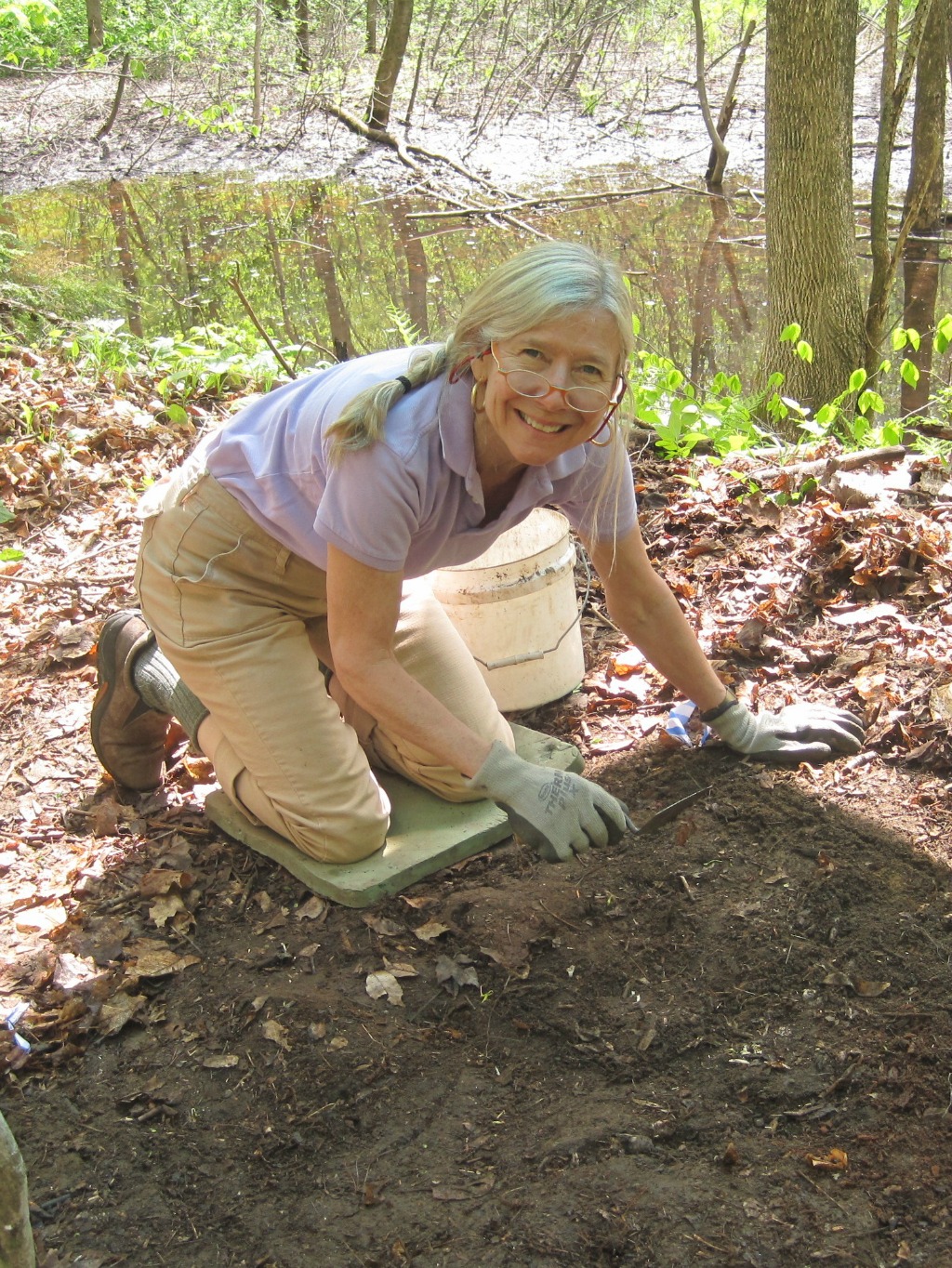
Editor’s note: This article is by Candace Page, a freelance journalist in Burlington. In This State is a syndicated weekly column about Vermont’s innovators, people, ideas and places.
BARRE – You know archeologists (the ones who aren’t Indiana Jones): Strong, silent men in khakis and heavy boots, wielding shovels and digging up bits of broken pottery they analyze in dry-as-dust academic papers.
Well … on this particular morning, Giovanna Peebles – Vermont’s first and only state archeologist – is wearing a flame-orange linen jacket, chartreuse flats and a black polka dot pencil skirt. Words pour from her in a cloud. Her hands fly off the steering wheel of her Honda Civic to gesture extravagantly.

She hasn’t put a shovel in dirt for 30 years.
Peebles is as likely to teach students about archeology with a box of defunct cellphones as with ancient arrowheads and potsherds. She posts an archeologist’s-eye-view of popcorn, maple syrup and copper mining on the Vermont Archeology Month Facebook page.
The core of her job is leading Vermont government’s various archeology programs, but her idea of a really great day is teaching history to a group of high school students by exploring the ghost farmsteads of Little River State Park in Waterbury.
For 38 years, her real job, she says, has been “to spread the gospel of archeology … to help people understand the importance of history.”
Peebles will retire June 30, leaving the office she has held since it was created in the mid-1970s. When she came to the job, Vermont had about 500 identified archeological sites. Today, there are more than 6,000, including 12,500-year-old Native American settlements, 18th century French homesteads and 19th century iron-smelting blast furnaces.
But Peebles’ legacy is broader than the thousands of boxes of archeological documentation stored in a state office basement in Montpelier.
“She made archeology accessible to the general public,” says University of Vermont anthropologist-emeritus William Haviland. “So many of us academics spend all our time talking to each other, but Giovanna can work with the general public, work with the Abenaki, work with the bureaucrats.”
Anne Friedrichs, a teacher at Mount Abraham Union High School in Bristol who worked with Peebles in the last decade, echoed: “She could get students to think about how you look at the ground and see the past, the people, the traditions, the culture, the economy that was there.”
‘Giovanna is irresistible’
Peebles read a book about archeology in the sixth grade, fell in love with the subject and never looked back. She was just 24 when she won the state archeology job, fresh out of a master’s degree program in Idaho. She was full of energy but very short on experience.
“Well, Giovanna is irresistible,” says Haviland, one of those who vetted the young applicant, who happened to be the daughter of Mariafranca Morselli, an Italian immigrant and longtime UVM faculty member.
Archeology in Vermont was almost entirely an amateur affair in the early 1970s. Haviland recalls with a shudder how state officials tried to attract tourists by inviting them to come and dig for artifacts – an invitation to destruction.
The state’s prehistory was almost entirely unknown. The dominant, entirely incorrect, theory was that Native Americans had never lived in the state, but only hunted or passed through.
“Things were not good,” Haviland said. “Giovanna had a job description, but she really made the job what it is.”
The good news was that the federal government had mandated the creation of historic preservation offices in every state and the hiring of state archeologists. Federally funded projects – and development requiring a state Act 250 permit – would require an archeological assessment before construction could begin.
Peebles oversaw those assessments, but within a year also had launched the first systematic survey for archeological sites in Vermont, a summer-long investigation in Chittenden County.
She plunged into the controversy over the provenance of stone chambers dug into hillsides around the state. A Harvard professor insisted the chambers were built by Celts who reached America before Columbus. (Peebles and others amassed conclusive evidence that the chambers were colonial root cellars.)
She pressed for hiring archeologists in the Transportation Agency, helped find grant money for archeological investigations, worked with landowners curious about old cellar holes and stone fences.
She reached out to amateur collectors for help locating archeological sites, collaborated with scuba divers to protect shipwrecks under Lake Champlain, worked with the Abenakis, inheritors of Vermont’s prehistory.
“I have learned new things every day, sometimes every hour,” she says. A long list of ‘thank-yous’ pours out, to other archeologists, other collaborators, bosses, her family. “It really did take a village to get us where we are today,” she says.
‘This is my dream’
If you are taking a tour with Giovanna Peebles, wear your running shoes.
Here is her tiny state office, stacked high with files and phone messages, an archeological site in its own right.
“I have 30 years of telephone pads I’ve saved,” she says, as she trades her flats for bright red running shoes. “People call; they tell me about artifacts they’ve found. You want to keep that information” until it is formally documented.
Here she’s dashing to the elevator, stopping to wave to maintenance woman, Jill Brown, who glances at Peebles’ vibrant outfit and says, “She is stylish.”
Now she’s in the car – there’s a fragment of a ceramic pot on the floor of the front seat – recalling her early days in the office (“It was the blind leading the blind”) and acknowledging the limits of her reach as state archeologist: “We try to work with landowners, to help them understand why history is important, but on private property people can destroy archeological sites if they want – this is America.”
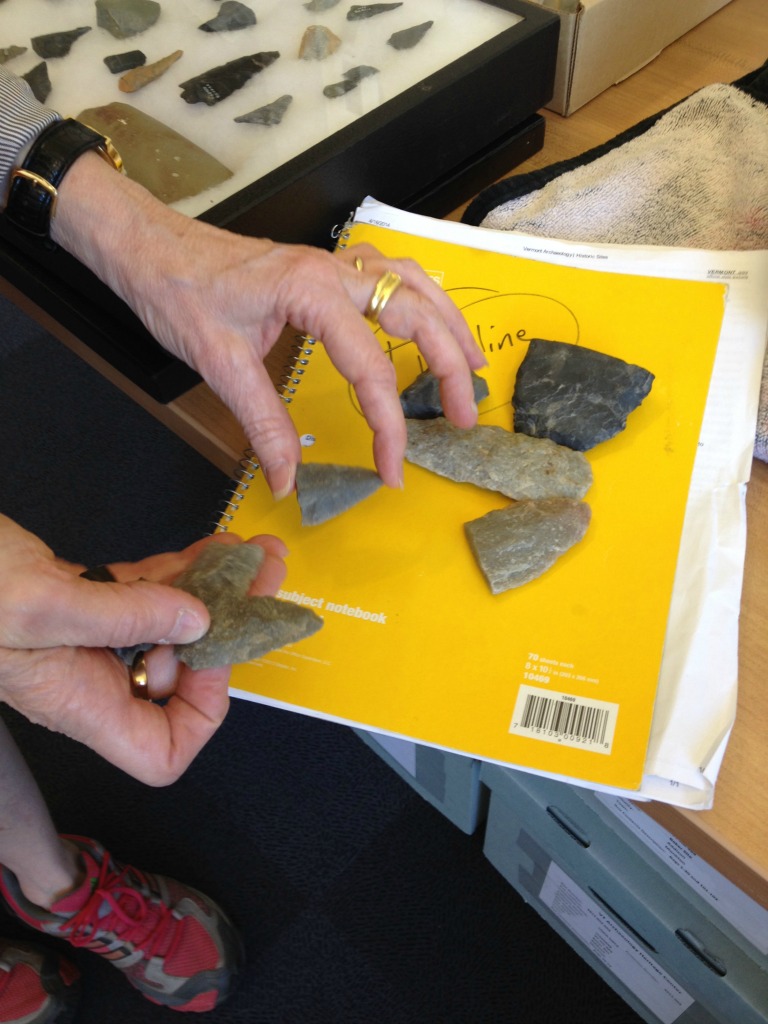
Now she’s headed up the wooden staircase at the Vermont History Center in Barre, headed for her pride and joy: the recently established Vermont Archeology Heritage Center on the second floor.
“This is my dream,” she says, throwing open the doors. A 400-to-500-year-old Native American dugout canoe recovered from Shelburne Pond holds pride of place. Panels on the walls present a timeline of Vermont’s history (Europeans arrive only at the tail end of the 12,500 years).
But the heart of the center lies in the storage rooms that house the artifacts retrieved during 38 years of archeological excavations at development sites. Most are packed in boxes, but not all.
Laid out on a bench are a group of broken plates and a nearly intact ceramic teapot excavated at the early 19th century farm of Ozias Atherton in Moretown. The site was explored before it was destroyed for a new bridge footing.

Peebles dons white cotton gloves and picks up the 190-year-old teapot, which has been traced to a pottery in Berlin, Vt., established by a family pottery company from Massachusetts. The blue-rimmed plates are fancier, imported from England. A fragment of milk pan shows where it had been repaired.
“You can see what was important to this family,” she says. “They’re living on this frontier; they’re frugal, repairing those holes in the pan, but they have plates imported from England.”
This is the power of artifacts, she says. “I don’t want these archeological collections sitting in boxes in storage. For students, they convey authenticity, they tell stories about people. And history is about people, not dates.”
“Archeologists have to get out there and tell their stories,” she says. “If we don’t share our knowledge and involve everyone, we will lose support and credibility.”
“It has been a privilege to have this special job,” she says. In retirement, she’ll complete her Ph.D. dissertation, write and do some consulting, helping landowners understand the history of their land and manage their archeological sites.
“You can’t take archeologist out of the state archeologist,” she says.
Candace Page is a freelance journalist in Burlington.
