

Editor’s note: This op-ed is by award-winning journalist Telly Halkias. It first appeared in the Portland Daily Sun.
I was 13 when I first read Robert Frost’s “Mending Wall,” and it changed me forever. That verse began my love affair with writing. As National Poetry Month is now upon us, it’s worth recalling how Frost inspired me to pick up a pencil every day and draft my inner thoughts on paper.
At that age, it was difficult to grasp many of the sensitivities Frost conveyed. The poem’s New England aura was lost on this native Brooklyn boy – who at the time had moved overseas.
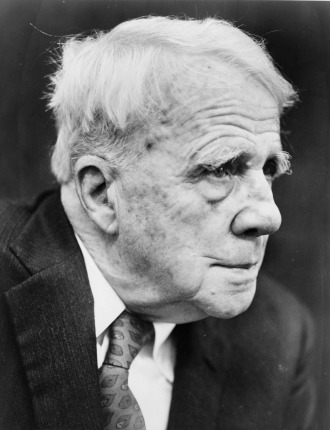
Congress photo
Yet while always a reader, “Mending Wall” compelled me to write. My parents seemed pleased another cerebral pursuit had barged into my puberty-stoked adolescence.
Between its first line, “Something there is that doesn’t love a wall,” and its last, “Good fences make good neighbors,” – a 17th century English proverb that “Mending Wall” made famous — Frost spoke to something inherently human. It’s a notion that Aristotle, who advised that we are social animals, could love.
Later, when New England became home and I’d lived here longer than anywhere else, the poem took on another life. It called to me every mud season, when we emerge from winter’s veil of snow, and the lilacs aren’t far behind.
In “Mending Wall,” Frost reflected on the springtime ritual of repairing a stone wall separating his land from his neighbor’s. The purpose, ostensibly, was to keep the structure intact:
I let my neighbor know beyond the hill;
And on a day we meet to walk the line
And set the wall between us again.
We keep the wall between us as we go.
Frost’s message of separation and isolation was a warning that even our differences shouldn’t matter. We’re allowed individualism; however, the best way to enhance it in the surrounding world is to share it. This act, more than any other, will break down barriers and render walls obsolete:
He is all pine and I am apple orchard.
My apple trees will never get across
And eat the cones under his pines …
Before I built a wall I’d ask to know
What I was walling in or walling out.
As a younger man I sang Frost’s mantra. Yet while still supporting it, in middle age I’ve come to respect, if not appreciate, his neighbor’s take on life.
Not all walls are bad. Not all walls need to be high and strong and constantly rebuilt. They, too, can allow reason from drifting out of the pasture where passion grazes. Sometimes, walls allow us to dream while keeping our feet planted in reality.
The pencil at 13 gave way to the keyboard at 53. It’s ironic to think that an ode doesn’t need a superlative billing to make a difference. That’s because “Mending Wall” isn’t my favorite poem; that honor goes to E.E. Cummings’ lovesick reverie, “somewhere i have never travelled, gladly beyond.”
But Frost’s meditation remains instructive and influential. It saved my life by teaching me not what to think, but more importantly, how. As my late father once advised: “Re-read the classics at different stages of your life. They’ll mean something else each time. If they don’t, it’s a sign you’re stuck in the mud and need to lift yourself up out of it.”
“Mending Wall” vindicates that notion as Frost and his neighbor navigate the mud on either side of their task. Reading it again just recently brought about fresh revelations. Like how I don’t write poems now that I’m a journalist and teach writing for a living. Or how my poetry and that of other poets has affected my prose, as well as the ideas I try to pass along to readers and students.
It’s also about those ubiquitous walls and what shape they currently take.
Today, while hiking all over New England, many of the rocky barricades I encounter are in bad shape. Maybe something there is that doesn’t love a wall, but I often stop to place a wayward stone back where it might have fit generations ago. One is usually enough. There is some comfort in that, and I don’t think Frost would frown.
After all, many such barriers are barely a foot high anymore. I continue down the trails, knowing I can step over any wall to find a young boy with pencil in hand, waiting for me.
You may e-mail Telly Halkias at tchalkias@aol.com or follow on Twitter: @TellyHalkias
