


Editor’s note: This article is by Matt Pierle, a master’s fellow in the Field Naturalist program at the University of Vermont.
Forget about American robins, crocuses and the other “classic” signs of spring on the front lawn. Across Vermont, the vernal and carnal season is now underway and winter’s fade signals the rise of more than just sweet maple sap. Here’s a short field guide to what’s happening out your backdoor.
Birds
The first turkey vultures, the 787’s of Vermont birds swept in a couple weeks ago on the windy heels of a mid March storm. Common grackles and cattail-clutching red-winged blackbirds are not far behind. Many of those first to arrive, to which we can add wood ducks, eastern bluebirds and red-shouldered hawks, aren’t returning from a Caribbean island or the pampas of South America.
These early birds are short distance migrants and have wintered here in New England or a few states south. Some owls are already paired up and by month’s end will be sitting on eggs.
Spring pioneers know how to sustain themselves on the appetizers this shoulder season offers. Until the ground thaws, fruits form and more insects hatch, early songbirds make do with last year’s berries, insect larvae and tender leaf and flower buds. Hawks and owls are picking off other birds and small mammals. The vultures, of course, are feeding on the carrion of animals that haven’t made it through the winter — or across the road.
Generally, the more colorful males of each species, eager to claim prime breeding habitat, appear before the females. A quality territory offers food, water, nesting materials and adequate cover to escape predation. Days or weeks after the males, the females will start arriving to survey the season’s prospects.
It’s good to get out to see birds soon. Before the trees leaf out you’ll have an easier time spotting our early a cappella singers. Even without binoculars, observe early migrants defending territory, building nests, courting and even copulating. At close range, or through binos, you’ll see birds consuming winter-worn fruits like rosehips, cherries or sumac seeds.
Insects
First a basic recap on insect biology — although an overgeneralized one since exception is almost the rule when it comes to this wildly diverse group. Insects have three life stages: egg, larva, pupa, and six-legged adult. Most insect species overwinter in either the egg or larval stage. A few early fliers, however, overwinter as adults and get airborne as early as mid-March. To find early insects look on or under tree bark, in decaying wood and in any open flower.
Starting this month, look for mourning cloak butterflies. They’ve spent the winter not as pupa but as adults tucked under tree bark. Their chocolate wings with blue spots and a buttery hind fringe are an elegant and hopeful sign of spring.
While the big firefly show doesn’t start until June, a few species have overwintered and are soon on the wing. Look on tree trunks for the quarter- to half-inch long Ellychnia species with their long, rounded, matte black wings, beaded antennae and a broad black head with reddish-orange stripes on either side. But don’t look for a glow. This early, day-flying firefly actually lacks the signal light that gives fireflies that name.
In the meantime a few intrepid insects, honing in on the scent of sugary pools of sweetness, are accidentally paying one-way visits to maple sap buckets.
Plants
A spring walk in the woods before leaves unfold to block sunlight from reaching the forest floor reveals a vibrant set of floral fireworks we call the “spring ephemerals.”
The spring beauties, trout lilies, Dutchman’s breeches, hepaticas and others are showy, and worthy of attention. But they aren’t the opening act. Our earliest flowers are up in the trees.
Along stream banks and lakeshore as early as March you’ll find the even earlier flower buds of the silver maple about to explode into sprays of tiny pollen-producing male flowers. The most aspiring female maple flowers may not set seed if subjected to a spring cold snap, but successful flowers will produce their familiar helicopter-shaped samara fruits sometime around mid-May.
As a rule, what blossoms early generally doesn’t continue flowering for long. Summer has its own floral show. Decades ago, naturalist Edwin Way Teale reported that spring flowering progresses from south to north at about 15 miles a day and upslope at about 100 vertical feet per day.
If you find that you’ve missed a plant in flower that you’d like to see, it may be possible to go back in time traveling north in latitude or up in elevation. The species you’re interested in may still be displaying flowers there. If not, it’s worth searching in cooler (shaded, north facing or sandy soil) microsites before giving up on that flower for the year.
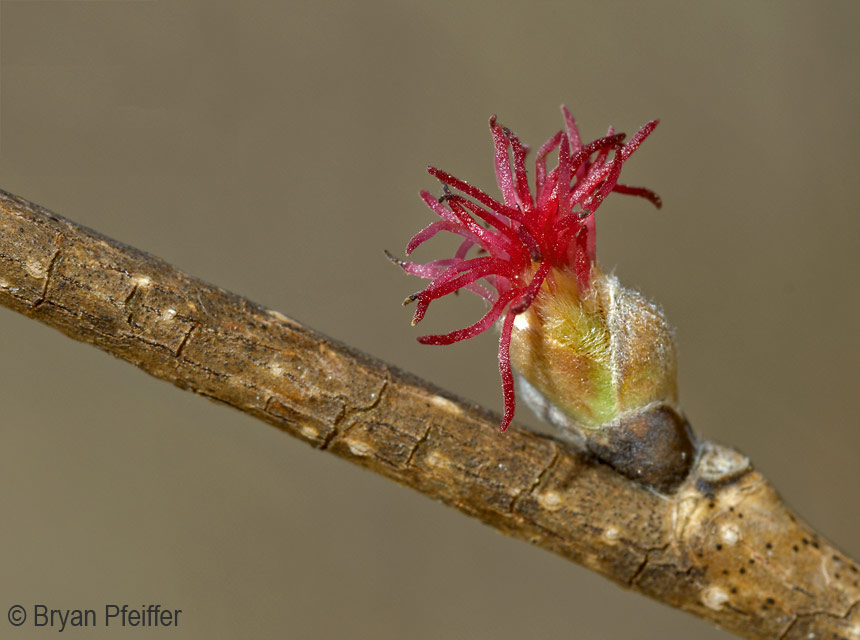
Lower, in the forest’s shrub layer, hazel’s lanky red petals are an early season kick-off to a floral pageant that will progress species-by-species from now until October when witchhazel sends out the year’s very last shrub flowers.
Closer to the ground still, in spongy substrate, keep an eye out for the creemee cone-sized flower of the skunk cabbage, and the nickel-sized, iridescent yellow flowers of the marsh marigold. These plants are good places to find early insects, including honeybees making pioneering forays from the hive.
Reptiles and amphibians
Almost everyone knows spring peepers, the thumbnail-sized altos of the choir that often monopolize the spring soundscape with mating choruses in excess of 100 decibels. But they aren’t the only amphibians singing and breeding in early spring.
Wood frogs, who can literally freeze solid and then thaw multiple times per winter — thanks to special nucleating proteins in their blood — make up the baritone section of the spring choir. They’ll begin singing before the peepers. These deepthroated gentlemen (gentlefrogs?) are spring’s opening aquatic act.
Vermont’s three species of mole salamanders, all designated as species of greatest conservation need, depend on special, but seasonal, forest wetlands for mating.

On warm nights soon, spotted salamanders will be on the move from upland leaf cover and hidey-holes to these vernal ponds, sometimes traversing over spring snowpack. Males of each species deposit their spermataphores, small packets of sperm, on plant debris, to be picked up later by the females. This mating drama will peak during April’s warm showers. By summer or fall, the vernal ponds will dry up and look like little more than leafy depressions in the forest floor.
Our earliest reptiles start the season about now, too. Spotted turtles and wood turtles are feeling the urge to mate, and doing something about it. As for snakes, Dekay’s brown snake is first on the scene. Brown snakes start moving and slithering when the sun heats exposed ground and rocks. A wide, pale brown stripe along the top and a brown or gray-brown body should allow you to identify this species. Look also for the intricate, checkerboard patterning often presented along each side of its body. Like about half of Vermont snakes, brown snakes give live birth to as many as 30 snakelets, each about the size of a cigarette. Unlike cigarettes though, these young snakes, and the adults, are completely harmless (to us).
Mammals
While most of our mammals are active during the winter, movement for all species ramps up in the early spring.
As new plant growth emerges, so do herbivorous mammals. Voles, chunky mouse-like rodents, are avid burrow builders, but can sometimes be spotted scurrying above ground. If you don’t see these vegetarians in the flesh you might notice their gnaw marks in the ankles of woody shrubs. They’re after the moist and nutritious, live inner cambium layer. Tiny piles of their feces reveal surprisingly orderly “latrines.” Much larger herbivorous rodents, the beavers, are performing spring-cleansing rituals of their own shoring up their lodges and dams.
Of course, a lot of spring activity is related to friskiness, foreplay and mating. Elusive male fishers are busy tearing through the forest, scent marking and finding females for coupling. Female fishers deliver small litters this time of year, and then mate again within just two weeks. They have a remarkable adaptation that delays the embryo that forms this spring from attaching to the uterine wall until early next year.
Squirrels, anything but elusive, can be conspicuous and cacophonous to the point of annoyance. There’s a reason they seem so frenzied. Unlike some small rodents that have as many as 10 litters a year, female red squirrels have just one and are in estrus (receptive to reproductive activity) for as little as 6.5 hours just once a year. The typical lifespan of a squirrel is just a few years. With such a small window of estrus, an “average” male (if there is such a thing) may have just one or a small few chances to mate in his lifetime so when he senses that a female is receptive he’s likely to be persistent, even pesky.
More playful perhaps, river otters can sometimes be spotted sledding down riverside embankments to conduct their noisy breeding rites in spring’s cold flowing waters.
There is no doubt about it; spring is a sensuous season. Birds are setting up shop, insect larvae are feeding on fresh leaves, amphibians are migrating and mammals are emerging from hibernation. With so much afoot and on the wing, now is the perfect time as the snow melts and mud emerges to discover the creatures and plants that are waking up after an especially long and cold winter in Vermont.
