

Vermont’s union roots are shallow at best when it comes to construction and building trades. It’s estimated that less than 10 percent of the state’s construction workers belong to a union.
Legislation up for a final vote in the House on Thursday wouldn’t change that, but it would push companies toward a union business model when it comes to paying for labor on state-funded construction projects.
H.878 would require companies to offer certain benefits if they want to bid on state jobs. Alternatively, companies that don’t offer benefits could boost employee wages for an amount equal to the value of what their benefits otherwise would be. The bill would accomplish all this by shifting Vermont’s prevailing wage laws from a unique state model to a federal standard. “Prevailing wage” refers to standards for how much construction workers should be paid on publicly funded projects.
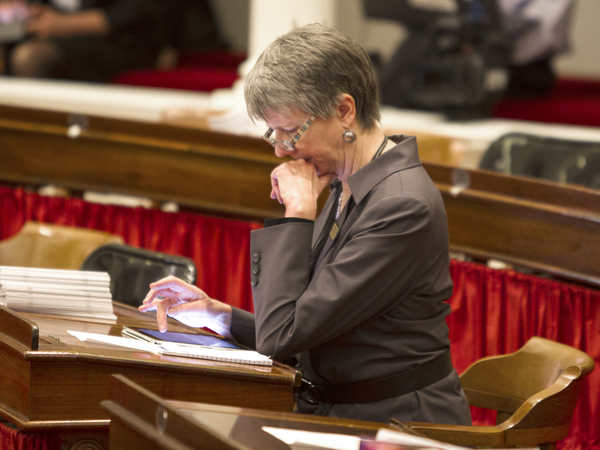
Rep. Mary Hooper, D-Montpelier, sits on the House Corrections and Institutions Committee, one of three House panels that recommended H.878.
“This was about what sort of employers do we want to be,” Hooper said on the House floor Wednesday. “Paying Vermonters decent wages and enabling them to purchase decent benefits. That’s the underlying concept of this bill,” she said.
Rep. Warren Van Wyck, R-Ferrisburgh, cast one of two dissenting votes in the House General Services, Housing and Military Affairs Committee. Van Wyck said after the floor debate that he dislikes the way the bill proscribes employment practices, and he believes non-union shops have more flexibility to find efficiencies.
A key to that flexibility, the trade group Associated General Contractors of Vermont argues, is employee benefits. Companies can choose whether, when and how many benefits to offer all or some employees.
All federally funded projects must follow rates set by the Davis Bacon and Related Acts. About 40 states have their own prevailing wage laws for state-funded construction.
Vermont’s current prevailing wage laws neither require benefits nor calculate their value into standards for compensation. The federal prevailing wage law does.
The switch to Davis-Bacon standards would mean that, in order to compete for any state-funded contracts, construction companies would have to offer benefits to their workers or else pay them extra.
That would drive up labor costs for companies that do not offer federally recognized benefits. These businesses have fought the bill.
Union and non-union shops that do offer benefits have praised the legislation. They say it will “level the playing field,” making it easier to compensate workers well.
The legislation started as a proposal to establish the going union rates as Vermont’s prevailing wage, similar to laws in Massachusetts, New York and Pennsylvania.
After some time in the House General Services Committee, that union-wage legislation was shelved and a new committee bill was created to align Vermont with the federal prevailing wage. Connecticut and Rhode Island tie their projects to Davis-Bacon rates.
The potential impact of the switch on Vermont’s capital budget is unclear. A fiscal note dated April 3 estimates an 8 percent increase in total project costs. That could be anywhere from $1.92 million to $3.36 million annually — down from a previous estimate in March of $2 million to $7 million.
Most years, Vermont’s capital budget ranges between $60 million and $70 million. Only about half of those projects are subject to prevailing wage requirements, and labor constitutes roughly one-third of the spending.
Rep. Thomas Koch, R/D-Barre, said more money won’t be added to the capital bill to pay for the increased labor costs, so the prevailing wage change just represents projects that won’t get done.
“The money isn’t going to come from the contractors. They’re going to write it into their bids. And the money doesn’t come from the state treasury,” Koch said. “It comes from the taxpayers. So all we’re doing is transferring from one taxpayer to another. Some will say, ‘thank you,’ and some will say, ‘ouch.'”
Hooper said the Institutions Committee gave the potential for increased costs a lot of thought.
“We protect that capital bill very vigorously,” Hooper said. The majority of the committee decided any increase in labor costs would be worth the money.
The House Appropriations Committee voted for the bill 7 to 4. The bill is scheduled for a final House vote Thursday morning. It’s uncertain which Senate committee would take it up.
CORRECTION: This article was corrected at 11:50 a.m. Thursday, April 10, to clarify that the federal prevailing wage standard allows companies to either provide benefits directly or raise wages to compensate employees for the value of what their benefits otherwise would be.

