


COLCHESTER — Canadian Ambassador Gary Doer stood up to Keystone Pipeline protesters Monday afternoon at St. Michael’s College.
The ambassador to the U.S., formerly the premier of Manitoba, where crude oil production has doubled in five years, visited the private campus as a guest of the Vermont Council on World Affairs. The organization brings international visitors to Vermont to promote global awareness and understanding.
Doer’s response to the protesters objections to the pipeline was emphatic: Oil and natural gas are being extracted from tar sands and through hydraulic fracturing — like it or not. Pipelines like Keystone, he said, are the best possible way to move the fuel.
He said demonstrators three years ago successfully delayed the laying of a pipeline in Nebraska, but ultimately, the protests did nothing to stem the flow of crude.
“People said, ‘If you don’t develop the pipeline, the oil will stay in the ground, and that will mean there’s less (greenhouse gases),'” Doer recalled. But oil production hasn’t slowed, he said; rail transport has doubled.
That’s a perilous alternative, he said, as made clear after the deadly train derailment and explosion at Lac-Mégantic, Quebec, in July.
Citing a recently released U.S. State Department report on the proposed Keystone project, Doer referenced three benefits of pipelines over transport by rail or truck: safety, cost and greenhouse gas emissions.
Those aren’t his findings, but the U.S. State Department’s, he reminded the audience several times. The audience reaction gave Doer ample opportunity to make this point.
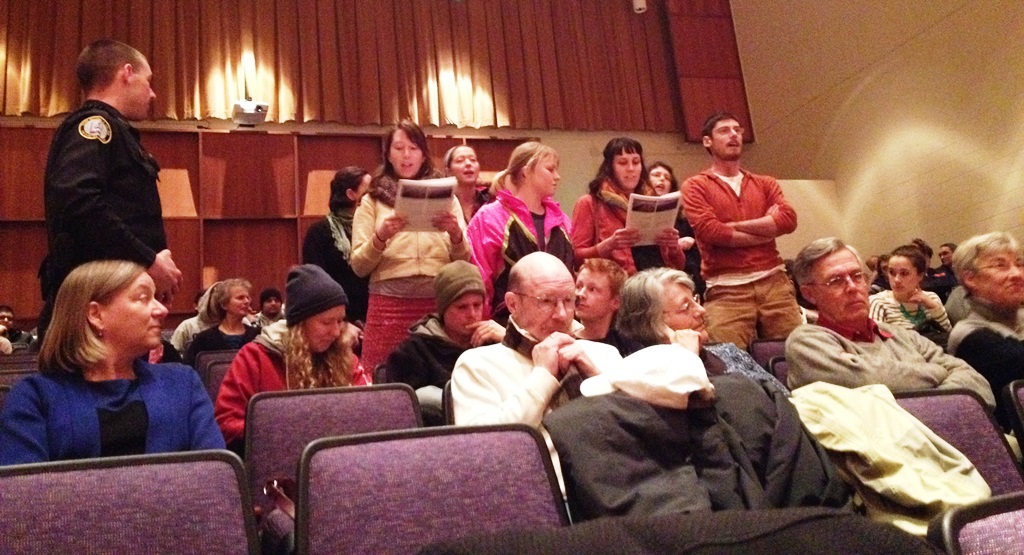
A small group of protesters interrupted his talk before he had dispensed with introductory niceties.
One woman began singing, “We will not give up the fight, we have only started.” She was soon joined by about seven others, who rose from their seats around her and began to sing in unison.
Doer instructed a police officer who approached the protesters to stand back and let the group express themselves. “This is a democracy,” he repeated calmly from the stage. Moments later, he nodded a go-ahead to the police officer, who gently led the protesters out of the room.
“I knew I couldn’t come to Burlington without something,” Doer said with a laugh to St. Michael’s President John Neuhauser after the talk. Later he told reporters that he didn’t mind the protest. “I just wish they would stay to let me get my side of it out,” Doer said.
He acknowledged throughout his talk that many of his positions — and those of Prime Minister Stephen Harper — are quite controversial. The ambassador focused mostly on a history of cooperation between the U.S. and Canada on a range of issues.
Regarding national security, the two nations have deepened their border efforts that began after World War II, Doer said. Cooperation on NORAD, the North American Aerospace Defense Command aerospace warning system, has now taken root at the land border, where the counterparts have begun adopting compatible inspection protocols that let them “inspect once, accept twice” to expedite cross-border trade.
Doer also talked about the advantages of the pending Trans-Atlantic and Trans-Pacific Trade Partnerships to streamline international commerce. The agreements are criticized by some for their secrecy and tilt toward corporate interests. But Doer said “reciprocity” and “rule of law” are the guiding principles at work.
The crux of his message deflected concern about the perils of domestic energy production. The current methods are not perfect, he said, but they’re getting better. And they’re necessary for reducing greenhouse gas emissions.
Doer said the quest to achieve domestic energy independence in North America starts with reducing demand through energy efficiency. He credited both the U.S. and Canada for enacting stricter emissions standards for light vehicles, and said the next target would be trucks.
And because electricity generation is the second highest contributor to greenhouse gas emissions, Doer said, renewable energy production also tops his hit list — including wind, solar, geothermal and hydropower.
Doer also made a pitch for his country’s large-scale energy producers such as Hydro-Québec.
“It’s our belief that, if it walks like a duck and it talks like a duck, it’s renewable,” Doer said.
But his points about water did not stop with hydropower. He predicted that water will be the next precious resource provoking debate.
“We will have to find a way to steward and store water, to deal with flooding and deal with droughts,” Doer said. “And we’ll have to do it together.”
“I think that five years from now, the protests will be about water,” he said.

