

Editor’s note: In This State is a syndicated weekly column about Vermont’s innovators, people, ideas and places.
It all started with a mourning dove.
Mark Paul was camping with his wife Deb at Lake Carmi State Park when a bird’s incessant hooting at dawn both irritated and intrigued him, and he struck off to find out what it was.
That was more than two decades ago. Since then you could say things have flown in a new direction for Paul, an affable biology and environmental science teacher at Essex High School. First came a growing interest in birds, then studies in ornithology and summer work with the Vermont Institute of Natural Science in Woodstock, and eventually a desire to try capture some of the interesting bird activity he saw on film.
Fast forward to the end of 2013. Paul has now shot, edited, narrated and produced three DVD videos of “Birds of North America,” with a fourth in the works for 2014. Along the way he’s extensively upgraded his equipment, honed his craft, and become an expert in bird habits and habitat. As for his birding sideline, it’s transformed from an enjoyable passion to what you might well call an artistic compulsion.
“I like to say, I’m a birder that just had to take his obsession to a new level,” jokes Paul, who is modest about his venture in bird videos and well aware of the unusual turn his life has taken.
Paul’s videography quest is one that most of us would consider quixotic, daunting and extraordinary: Get high-quality video – not fuzzy flying or boring shots, he makes clear – of every bird in North America. That’s 501 birds, in case you wonder – a number he came up with because it’s one more than famed wildlife artist John James Audubon painted.

He’s got 160 so far, and 340 to go. No sweat. “That’s all very doable,” he says.
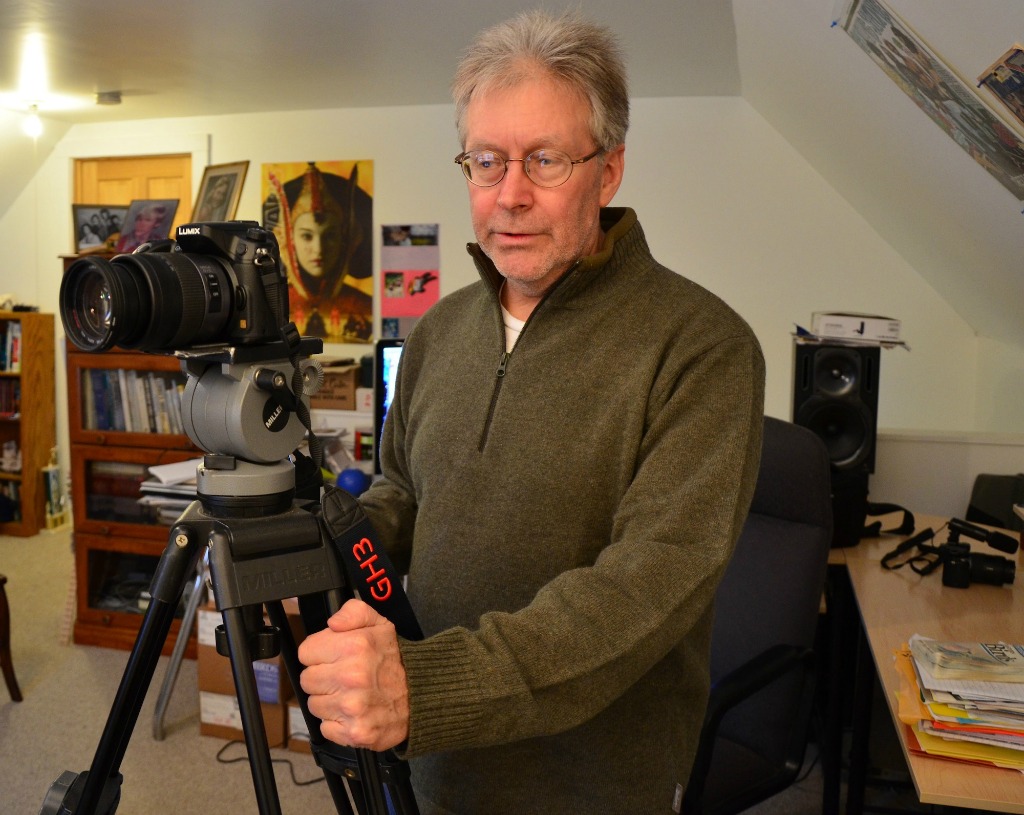
This would be an ambitious life goal for someone in their 20s but Paul, who has short-cropped spikey gray hair, glasses and a relaxed easy manner, is now 58 and still has three years of teaching left before he plans to retire. If you guessed he’s got his spring and summers and falls planned out in the fields, marshes, forests and ponds, lakes and mountaintops, you’d be right. But he’s not fazed by the task, propelled instead by the exhilaration that comes with downloading his videos to discover the secret lives of birds unveiled.
“One of the things I like about doing this is that I’m always learning,” explains Paul, sitting in the office chair in the third floor aerie that is his editing studio in his house in the tiny, mountain village of Jerusalem in Starksboro, off Route 17.
Surrounded by a big screen iMac, tripods and video gear, he pulls up one of his videos to show what he means. A female hummingbird flits into view to perch over a well-hidden nest with two chicks, backlit by soft yellow leaves and blue sky. She bends over and like a sewing machine needle at high speed, pumps her long bill into the open throat of a chick. Then she pauses, and with a different, very gentle motion slides her beak in the chick’s open mouth.
In the first feeding technique, Paul surmises the hummingbird is actively regurgitating an insect, and in the second, depositing nectar.
“I love getting neat shots to show what birds are being fed,” he says.
His close-up bird videos, are 45-60 minutes long and “arranged thematically so you get a sense of being in their habitat.” Each is a string of revelations about bird life. He pulls up an example, a red-eyed vireo building an unusual shredded-leaf nest, pointing out how the female bird uses balled-up, sticky spider web material to bond the nest together.
“What makes my work special is I show people things they can’t see without binoculars,” he says, calling it their “behind-the-scenes behavior.”
One of his more remarkable recent takes is of a bittern he spotted as he was driving along a road in Chittenden County in spring. He hit the brakes, jumped out of the car, set up his camera and tripod and caught the bird – sort of chunky dwarf heron – doing its odd head-waving dance in imitation of a swaying reed for disguise. The video then cuts to the bittern hunting the shoreline, spiking its long sharp beak into the water to come up with a good-sized wood frog, legs flailing. After rearranging the unfortunate frog in its beak, the bittern raises its head and gulps it down, still live and kicking, its neck bulging in a funny pantomine of swallowing a much-too large object.

Paul is still exultant about his luck and the odd circumstances. “I was standing beside the road inches from being run over, filming this thing eating wood frogs, getting amazing footage,” he recalls.
It was bird songs that drew him into birding.
“I think it has a lot to do with the sounds. I’m a musician and I’m always attuned to sounds,” he said, citing as an example the ethereal flute-like song of the wood thrush. A Vermont native and late bloomer, he grew up in several Chittenden County towns and didn’t go to the University of Vermont until he was 30, after playing bass and guitar and singing in bands.
Paul was inspired to shoot bird videos after looking at what was available and finding it “mostly crap.” He now has two videocams, which look like regular DSLR cameras with modest telephoto lens, a fact that often surprises people. His key is to find and set up in great bird habitat close to a nest or activity site, sometimes using a “blind” (which can be anything from a tent to his car). His most vital piece of equipment is a sturdy Miller tripod – it costs more than the cameras, he notes.
The process requires patience, a knowledge of habitat, bird song (to locate birds), some luck and being inured to all manner of obstacles, especially bugs. “You’re always dealing with adversity,” he admits. After all that, comes hours of editing. And sometimes, he comes up empty, recalling last year when he thought he had found “morning warbler heaven.”
“I was sure I was going to come away with great footage,” he says, “I went there four or five times.” Instead, he got zip, nada, zilch.
More often than not, though, when he downloads his video he finds a thrill on the screen, from scarlet tanagers, indigo buntings and pileated woodpeckers to kestrels and merlins. He pulls up a video showing a matted-down spot of brown grass surrounded by green marsh grass. Suddenly a shadow appears and a beautiful marsh hawk plops down into view, settling itself as it peers around. Paul explains that its chicks are hiding away from the exposed nest. His pleasure at the shot is obvious, even long after it was taken.
With changing viewing habits – smartphones, online streaming – he’s aware of the need to find different ways to get his work out to folks. Until he retires, that will have to wait, perhaps his only frustration. But he remains totally enthralled by his birding venture.
“I feel real fortunate to have this passion,” he says.
Andrew Nemethy is a longtime Vermont journalist, writer and editor from Calais.
