

Editor’s note: This story is by Nancy Price Graff, a member of Maple Corner Media, a group of freelance writers based in Central Vermont.
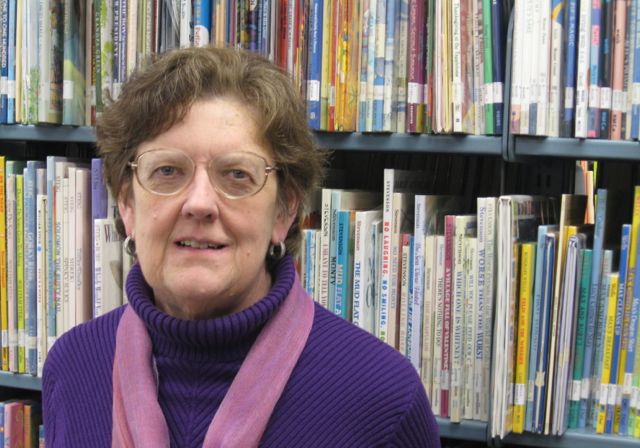
For almost 28 years Grace Greene has been traveling the state as the youth services consultant for the Vermont Department of Libraries. From outposts of literacy in some of the state’s smallest towns to temples of civic pride in its largest cities, Greene tends to the needs of children in Vermont’s 183 public libraries. It is the only thing she has ever wanted to do, and come early summer, she is not going to be doing it anymore.
Replacing Greene won’t be easy.
“She really cares about what is happening with these children,” Martha Reid, state librarian, says of Greene. “If anything, her passion and energy and love for her work will continue to increase until she’s out the door.”
The closing of that door behind Greene will mark the end of a generation of extraordinary service to Vermont. A wonder woman of sorts who has advocated tirelessly to give every child in the state the gift of literacy, Greene will have a hard time climbing down off her soapbox. She has seen for herself that many of the obstacles that stand between children and all the opportunities that literacy opens up for them can be fixed or changed or ameliorated. Those possibilities have driven her work since the beginning.
“Access is key. Children need good school and public libraries and good librarians,” she says.
Green’s immeasurable impact on the children of Vermont over almost three decades is like reflected light. She rarely works directly with the children themselves, who include babies through teens. Instead, she works one-on-one and through workshops with public librarians to develop programming that brings together children with each other, their parents, their caregivers and their libraries. At least twice a year she travels the state from Rockingham to Alburgh lugging boxes of books into libraries big and small to introduce librarians to the best in the latest crop of children’s books so they can improve their collections.
She is the primary or a contributing organizer of the Dorothy Canfield Fisher Award, the Red Clover Award, and the Green Mountain Book Award, three statewide contests held every year, one for young children, one for middle schoolers, and one for high school students that let these readers choose their favorite books. Every summer she organizes a Vermont Summer Reading Program for children through the state’s public libraries to make sure that school children stay engaged with reading throughout the long vacation.
As she generously allows, she relies heavily on the contributions of public librarians and partnerships with organizations such as the Vermont Center for the Book, in Chester, and CLiF, the Children’s Literacy Foundation, in Waterbury, to achieve her goals. Sometimes this makes for strange bedfellows: the state treasurer’s office (to promote financial literacy) and the Center for Cartoon Studies (an advocate for graphic novels). It’s Greene’s willingness to work with a wide variety of organizations and the diverse cohort of public librarians she serves, plus her regard for others’ opinions, that makes her respected and beloved across the state.
“The sheer amount of what she can accomplish is amazing,” says Reid. “She has a knack for collaboration. She thinks broadly. We’ll be discussing libraries, and she’s already thinking, ‘How can we connect with kids, kids with parents, kids with libraries?’”
Greene accomplishes all this in a small office amid a bunker of children’s books tucked behind the microfilm room at the state library in Montpelier. In the main room her assistant’s desk is invisible under piles of children’s books while boxes on the floor are strategically arranged to create a path to her door. Greene urges librarians visiting the office to take these books back to their home institutions to strengthen their collections. Dividing the room are metal stacks running almost floor to ceiling crammed with children’s books and young adult works covering virtually any topic imaginable.
Greene has an encyclopedic memory for the stories recorded in these thousands upon thousands of books. She can tell you all about Harold and his purple crayon or the indignities suffered by Octavian Nothing, a young black slave in Massachusetts at the outbreak of the Revolutionary War. She can empathize with Alexander’s terrible day and talk knowledgably about the habits of hobbits.
Her love for these stories is inclusive, not exclusive. There is always room in her heart for another new favorite. In the course of her long career, she has supervised the introduction of computers in children’s libraries, embraced graphic novels for enticing reluctant readers to read, watched children devour the Harry Potter series despite the warnings of doomsayers who predicted children wouldn’t read long books, and held workshops for librarians wondering how to introduce gritty new topics such as divorce, rape and racism. At the moment, she is keen on the stuffy tiger that learns to be true to himself in “Mr. Tiger Goes Wild,” one of dozens of books under consideration for Vermont’s Red Clover Award.
After almost three decades of serving as a passionate ambassador for children’s literacy, Greene has many stories of her own. She remembers keenly a new librarian at one workshop who asked her what was the worst mistake she could make. “Making anything off-limits,” Greene replied, knowing that her answer might be controversial. “Everything in a library should be open to everyone. Only a parent can control what a child reads.”
Nonetheless, she says, “Children’s librarians have a great deal of power, even though “they tend to underestimate the value of their work.”
Greene sees her job as empowering them.
“I enjoy anything that involves working with children’s librarians,” she says. “They are so responsive and grateful for anything that you do.”
And what they do is far more than what librarians did a generation ago. This year, for example, Greene worked with the Vermont Center for the Book to help train 57 public children’s librarians through the Vermont Early Literacy Initiative to work on language and math skills with parents, caregivers and children using the latest findings in children’s cognition.
“It’s a combination of teaching early brain development and how children learn,” says Greene. “It’s not enough just to read to your child. You have to talk with your children. It’s so important. Most parents don’t realize that.”
To prove her point, she cites studies showing that a child from a high-income family will likely hear 30 million more words by the time he’s four than a child from a low-income family. By the time those two children enter kindergarten, an almost insurmountable gap will have formed. One of those children should thrive in school; one will struggle from the very first day. When Greene finishes teaching the workshop, librarians, parents and caregivers have learned how to incorporate clapping, reading, feltboard stories, rhyming, singing and playing into an integrated program rich in learning opportunities for children from all kinds of families.
And it all starts with a book.
Greene has spent her career spreading that gospel to children in the farthest corners of the state. She will miss working with public children’s librarians, but she looks forward to reading for her own pleasure.
“Some of my best friends are books,” she says with a twinkle in her eye.
