


Editor’s note: Dirk Van Susteren of Calais is a freelance writer and editor. In This State is a syndicated weekly column about Vermont’s innovators, people, ideas and places.
One weekday in late September, Bob Joly climbed into a “shiny behemoth” – a rented black SUV that “looked like the kind that transports presidents” – and drove three hours from St. Johnsbury to Brandon. Carrying bubble wrap and egg-crate foam in the back, he arrived at the home of folk artist Warren Kimble, who enthusiastically helped load the vehicle with 13 of his already packed and protected paintings.
Obtaining this art was a milestone of sorts. Joly returned to St. Johnsbury, and with an exhibitor’s sensitivity, over the next week hung the works of one of Vermont’s most esteemed artists on a wall in the second floor of the historic Athenaeum library and gallery.
“I didn’t see the paintings until I opened them that next day,” says Joly, the Athenaeum’s new director. “I loved them.”

Joly describes these works of Kimble as “very different” from the art for which Kimble is best known: the colorful roosters, the barns, the cows, and the cats striking oddball poses.
Nor do they reflect his darker side, revealed a few years back at the Shelburne Museum with an anti-war exhibit titled “Widows of War.” Among the works of art was one with splashes of red, barbed wire and figures suggesting body counts.
This Athenaeum exhibit, “Let the Sun Shine,” shows Kimble the optimist, says Joly. “The sun makes us happy.”
As if he himself were reflecting a Kimble sunrise, Joly expresses excitement about the future of the Athenaeum, which has struggled over recent years. A year ago this month, the Athenaeum summarily dismissed its entire 11-person full- and part-time library staff to cut costs. The library and art museum later rehired a few, but the episode was considered ham-handed by many in the community, a slap in the face to dedicated employees.
There were protests from scores of the Athenaeum’s ardent supporters, who wrote letters to the editor, demanded (unsuccessfully) to meet with the board of directors, and who on a cloudy day in January, encircled the Athenaeum, joined hands and sang in a big “Hug the Library” demonstration.
Joly, 55, was among those laid off. He was as shocked as the rest when he got his dismissal papers. With a background in art and rare-book preservation, however, he was one of the lucky ones rehired, only in his case as gallery curator. Then, just last month, he was named executive director of the Athenaeum after the departure this past summer of the former director.
Formally exhibiting art on the second floor is a significant step in an effort to re-energize the Athenaeum, says Joly, talking about the changes on a recent morning while seated on a bench in the gallery in front of Albert Bierstadt’s “The Domes of Yosemite,” the museum’s centerpiece painting.
Like the Kimble works upstairs, future exhibits will be complements to the Bierstadt art and the other 19th-century paintings and marble sculptures. Joly says he hopes opening new gallery space, and scheduling new exhibits every two or three months, will draw visitors, boost grants and donations.
And it won’t just be fine art that will be displayed, he says, mentioning that visitors will see anything from black-and-white photography, to contemporary art, to fabric and shadowbox art.
“We want to create a buzz,” he says.
The Athenaeum has buzzed in many ways, mostly positive, ever since 1871 when it was built as a gift to the community by Horace Fairbanks, scion of Erastus Fairbanks, co-founder of E&T Fairbanks & Co., the scale company that once had St. Johnsbury on the industrial map.
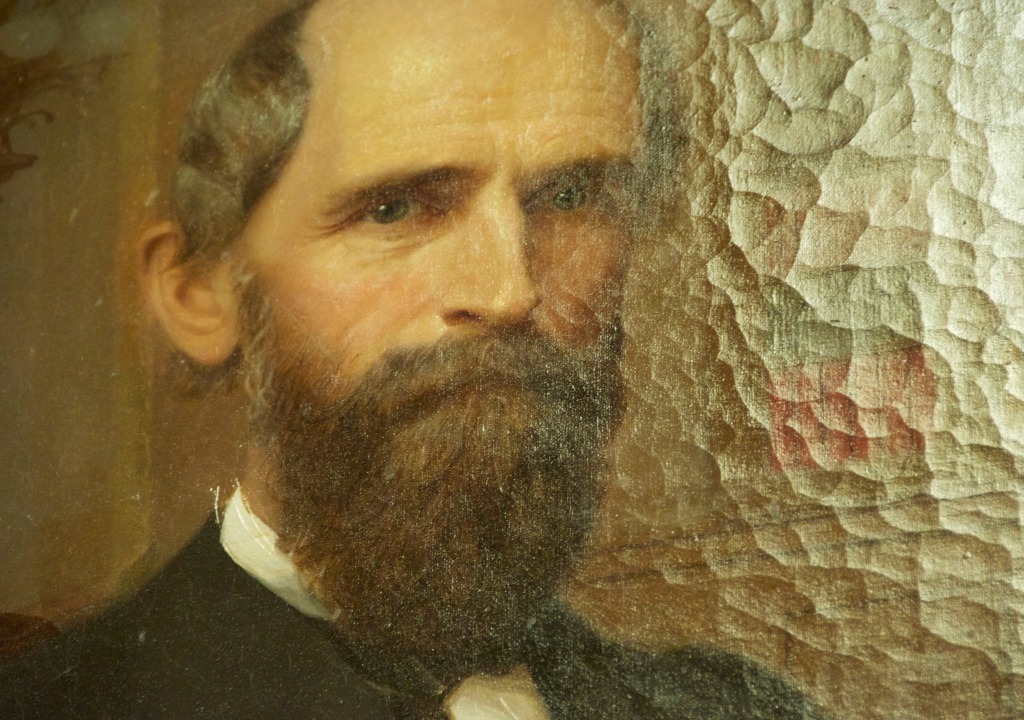
Horace, who later served as governor, opened the library with a donation of 8,000 volumes, adding the gallery in 1873, filling it and much of the rest of the elegant Second Empire structure with paintings he had collected. These included historically significant reproductions of Renaissance and Baroque art and original Hudson River School paintings, among them the 10-foot by 15-foot “Domes of Yosemite,” whose size alone qualifies it as a jaw-dropper.
Over the decades the Athenaeum has been visited by the famous – Presidents Benjamin Harrison in 1891 and William Taft in 1912 – and the not-famous: local folks intent on self-improvement and edification, who came to borrow books, attend lectures and even hear music at a building they viewed as their own.
Some visitors come from afar. A dozen high schoolers from Uzbekistan happen to pass through the gallery as Joly is talking.
“Pick a painting and describe its mood and tone,” intones Katy Smith, who is introducing them to the gallery and who teaches English-as-a-second-language at St. Johnsbury Academy.
Time heals, but a year after the firings, there’s still some hurt. “What they did was heartbreaking and cruel,” says Marianne Robotham of Lyndon Center, once a library regular, who homeschooled her kids when they were young and considered the Athenaeum a marvelous classroom.
She said she was particularly upset when the board of directors refused to meet with “Neighbors in Support of the Library Staff” to explain what had happened.
Robotham says the protest group’s efforts dwindled by spring, but “I still can’t bring myself to go in.”
“I would say, yes, things have settled down,” says Charise Baker, who heads the Friends of the Athenaeum, which raises money to support the institution. “I feel the Athenaeum still needs our support.”
So, apparently, did a majority of St. Johnsbury voters, who on Town Meeting Day last March approved a $115,000 appropriation for the Athenaeum, matching the previous year’s donation. Unlike most community libraries in the state, the Athenaeum is a private nonprofit entity that survives not on local tax dollars, but on grants and contributions.
Joly explains that the Athenaeum had been in a financial bind — as many businesses and nonprofits were during the recession — relying too heavily on its $2-million endowment for operating expenses. In recent years it ran deficits of around $70,000. Today, the Athenaeum’s ledger has improved as a result of the layoffs and “some substantial gifts.”
Not all of the gifts have been financial.
In October, Joly unveiled a rather impressionistic painting by the late Frank Mason of Peacham and New York City. The donated painting, titled “The Great Elm,” offers a glimpse of a bygone-era Vermont landscape, with billowing hills and trees and clouds, serving as a backdrop to a tiny hay wagon making its way across a field.
The painting, located prominently at the top of the stairs on the second floor, signals “the beginning of this process of building the collection,” says Joly.
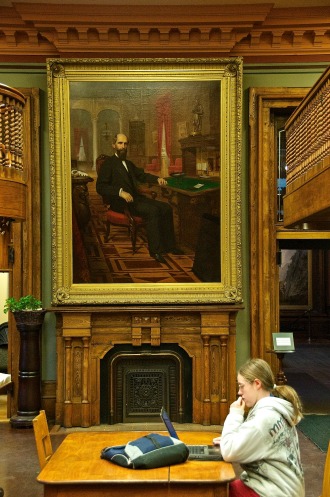
One thing unlikely to change is the Athenaeum’s ambience and purpose, it’s combination 19th-century elegance, modern technology offerings and Vermont-style informality. In late afternoon, with the visage of Horace Fairbanks looking down from his portrait above a fireplace, a student works on her laptop. There’s a jigsaw puzzle on a table upstairs ready for anyone to assemble, and a rocking chair with Stephen Huneck dog-art emblems, inviting anyone with a book to plunk down in and read.
“This is a beautiful building to sit in and relax, which is becoming increasingly rare,” says Joly.

