

Next year’s budget won’t be drafted until January, but members of the House Appropriations Committee got a taste Wednesday of what they can look forward to when the Legislature reconvenes in 2014: budget shortfalls, increased costs and unfunded pension obligations.
Between dismal financial updates, committee members discussed how to prioritize allocation of the state’s limited resources and evaluate funding requests amid the now-chronic coupling of increased state costs and reduced federal funding.

Appropriations Committee Chair Martha Heath, D-Westford, warned her colleagues they would face a lot of competing demands in the coming months, and “the pressure not to make … changes is going to be very great,” she said.
The gaps
The current fiscal year 2014 budget, which runs through June 30, is likely about $12 million short, according to preliminary estimates by Department of Finance & Management Commissioner Jim Reardon.
“Budgets are estimates, and sometimes they need to be further adjusted,” he said, noting that he’s pleased with how little adjustment is needed so far. “Less than 1 percent, it doesn’t get any better than that. I just wish it was 1 percent the other way.”
Reardon said Gov. Peter Shumlin’s administration has committed to delivering a request for budget adjustments by Dec. 2 to the House Appropriations Committee, in hopes of resolving the most immediate budget pressures before turning attention to even greater gaps in the near future.

He doesn’t expect future congressional funding to be finalized in time for the state’s own budgeting process, however. He said departments have been instructed to request budgets in line with federal funding from last year.
Joint Fiscal Officer Steve Klein reiterated his prediction that the state budget would fall roughly $56 million short in fiscal year 2015, just from previous one-time funds that will no longer be available. Other discrepancies bring the annual gap even higher in the coming year and into FY 2017.
“We’re looking at a $70 million problem,” Klein said. “If you do not create revenues, that’s what you need to solve with reductions in spending.”
Klein said the gap is revealed most clearly in funding for education, Medicaid and retirement obligations. He added that the state’s Rainy Day Fund is nearly depleted, and there’s no money earmarked for technology improvements.
“We have no known source for technology funding,” Klein said. “Without … a regular source, it leads to other problems. It would be nice to have $10 million.”
State Treasurer Beth Pearce was more blunt in her plea for complete funding of the teacher retirement system. She closed the meeting with a stark warning about unfunded health care liabilities — costs that she said cannot continue to be covered by the pension fund.
“I understand the budget constraints you live in, but this one is costing us a boatload of money,” Pearce said.
Saying the retirement system is nearing a “tipping point,” Pearce blamed its woes on poor judgment in the past. She said actuarial improvements, benefit restructuring and “modest” increases in health care funding have helped stabilize the system, but a serious infusion of resources will be needed to keep it from accruing more debt that will balloon as it ages.
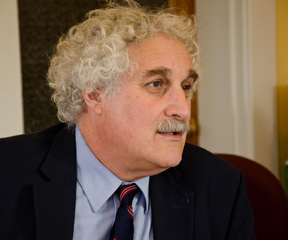
Pearce asked for as much as $20 million of additional funding for teacher health care costs.
What’s a committee to do
Reardon, Klein, Pearce and several lawmakers noted that the message delivered Wednesday was not new. Pearce, in particular, said she had been warning of the same tipping point since 2009.
Klein acknowledged the conundrum: The biggest “chunks” of the state’s roughly $1.3 billion General Fund budget are not easy costs to cut, but the remaining 28 percent of the budget is too small to find so much in savings.
As committee members shared their priorities for the next round of budgeting, Rep. Kitty Toll, D-Danville, hinted that she wanted to re-evaluate well-established appropriations traditions.
“I know there are some untouchable things,” she said. “I’d like to touch some of those things.”
Toll didn’t want to hazard an example on the spot, but other representatives caught on to her thinking, which aligned with another item on the committee’s agenda for the day: Results-Based Accountability.
Twenty existing programs have been identified for a pilot run of RBA principles applied to the budgeting process. When the appropriations committee evaluates those funding requests, they’ll look at finances alongside measurable program outcomes to help determine if the money is being well-spent.
Correction: This article was updated on Oct. 31, 2013, to reflect that the fiscal year 2015 budget gap is approximately $70 million, and to remove the statement that $15 million of the $20 million Pearce is requesting is included in Klein’s predicted budget gaps.
