

The federal government has fined the state $500,000 for two years’ worth of overpayments to food stamp beneficiaries in Vermont.
The Vermont Department for Children and Families has one of the highest “error” rates in the country, and it looks like the state will be sanctioned again next year for failing to provide accurate benefit amounts to low-income Vermonters who are eligible for the Supplemental Nutritional Assistance Program, also known as SNAP.
The glitch? The DCF formula consistently miscalculates incomes for beneficiaries, resulting in benefit levels that exceed the amount participants in the program actually qualify for.
In addition to the fine the state must pay, the Vermonters who are ultimately on the hook for the agency’s overpayments are the very people who participate in Vermont’s 3SquaresVT program. The government is requiring recipients who received larger amounts than they qualify for to repay the difference. (The Supplemental Nutrition Assistance Program is federally funded and overseen by the USDA. DCF oversees the state version of the program, known as 3SquaresVT.)
In some cases, recipients are faced with $2,000 in repayments to the feds.
Vermont rarely skimps on food benefits, according to United States Department of Agriculture error data; the Department for Children and Families is inclined to issue too much money.
But that’s not reassuring for the 429 families and individuals who are currently paying back the $400 or more they were given because of the state’s miscalculations.
Sylvia received a curt letter from the state in May, informing her that she owed more than $2,000 to the federal government owing to the department’s mishap. The letter requested that she “begin cash payments by the first of next month.”
For food stamp recipients like Sylvia, who asked not to be identified, an out-of-the-blue bill for $2,000 can spell serious financial stress. Marissa Parisi, executive director of Hunger Free Vermont, an anti-hunger advocacy group says the onus should be on the state to make the repayments, and they are calling on Gov. Peter Shumlin and lawmakers to make money available to hold recipients harmless.
“If families make no mistake and the agency makes mistakes, they shouldn’t be saddled with debt. It’s just not fair,” Parisi said.

So far, state officials haven’t made any promises.
“It’s something that personally I feel terrible about,” DCF Commissioner Dave Yacovone said, but, “If Vermont were to say, ‘we are going to pay for the errors we created,’ we would be the only state in the nation to do so. It would be really setting a precedent.”
High error rates
Vermont has among the worst state error rates for food stamp administration in the nation. Vermont’s error rate was 48th in the nation for fiscal year 2012. A shortage of staff and outdated technology contribute to complaints that the system is at once too generous and too restrictive.
Shumlin, when asked whether recipients should be responsible for paying these bills, said, “We are working hard to try to straighten it out. As you know, we’ve been hiring there, and you know I’m confident we’ll get better results in the future.”
The state’s error rate also reflects instances in which eligible people have had applications turned down, due to a miscalculation of their income. In fiscal year 2012, there were 34 known cases that were rejected, according to DCF officials.
The 3SquaresVT program turned down Mary and her family for nine months.
Mary homeschools her three teenage daughters and works part time at a friend’s toy store. Her husband, who is self-employed, does heating and plumbing work. During the spring of 2012, his work slowed. Several car repairs and a dental procedure — neither Mary nor her husband have health or dental insurance — put the family on the financial edge.
Mary, who asked that her real name not be used due to her family’s hesitancy about receiving food stamps in the first place, decided they needed help, and she submitted an application for 3Squares.
“I believe that program is meant to be a temporary help, and that’s what I was looking for,” Mary said. “It was frustrating not to be able to get the help when I really needed it. Every month I’d be wondering if it was coming this month, putting off buying this, wondering if it’s going to come.”
DCF determined that the family’s income was too high to qualify. Mary was convinced they were wrong because much of the paperwork she’d received from the department, according to her, had been riddled with inaccurate information.
“Every time they would come back with something, there would be a piece that would be incorrect. One time I got paperwork for some name and some company that I’d never heard of,” Mary recalled. “They couldn’t keep things straight. It wasn’t that confusing— there’s myself and my husband and my three children.”
The story behind the error rate
The program’s woes, according to the Shumlin administration, can be traced to two sources: the economic recession and changes made under the Douglas administration.
The recession, coupled with an expansion of the program’s eligibility requirements, boosted participation levels from 28,000 people in FY 2008 to 52,000 in FY 2012.
During 2009 and 2010, at the end of the Douglas administration, the program disbanded its five-person training unit and cut back on its benefits specialists, as part of the “Challenges for Change” initiative. At the same time, it pulled 30 staff from district offices to work in centralized processing office and call center. Yacovone describes this as a “failed attempt at modernization” that left district offices understaffed.
“There was a real reduction in the employment force — state workers running the program — at the same time that we exponentially increased eligibility … So that coalescing of those two issues made it tough from an administrative standpoint,” Shumlin said.
The USDA conducted a “payment accuracy review” in December 2012 and found that caseloads had increased from roughly 400 cases per worker to 1,000 per worker.
What DCF is doing about errors
“We’ve been methodically trying to address this,” Yacovone said. The department recently hired three trainers and 14 new benefits specialists, and it’s brought caseloads down to about 650 per worker. Yacovone said his goal is to bring that number below 500, and he thinks the error rate — which has been too high by USDA standards since FY 2010 — will take drop significantly by January.

Starting in January, the 3SquaresVT staff will no longer have to handle health insurance applications, and Yacovone said relieving them of this duty is the equivalent of adding 15 new staff.
The commissioner also points out that the overpayment rates, though high, are still just a fraction of total benefits they distribute. In FY 2013, only 141 of roughly 50,000 households have been saddled with an overpayment, totaling $132,000.
And Yacovone says the department does all it can to lessen the debt burden, either by coming up with a payment plan or by forgiving part of the overpayment. (The USDA has a formula that allows states to forgive part of the debt in certain situations.)
“I cannot say right now we will pay back our errors, but I can commit to writing off as much as I can,” Yacovone said.
IT struggles
There’s a third issue, too, that likely won’t get resolved for several years. Staff rely on a database that dates back to 1981.
Yacovone described the system: “If you were to sit at the screen, it’s really like going back in time.” The USDA says the state is also too dependent on the program Excel which can only be used by a limited number of people. When the system crashes — which happened during their assessment — it costs $32,000 per hour in lost productivity.
DCF is going to use the database being developed for the state’s health insurance system, but by Yacovone’s estimates, that transition won’t take place for another three years.
That timeframe didn’t appease the USDA officials who reviewed the program in December. Their report concluded, “ESD should make 3SquaresVT, a greater IT priority given the $141 million plus contribution into the Vermont economy.”
Advocates, too, are dissatisfied with the pace of DCF’s progress.
“This might be one of those cases where we need to make an investment in a shorter-term solution also and that might mean upgrading our current system,” John Sayles, the executive director of the Vermont Foodbank, suggested.
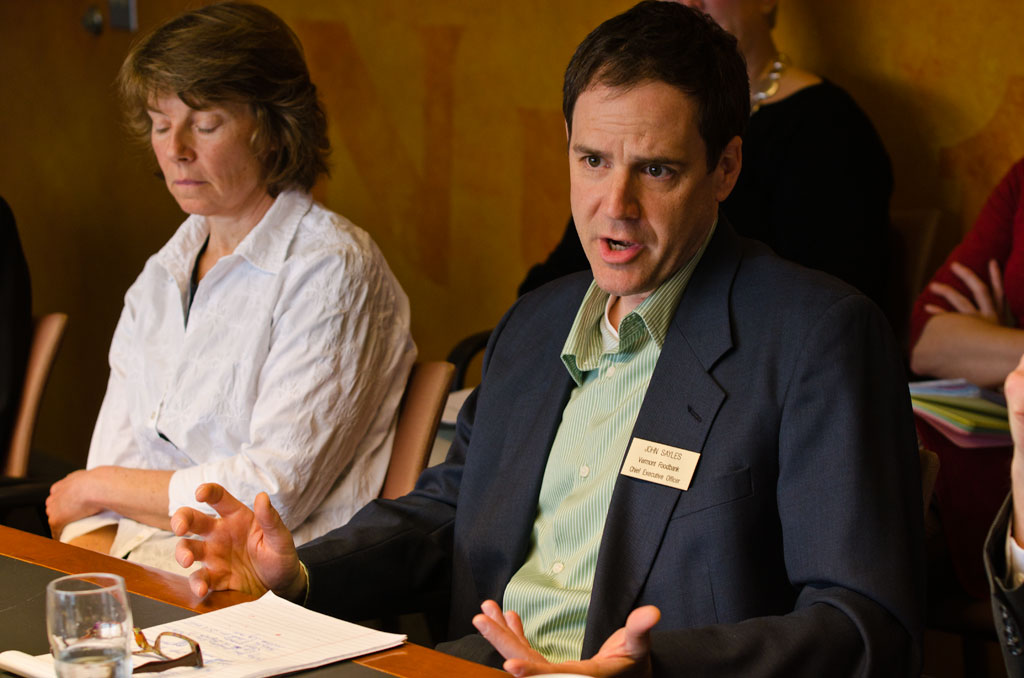
Sayles said the uncertainty surrounding federal funding — Congress has yet to agree on a new funding bill for the program, but both Senate and House versions include cuts, and, regardless, benefits will be reduced in November when stimulus funds expire — adds to the urgency.
“There’s a tremendous amount of urgency. The charitable food system isn’t in any kind of position to make up for cuts in federal programs.”
Advocates are also concerned about eligible people who aren’t taking advantage of the program because the process is too complicated. According to HungerFree Vermont, only 30 percent of eligible seniors are enrolled in the program.
In the meantime
As Mary submitted, and resubmitted wage stubs, tax returns, mortgage documents, her family started racking up credit card debt to get by. Mary said she considers herself fortunate that her credit was good enough to allow her to that.
The other godsend, she said, was that her husband is a hunter. “The venison we had — we usually get a few deer a year and he also shot a couple of turkeys — was … I can’t imagine if we had to buy meat. That would have been too much.”
After several months of sending mail back and forth, and attempting to straighten details out with different department staff members over the phone, Mary appealed the decision.
“I have a stack of papers at least two inches thick of our correspondences.”
She contacted Vermont Legal Aid, and with the help of a lawyer there, won her case in December and finally started receiving $364 monthly deposits, retroactive back to August.
While the money was a help, Mary said, it didn’t undo the months-long ordeal she’d gone through to get it, nor did it lessen the debt on her credit card. Her daughters, too, had made sacrifices that could have been avoided.
“You don’t do music lessons, you don’t do dance lessons, you don’t go to movies, you don’t go out to eat. In the summer it’s easier because beaches are free.”
Mary and one of her daughters have food allergies — to gluten, yeast and dairy — and that made things even more difficult.
“I have always been frugal about shopping. You watch the sale ads, you cut the coupons, you go to the discounts stores, you choose the foods that are more filling and cheaper.” But pinching pennies on items like almond milk and gluten-free bread isn’t as easy. “Those kinds of thing became treats,” Mary said.
And then in April, Mary got yet another letter from DCF saying they had made an error, and she was, in fact, ineligible for the program. Fed up, she decided not to appeal.
“There was nothing left in me to go through that again.”
Mary, who kept meticulous records throughout her experience, said she thinks she’s probably one of a few who actually contest their turned-down applications.
“I think a lot of people get that letter in mail, and they say ‘oh well.’ They will just bow out and do what they have to do to. People know how to survive.”
Legislative action?
Hunger advocates including Sayles and Parisi made their case to a group of lawmakers that met at the Statehouse in later August to discuss the 3SquaresVT program.
After the meeting, at least one senator — Anthony Pollina, P-Washington — has started exploring a legislative solution.
“The one thing that really struck me was to how the overpayments are handled,” Pollina said. “I think it’s ridiculous.” Pollina is looking for a way to address the situation through legislation, and he also wants to find ways to simplify the process.
“I’m looking into the language to make sure everything is in plain English to make sure people can understand what is happening,” he said.
But Pollina said he doesn’t think wording changes and additional funding to cover the people’s debts will solve the program’s problems.
“We are not willing to fund the workforce. That is one of the critical pieces we need to change. All the training in the world is not going to make it any easier to handle 600 cases at a time.”
