


Along with new jobs and broader tax bases that development hopefully brings to communities, come cars.
Making room for new traffic created by commerce can be an expensive enterprise — all the more costly in areas where prior development has already generated congestion.
Under current land use rules, the last developer to build in an area picks up the bill for any “traffic mitigation” required to accommodate a heightened demand caused by his project. Think new turn lanes or traffic lights.
The result is not always what’s intended by a broader policy goal, said Ron Shems, chair of the state Natural Resources Board, the office that administers Vermont’s Act 250 land use law.
“If you run the risk of being tagged as the last one in, I would probably try to go to a greenfield where there is no traffic impact,” Shems said. That sprawl scenario is not purely speculative.
The board is trying to understand what discourages businesses from locating in high-density areas. Concentrating development in small areas, with working landscapes in between, is a concept promulgated by “smart growth” principles at play in many of the state’s development policies.
To that end, the board has developed a “fair share” model to change the way traffic mitigation is paid for. Instead of the last-one-in model, new developments would pay for traffic flow improvements only to the extent they contribute traffic to the intersection.
In addition to incentivizing concentrated growth, the goal is to more equitably distribute the cost of upgrades among the businesses that benefit from them.
But, Shems says, recognizing what’s not fair is a lot easier than naming what is.
Predictable expenses
Agency officials are careful to underscore that the fair-share model can only be applied to future developments, not retroactively to established businesses.
“We can’t go back to people already established and say, ‘Oops, we want you to pay more,’” Shems said.
This apparently is a lesson learned the hard way. Shems said some permits were written with a condition that developers would have to pony up for traffic investments as the intersections serving their businesses grew and aged.
Developers balked at the prospect of such uncertain costs, according to Rajnish Gupta, traffic research manager at the Vermont Agency of Transportation. He said that approach was discontinued in the past year or so.
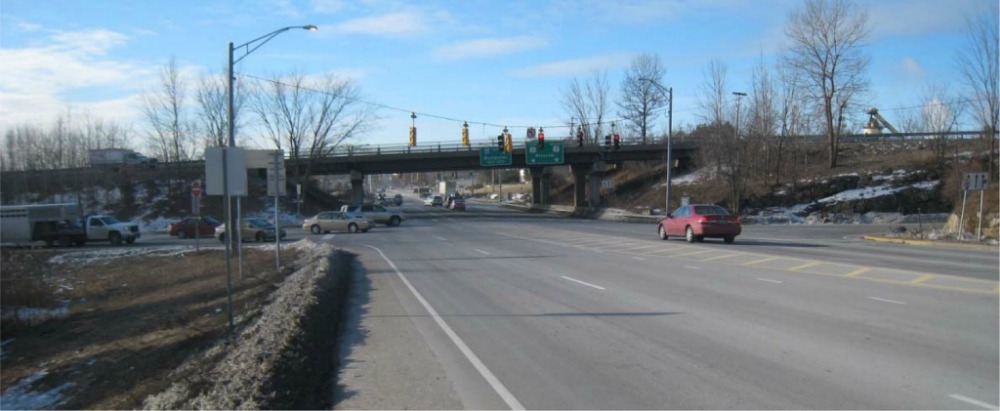
For now, the fair-share model is being applied only on a case-by-case basis, and only to developments proposed at intersections where VTrans already is planning improvements. This limited scope equates to low-hanging fruit on two counts:
First, the total cost is known because the project is already planned. By running some formulas to predict the amount of traffic a particular business will generate, the state easily can establish a dollar value of any business’s fair share of construction costs.
Second, getting the developers to pay their fair share of costs the state already is poised to incur is an easy sell to the keepers of the public purse. Simply put, the state stands to save money when developers contribute to the cost of state projects.
An entirely different prospect would be to apply the fair-share model outside of existing VTrans plans.
If a developer were moving into a less congested intersection, for example — one that VTrans was not already committed to improving — the fair-share model would ask that company to pay for improvements only to the extent that they create a need for upgrades.
Barring additional developers coming in to contribute to the demand and therefore underwriting the cost of intersection construction, the state would be left to pick up the remainder of the tab.
“That is one of the issues we’re grappling with,” Shems said. “Where we should draw the line … is complicated.”
What Costco’s got to do with it?
One of the busiest interchanges in the state is Exit 16 of Interstate 89 in Colchester. It’s also the most high-profile application of the fair-share model to date.
“There’s no way a business was going to build at that intersection, if it meant having to pay $5.1 million in traffic upgrades,” said Chris Cole, director of policy and planning at VTrans, citing the price tag for a plan the agency has established for upgrading the intersection.
VTrans hadn’t planned to facilitate new development at Exit 16 with its work, but new development interest happens to be a byproduct of the improvements, Cole said.
The discount retailer Costco is one such interest. The company has received a permit to build a new gas station and a 14,080-square-foot addition to its warehouse there, although that permit is being appealed by neighboring businesses in environmental court.
Should the appeal be shot down, Costco would not be asked to pay full freight on the intersection upgrades, because VTrans already had identified the exit as a priority for safety reasons. In other words, the agency was already planning to implement — and pay for, with help from federal highway dollars — traffic flow upgrades.
But under the fair-share model, Costco would be asked to fund a portion of the traffic mitigation work.
It’s not the only one. Two other, much smaller developments recently approved for the area already have paid their “fair share” up front. Over in Williston, at the site of a different VTrans project, the company Eco Car Wash also was guinea pig for fair share, as was Reinhart Foodservice in Essex.
Should the appeal succeed, on the other hand, Costco’s lawyer fears it could damage the fair-share model’s prospects.
Mark Hall, a development attorney with Paul Frank + Collins P.C., who’s representing Costco, said that under current regulations, the entire intersection’s improvements do not have to be completed before Costco could open its doors.
“Only the improvements related to our impacts have to be addressed,” he said. “The alternative would be that they all have to be addressed before Costco could open.”
It wouldn’t mean the new developer would have to pay for more than its fair share of improvements, in other words, but it could change a project’s timeline. By consequence, that could alter a developer’s calculus of whether it’s worthwhile to build in one particular area or another.
Skip Vallee, who owns a chain of gas stations around the state, including one near the proposed Costco development, is one of the parties appealing the company’s permit at Exit 16. He said he’s in favor of the fair-share model in concept, and said he has helped to fund traffic mitigation at another site of his own store’s development.
His objection to the Exit 16 plans, he said, is based more on the VTrans proposal to fix the intersection — upgrades that he claims are insufficient and made all the more inadequate by the introduction of Costco’s gas pumps to the equation.
Stakeholders and next steps
Meanwhile, the Natural Resources Board is working with VTrans and the Agency of Commerce and Community Development to get more traction on the fair-share approach to paying for traffic mitigation.
Shems underscored that involving stakeholders — developers, housing groups, municipalities, regional planning commissions — is crucial to crafting a more broadly applicable policy that’s fair to all. The agencies are trying to figure out how to best administer the program to capture all it should and not capture what it shouldn’t, he said.
While the program is still relatively new, the issues that sparked it are not. Objections to the last-one-in model, Act 250’s default mechanism to pay for traffic mitigation, have been grappled with since the Douglas administration, Cole said.
He’s not necessarily optimistic that the agency will come up with a solution this time. The next step for the agencies is to draft a proposal to float to the stakeholders for their input. With any luck, legislation could be introduced in 2014 and the Natural Resources Board would have a more solid framework from which to apply the fair-share model.
“But there’s no guarantee we’ll even get to that agreement,” Cole said.
If they do, Shems pointed out, and if it got through the Legislature, there’s no telling what shape it would be in after lawmakers had grappled with it, too.
“It’s hard to predict what we’re going to propose, and harder to predict what we’re going to end up with,” he said.
