

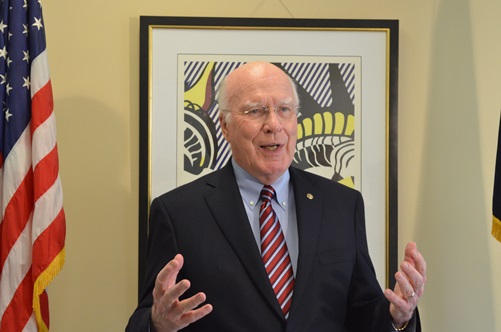
Immigration reform and surveillance scandals have put Sen. Patrick Leahy, chair of the Judiciary Committee, at the front and center of some of the most prominent political skirmishes on Capitol Hill. The recent spate of Supreme Court decisions will put more work in Leahy’s lap.
Leahy met with reporters at his Montpelier office Friday where he reflected on the first six months of the 2013 session; he says he is enjoying his job more than ever.
Immigration reform
Leahy oversaw the markup of the immigration reform bill and helped steer the debate once it reached the Senate floor.
The Democrat described the speech he gave moments before the bill passed on a 68-32 vote as the emotional pinnacle of his congressional career.
“I’ve got to admit that in all my years there I cannot think of a time I was so emotional on the floor as when I was talking about my family, Marcelle’s family … and then talking about the young Dreamers who now have a path to citizenship. We’ll get there,” he said.
Leahy left no doubt that he’ll be crushed if immigration reform falters in the House. But, while the House Republicans could quash months worth of work done on the Senate side, Leahy pointed to one accomplishment he can’t be robbed of — in passing an immigration reform bill, the Senate proved itself capable of bypassing partisan paralysis. Leahy lauded his committee’s contribution to that effort.
“We tried to demonstrate the way the Senate used to work,” Leahy said. “I think it set the tone so we could get the immigration bill through.”
Leahy made no direct reference to the “Gang of Eight” — a bipartisan group of senators who drafted the bill and helped marshal it through, attracting attention from the media along the way.
But he did say he didn’t hold a single news conference about the bill until after its passage. “I just did the work. I let others do the press conferences.”
Leahy pointed to the roughly 300 amendments that the Judiciary Committee fielded “almost 40 hours of markup, all of it online, all of it open, all of it transparent.”
Of the 136 amendments that made it into the bill, roughly a third were proffered by Republicans and all but three passed with bipartisan support, Leahy said.
He also offered a glimpse into his role in the closed-door negotiations that laid the groundwork for the Senate’s vote on the bill.
“We would use the president pro tem’s office, which is a nice spot to bring Republicans and Democrats together because it’s kind of a neutral area. Being the most senior member of the Senate, I could say, ‘Hey guys, I’ve seen everything that’s ever gone right and everything that’s ever gone wrong. Let’s work,’ and they would come in knowing they were never going to hear a word outside of our deliberations.”
Leahy has adopted a benevolent stance toward the senators on his own committee who voted against the bill — “I can’t compliment enough the senators who sit on the Judiciary Committee from both parties, including those who voted against the immigration bill, for working in a serious and constructive way.”
And he’s been more sympathetic than some of his Democratic counterparts have been toward Republican House Speaker John Boehner, who has said he won’t bring an immigration bill to the floor unless the majority of his caucus supports it.
“The Speaker is a good man. He is also a good legislator, but he is being thwarted by a tiny and radical element, a Tea Party element in the House, and they are threatening his speakership.”
Leahy also, however, urged Boehner to put moral concerns ahead of political ones. “Frankly if I was in the House, I’d rather be right than be Speaker.”
Besides publicly prodding House Republicans, Leahy has arranged a meeting with Rep. Bob Goodlatte — a Republican from Virginia who chairs the House Judiciary Committee — in hopes that he will be able to hash out a plan to salvage immigration reform in the House.
Voting Rights Act
Leahy was dismayed by the Supreme Court’s decision in Shelby County v. Holder, which struck down the provision of the Voting Rights Act that required jurisdictions with records of discrimination to get federal approval before making changes to their voting laws. He said the court’s decision undid a deliberate legislative process and flew in the face of near-unanimous congressional support.
“They looked at that [the Voting Rights Act] and determined after an hour’s argument, that this was the right thing to do. We had had hundreds of hours of argument in the House and Senate, all kinds of debates before we came together 98-0 in the Senate and an overwhelming margin in the House in passing this bill… The Supreme Court, I think, totally ignored what we did.”
Leahy said he has already started the search for a legislative fix that might mitigate the ruling’s impact, and the Senate Judiciary Committee will hold its first hearing on the subject next month.
“I’ve been talking to constitutional lawyers all over the country. This coming week, I’ll be spending hours on the phone with people around the country … to try to figure out the best way to respond to this.”
Leahy didn’t have specific solutions to offer. “We’ll get somewhere with it,” he said.
Same-sex marriage
The Defense of Marriage Act ruling, which paves the way for same-sex couples to gain access to the same federal rights available to heterosexual couples, nullified one of Leahy’s most difficult decisions, made last month, and one of a “tiny handful” of votes he regrets, cast nearly 17 years ago, according to the senator’s own reckoning.
The court’s decision came after Leahy backed down from offering a controversial amendment to the immigration bill in his committee that would have allowed people in same-sex marriages to sponsor their spouses for green cards. But the ruling arrived before Leahy had to decide whether to offer the amendment once the bill reached the floor. The DOMA case will give couples those immigration rights, freeing the senator from having to choose between risking losing support for the immigration bill or failing to prioritize the rights of same-sex couples.
Leahy voted for DOMA in 1996. He said Friday he erroneously believed the vote would move Vermont closer to marriage equality by mollifying lawmakers who were rigidly opposed to the idea.
“I thought what I was doing was keeping us from going to a more sweeping thing, which would be a federal standard of what states could do on marriage, and I wanted to protect Vermont’s ability to do whatever we wanted. In retrospect it was too sweeping.”
Some lawmakers on Capitol Hill want offer a constitutional amendment to undo the DOMA ruling. Several of those people have approached Leahy, inquiring about the chances that the Judiciary Committee would take up such an amendment. The senator pantomimed his response, cocking his head and bringing a hand to his chin in feigned deliberation. “Not good,” he recalled telling them.
NSA scandal
After leaks exposed the expansive nature of two surveillance programs at the National Security Agency, Leahy resubmitted several of his previous legislative attempts to bring more transparency to those operations.
When asked if he thought the country had benefited from the leaks, he answered. “I can’t think how,” but he later clarified, “If it helps me get the legislation through that I want, I think that is a benefit.”
Leahy also expressed frustration that NSA officials haven’t been held accountable for the leak, a matter he says is outside his jurisdiction as judiciary chair.
“What kind of sloppy, sloppy management was there at the NSA that they let a 29-year-old contract worker come in and leave with hard drives, thumb drives, computers, with all this material, and nobody knows?” he asked. “If this was corporate America, a lot of people would be fired and I haven’t seen anything other than talks about (Edward) Snowden.”
