

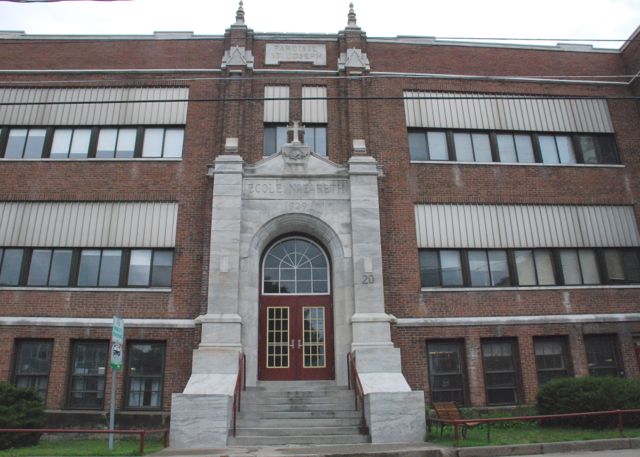
The University of Vermont has finally found a way to purchase a building it has coveted for years. The Elihu B. Taft building belongs to the Burlington School District, which has been trying to divest the property for at least as long.
The two institutions seem to have finally found a way around a stumbling block that’s long stood in the way of a deal — the will of a long-deceased Burlington philanthropist.
Elihu B. Taft willed the property — a stately brick building with white columns, located on the corner of Pearl and South Williams streets — to the Burlington School District in 1938. But the gift came with strings attached: It had to be used for school purposes. And if the Burlington School District chose to sell the building, Taft’s will mandates that it be converted into a home for elderly and indigent men.
That stipulation has irked the Burlington School District for some time. It stopped using the building as a classroom facility in the 1980s, and since then, attempts to sell or lease the space have been thwarted by protests and lawsuits from homeless advocates who have argued those arrangements would fly in the face of Taft’s will.
UVM officials are eager to take the problematic piece of real estate off the Burlington School District’s hands. Three different UVM presidents have had their eye on the Taft building, according to Richard Cate, vice president for finance and administration, and acquiring it has been part of the Campus Master Plan since 2006.
Rather than buying the building (in which case it would be obligated to set up a homeless haven) the university plans to lease the space for 80 years at a rate of $20,000 a year, but it will pay the rent all at once, in a lump sum of $1.6 million. When the 80 years are up, UVM can continue to rent the space at a steeply reduced price — $1 per year. UVM will cover the operating costs, which run at roughly $68,000 a year.
A press release announcing the deal notes that the “School District is not selling Taft but is entering into an agreement for the University to utilize the property for academic purposes in keeping with the deed and legal covenants.”
That’s just one piece of a multi-part real estate transaction that UVM and the Burlington School District have arranged. UVM also plans to purchase the Ira Allen building, located at 150 Colchester Ave., from the Burlington School District for $2 million.
The district wants to use proceeds from the sales to make a purchase of its own — the St. Joseph School on Allen Street. It has offered to buy the building — which housed a Catholic school up until 2010 — from the St. Joseph Co-Cathedral Parish.
The three-way deal is contingent upon approval from both the Burlington City Council and the St. Joseph Parish Council. “It’s not done deal. We need their approval,” Collins said.
The Burlington School District stands to gain more than 10,000 square feet, and it will save money on operating expenses — the operating costs at St. Joseph will be half of what it currently pays for the Taft and Ira Allen buildings. Collins says the deal will allow them to renovate the St. Joseph building without tapping into taxpayer dollars.
In a statement announcing the deal, Burlington Superintendent Jeanne Collins said, “We are very excited to be able to utilize a school facility close to the center of our city. We believe that this opportunity will enhance school operations and benefit our community.”
There are 67 students in the 24,500-square-foot Taft building who are either part of OnTop, a special needs program, or Horizons, an alternative high school program. The Ira Allen building houses the district’s school administrative offices and an early education program with 36 children. The district has already leased classroom space in St Joseph while two schools were being renovated.
UVM’s Cate says the purchase won’t further stress the revenue-starved budget because the university plans to pull the money for its purchases from a savings account that’s been set aside for construction and property acquisition. The account contains roughly $20 million.
Cate says UVM needs the space — more than 100 employees are housed in rented space off-campus, and other staff are working in “inappropriate buildings” on campus — and the Board of Trustees is attracted by the properties’ historical value and proximity to campus. Cate offered the example of some faculty whose offices are located in 150-year-old wood-frame houses that are not handicapped-accessible and aren’t conducive to student visits.
UVM officials say they haven’t settled on what they’ll put in the either building, but the activities in the Taft building will have be “academic” in nature. They plan to move into the buildings in the summer of 2014.
