

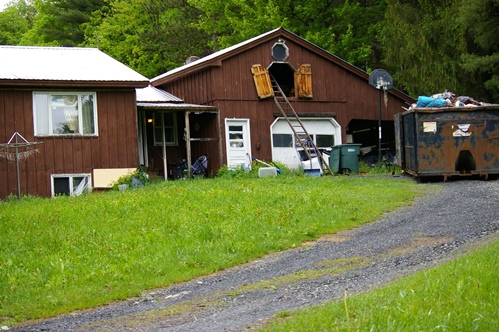
On Wednesday, Gov. Peter Shumlin offered to return the property of his low-income neighbor, Jeremy Dodge, in exchange for the money the governor has already paid out of pocket to purchase it.
That’s the news from Shumlin’s attorney M. Jerome Diamond, a former Vermont attorney general.
“What Jeremy has said on a number of occasions is that he would give the governor back what he has paid out of pocket, if he gets the property back, and that’s one of the proposals that the governor has discussed,” Diamond said. “The governor is prepared to do that.”
The property dispute came to light two weeks ago, when the media began scrutinizing the deal. Dodge, a high school dropout and ex-con, regrets selling his family homestead to Shumlin and claims that he had no idea what his options were when the governor, who lives next door, purchased it. Dodge says he has received just over $20,000 for the property, or about a seventh of the assessed value, since the governor bought a few days before it was slated for a tax auction.
Diamond said he wasn’t sure what the governor had paid out of pocket for Dodge’s property, but “it is substantially less than the $58,000 total” on the settlement statement, which included contingencies.
“We can negotiate what that amount is and the amount of time, but I can tell you Jeremy would get substantially more time than he would get from redeeming a tax sale,” Diamond said. If Dodge’s home went to tax sale, he would have had a year to pay off the back taxes of more than $17,000 plus interest, and he could have lived there for an additional year.
Shumlin’s proposal to sell the land back to Dodge was one of several options the governor considered, Diamond said. The attorney declined to talk about the other options. Diamond said the governor first suggested the idea of returning the property to Dodge at the end of May. In media reports at the time, the governor said he would not void the sale.
Jeremy Dodge was not immediately available for comment on the matter.
His 19-year-old son Shawn responded on his father’s behalf. “I think it’s awesome that Shumlin finally agreed to do what we asked in the beginning and now we can resolve this peacefully,” he said.
Diamond said that as soon as Dodge finds legal counsel, they can move forward with the negotiations.
“He literally told me: ‘I don’t want any proposals in writing. I’ll let you communicate to my lawyer when we get one,’” Diamond said about an earlier conversation he had with Dodge.
Wednesday morning, Dodge said he had not yet found legal counsel, and Shawn confirmed on Wednesday evening that his father did not have a lawyer.
“We are still looking, and we are still looking up, and it looks like this whole thing turned around because of the (media) letting everyone know what’s going on and all of the Dodges want to thank you guys for it,” Shawn Dodge said.
On Tuesday, Dodge met with an attorney at Vermont Legal Aid. Eric Avildsen, director of Legal Aid, said that the nonprofit law firm would not represent Dodge. The firm takes cases when banks improperly foreclose on a low-income Vermonter, “as opposed to someone who voluntarily entered into an agreement and now wants to undo that,” he said.
Since Vermont Legal Aid does not receive any funding for such work, Avildsen said, the firm must pick and choose, and Legal Aid is only able to serve about 15 percent of the people who seek its services.
“On the land deal we suggested he get a private attorney,” Avildsen said. “He has some other issues that don’t have to do with the land deal involving the service of state agencies and we did provide him some counsel and advice in some other areas.”
Dodge’s reported annual income of less than $10,000 make him eligible for large property tax adjustments. Dodge did not file for a tax adjustment, and Shumlin did not bring the matter to his attention. Former Rep. Oliver Olsen, R-Jamaica, estimates that Dodge should have been liable for paying $463.26 in 2012 taxes, rather than the $4,597.11 he owed without an adjustment.
