


Is there a place for civility in Vermont’s political process? Can citizens and politicians engage in opinionated debate within the parameters of well-mannered polity?
Lawyers, journalists, lawmakers, advocates and members of the public at large pondered that question on Saturday at a Montpelier conference held by the Vermont Bar Association and the American Bar Association Division for Public Education.
Political infighting and debate may rage on at town halls and the Statehouse, but politicians and citizens have to listen, too, once in a while. That was the consensus that emerged from “Civility and Political Discourse in Vermont: How Do We Compare to the Nation?”
“It’s never going to be calm. I don’t want a town meeting that is calm. I want it to be rough and ready and dynamic,” said Paul S. Gillies, partner at the law firm Tarrant, Gillies, Merriman & Richardson.
Despite its town meeting tradition and inclusive ethic, Vermont is vulnerable to the bitter partisanship that has impacted politics elsewhere, experts on the matter said. The unrestricted flow of money for negative campaign spending and wayward online public debate have undermined open, nonpartisan discourse.
The conference, in the spirit of the very comity it championed, engaged the assembled in a well-mannered discussion about the hostility that has come to mark politics in America.
Money matters
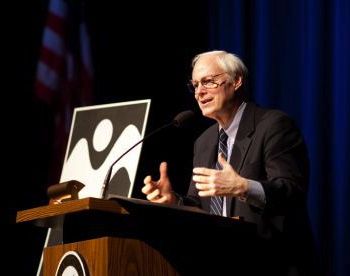
Corporate campaign money has harmed civil discourse in Washington and could soon affect Vermont, according to James A. Leach, ninth chairman of the National Endowment for the Humanities and keynote speaker at the event.
“Money is the elephant at the door in Washington,” Leach said.
The U.S. Supreme Court’s 2010 Citizens United decision, which defined corporations as individuals with First Amendment rights to free speech, has facilitated negative political campaigning.
Leach said money for attack advertisements should not replace traditional debate between candidates. “Rather than conflate a corporation with a person, and money with speech, should not the focus be shifted to the transactional relationship inherent in speaking and listening?”
Without limits on independent expenditures made by corporations, more money will be spent on negative attack ads for political campaigns that will further taint the tenor of the debate and erode the focus on real issues, Leach said.
“At one end, uncivil speech must be protected by the courts, but filtered by the public,” Leach said. “At the other, moneyed speech must not be allowed to weaken the voices of the people. The Constitution begins, after all, ‘We the People,’ not ‘We the Corporations.’”
Burns said that limits on campaign contributions would allow more voices to be heard. Money has the effect of silencing opponents, in his view.
“You aren’t helping to make clear your position, but instead drowning out, potentially, your opponent,” he said.
Paul Burns, executive director of the Vermont Public Interest Research Group, said his greatest concern is the effect of intimidation and its power to reduce public participation.
Size matters
Vermont’s small geographic size creates a culture of accountability, several of the panelists said.
Emerson Lynn, editor and publisher at the St. Albans Messenger, said leaders and citizens alike are held accountable to one another in Vermont.
“We really don’t afford our leaders a place to retreat; there is no place for safety,” he said.
Accountability keeps the dialogue respectful and honest, he said.
“I think that is a lovely thing,” Lynn said. “Everybody is so close, and there is this need to deal with each other, you can’t escape that.”
Deborah Markowitz, secretary of the Vermont Agency of Natural Resources, agreed the size of Vermont plays an important role polite discourse.
“We can’t objectify the other the way you can in a larger place. We know the other: they are our neighbors, we go to town meetings, we see them at farmers markets,” Markowitz said.
She added that it is important to maintain a decent reputation with neighbors.
“Even more so, we know that if we are driving home, and we get stuck on the side of the road, we might need them to pull us out of the ditch,” Markowitz said.
However, accountability also means public discourse is vulnerable to both constructive and baseless criticism.
Lynn said that he had spoken with people in the governor’s office about how they can improve their communications with the general public.
“Their response to that is that they don’t dare, in many instances, because they are terrified of putting information out that can be torn apart by the public,” he said. “If you do that, then the blogs, the online chatter groups, tear them apart. They said it’s an absolutely vicious environment out there.”
Lynn said that even in the small state of Vermont, citizens hide in anonymity and intimidate others. He said that when small groups dominate a conversation, it paralyzes the larger debate.
“This is all about information. It’s all about having the right information,” he said.
Lynn said that he doesn’t allow for anonymous comments at the St. Albans Messenger because he does not believe that anonymous comment sections add any useful information to debates on local issues.
“If people are going to comment, they have to comment thoughtfully and respectfully,” he said.
Arbiters of civility: Moderators, the courts and the media
Gillies, who has moderated town meetings in Berlin, said moderators are to a debate what an orchestrator is to a symphony.
“What I see is a process,” he said. “I think what we have developed over the years is the ability of reasoning together. Not the ability to give up our own positions, but to at least listen to what the other is saying.”
Jeff Amestoy, fellow at the Center for Public Leadership and a former chief justice of the Vermont Supreme Court, said that like a moderator, the courts guide debates by offering constitutional guidelines.
“It seems to me that courts act best when they prompt constitutional debate – when they infuse debates with constitutional principles,” Amestoy said. “But you don’t want courts precluding the democratic process.”
Courts should guide debates, not foreclose them, he said. Amestoy cited the 1857 Dred Scott decision, a ruling that African-Americans were not U.S. citizens and that the federal government did not have the authority to ban slavery. Today this decision is inconsistent with American values.
Aside from town meeting moderators and the courts, the press, for better or for worse, also guides public debate.
However, Markowitz said the modern media does not have the same level of credibility. Reports, she said, are often laced with opinion, and citizens look to confirm their biases in the media.
“We used to have an arbiter of facts, and that was the press,” she said. “Now what we are seeing in Vermont, as well as everywhere else, is that people get their facts from sources that are really editorial sources.”
Civil citizens can still quarrel
Paul Costello, executive director of the Vermont Council on Rural Development, defined civility as an inclusive democratic process, not just a way of behaving.
“The process of dialogue and listening and kindness to neighbors and appreciating the best side of those we interact with at the community-level are kind of the foundations for democracy,” Costello said.
He said that civility is endangered by the segregation of communities in Vermont, including the growing divide between the rich and the poor. Groups on either end of the economic spectrum should interact as equals even if there is conflict.
“We don’t bump elbows as much as we used to. We don’t have to,” Costello said. “We can go on online communities of interests where people think the way we do and reinforce our internal prejudices, for good and for bad.”
He said that civility is about a mutual invitation to public dialogue and civil society. This does not necessarily mean the debate will be easy. In fact, it may be difficult.
“We have to have hard conversations and be ready to disagree,” Costello said.
A courteous closure
State Sen. Joseph Benning, R-Caledonia, said he came to the conference because he wanted to speak directly with the panelists.
The senator appeared to be picking a fight with Burns, citing content VPIRG posted on its website that said Benning lacks scientific judgment. On the other hand, Benning said he found humor in another web post that said he was a saint for advancing the bottle bill.
“We know we will be at each other again at some point in the future,” Benning said. “You and I never had the chance to do what I hope to be a demonstration of civility. So let’s make amends.”
Burns and Benning then shook hands, marking a textbook adjournment to the conference and a hopeful new beginning for civility between Vermont’s leadership.
The event was part of the program “Civility and Free Expression in a Constitutional Democracy – A National Dialogue,” conducted by the American Bar Association Division for Public Education.
The program is funded by a $500,000 grant from the National Endowment for the Humanities, $15,000 of which was used to fund the event in Montpelier, said Christine Lucianek, program manager at the American Bar Association Division for Public Education.
