

Just five days after home-care workers officially gained the right to unionize, the two contenders are laying the groundwork for what’s going to be the state’s largest union election.
The American Federation of State, County and Municipal Employees (AFSCME) and the Service Employees International Union (SEIU) both want to represent the state’s 7,000 home-care workers.
The workers, who provide in-home care to the elderly and people with disabilities, are paid with state Medicaid funds but employed by their clients. Under the new law, workers can bargain with the state for subsidies and benefits if they decide to unionize.
AFSCME and SEIU were united in their push to pass the legislation this session, but the alliance splintered as soon as the law passed. Now, the competition for new members is pitting one union against the other.
During the legislative session, “we were very conscientious to putting aside our differences,” said Matt McDonald, Vermont campaign director for SEIU. “I think some people are surprised that we are now going head to head.”
The tussle is taking place at a time when unions are engaged in nationwide effort to maintain their relevance, and an infusion of new members means more clout. “Unions are involved in a crucial struggle to add members to build up the strength of the labor movement,” McDonald said.
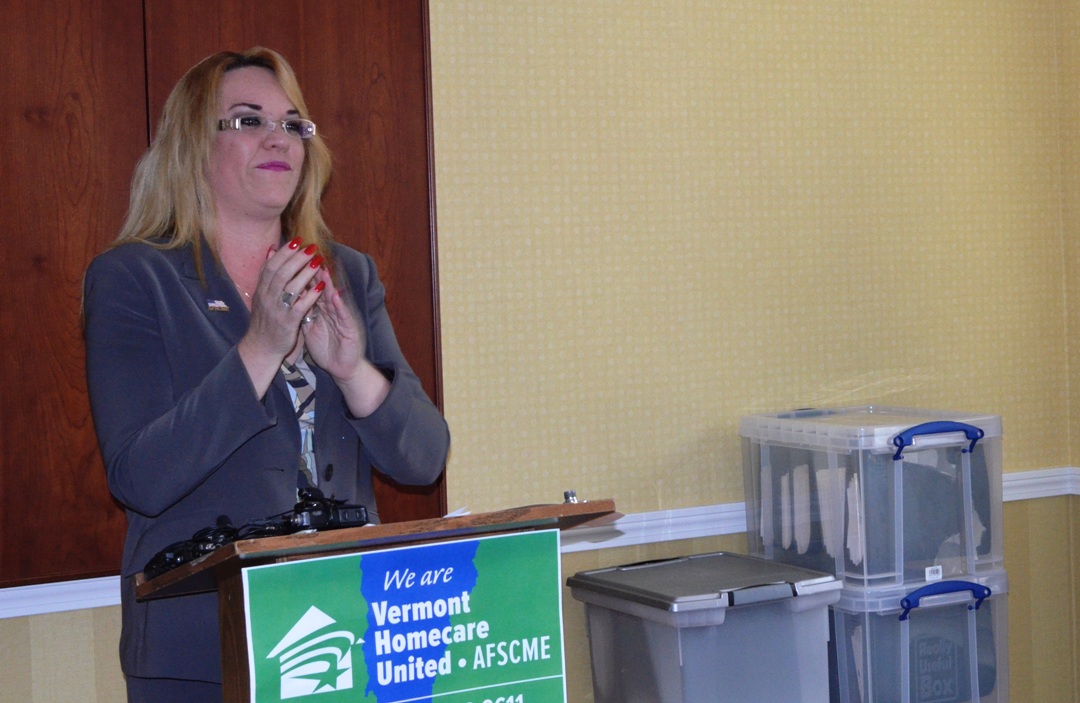
The rival wooing is already in the works. AFSCME has amassed 4,000 signatures for its bid to represent the workers. It delivered seven plastic bins full of what are called “showing of interest” cards to the Vermont Labor Relations Board today.
To initiate an election, a union has to muster signatures of support from at least 30 percent of the employees. AFSCME has comfortably cleared that threshold, but it jumped the gun when it submitted its stockpile of signatures today. The Vermont Labor Relations Board won’t finalize the rules for the election until June 6 at the earliest, and it can’t process signatures before then.
McDonald says SEIU will submit its signatures once those rules have been formally laid out. When a second union wants to add its name to the ballot, it has 10 days to submit signatures from 10 percent of employees. McDonald said SEIU has the necessary signatures, but he declined to disclose the actual number.
Tim Noonan, executive director of the Vermont Labor Relations Board, said that “logistical realities” could make the election process a lengthy one. “This is a big group and we are not a big board,” Noonan said. Home-care workers will vote via mail on whether or not they want to unionize, and those who want to join will pick between the two.
Carolyn Klinglesmith, a spokesperson for AFSCME, said she expects the election to take place in early August. If AFSCME come out victorious, she expects the first contract between the state and its home-care workers will be drawn up by the start of next year.
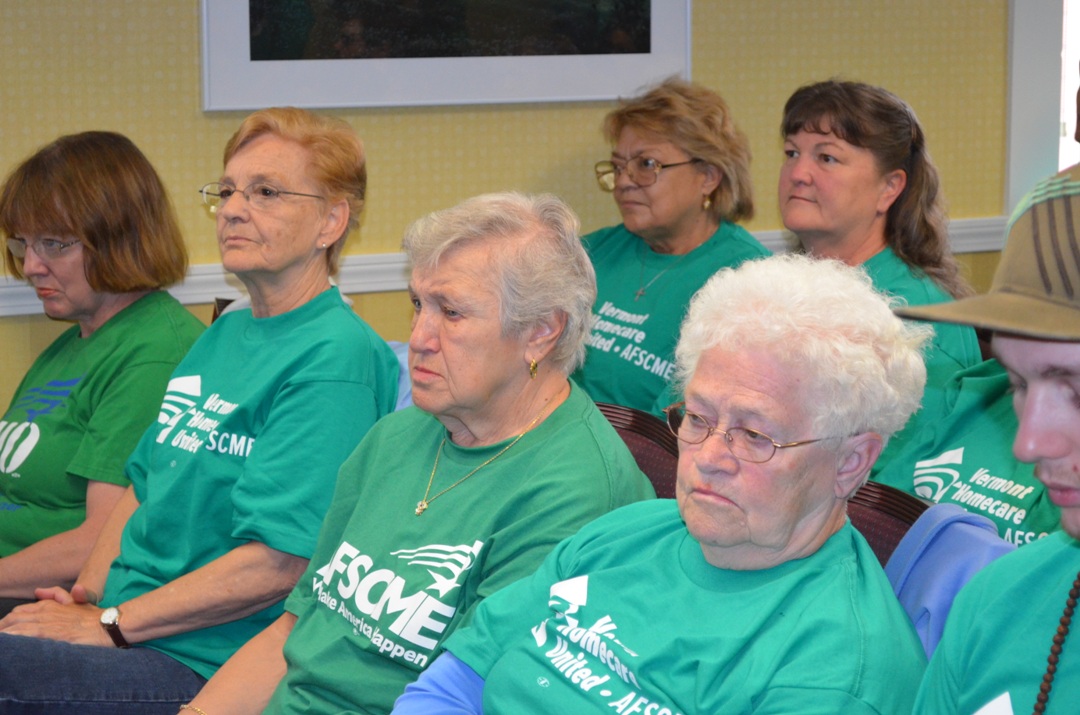
AFSCME is billing its campaign as a “homegrown effort.” At a press event held today, the union brought an out-of-town guest to make that case. Laura Reyes, the secretary-treasurer of AFSCME, AFL-CIO, led union supporters in a call-and-response chant: “Are we Vermont? Are we AFSCME?”
Reyes told the crowd, decked out in green T-shirts, “AFSCME already has a proud history in Vermont. For six decades and thousands of workers across this beautiful state, AFSCME has been working hard for the best interests of working families.”
SEIU says it has more expertise in the home-care arena. McDonald pointed to the union’s already substantial home-care worker membership base, which numbers around 600,000, and said SEIU spearheaded the first efforts to unionize this group in the 1990s.
“This is who SEIU is. This is our expertise. We have a proven track record of success in New England. AFSCME does not represent home-care workers in New England,” McDonald said.
Both unions are national entities with sizeable membership bases— SEIU has 2.1 million members and AFSCME has 1.6 million. The most recent lobbyist disclosure filings — submitted on April 25 — show that the SEIU spent $33,250 on lobbying the Vermont Legislature this year whereas AFSCME spent about $9,100.
McDonald said “old-fashioned” door-to-door canvassing will be the keystone of SEIU’s campaign strategy, since home-care workers are so dispersed throughout the state. The union will also use direct mail, paid media advertisements, and social media advertisements efforts to drum up support. SEUI will spend in the hundreds of thousands of dollars range during its campaign, he said.
